The Investor Read
On October 1, 2026, Morgan Stanley initiated coverage of PulteGroup at Equal-Weight with a price target of $128, against a share price near $116. A cautious call on a homebuilder is not news by itself. What makes it worth reading is what the builders themselves reported in the three months before it.
Here is the thesis, before any exposition. In this cycle the homebuilder is not selling a house. It is selling a monthly payment, and the incentive line is the real price. So the only variable worth modelling is how much gross margin each builder is willing to hand back to keep its sales pace, and how long it can afford to keep handing it.
The builders stopped competing on houses. They are competing on the payment.
How different can two homebuilders be in the same interest rate environment?
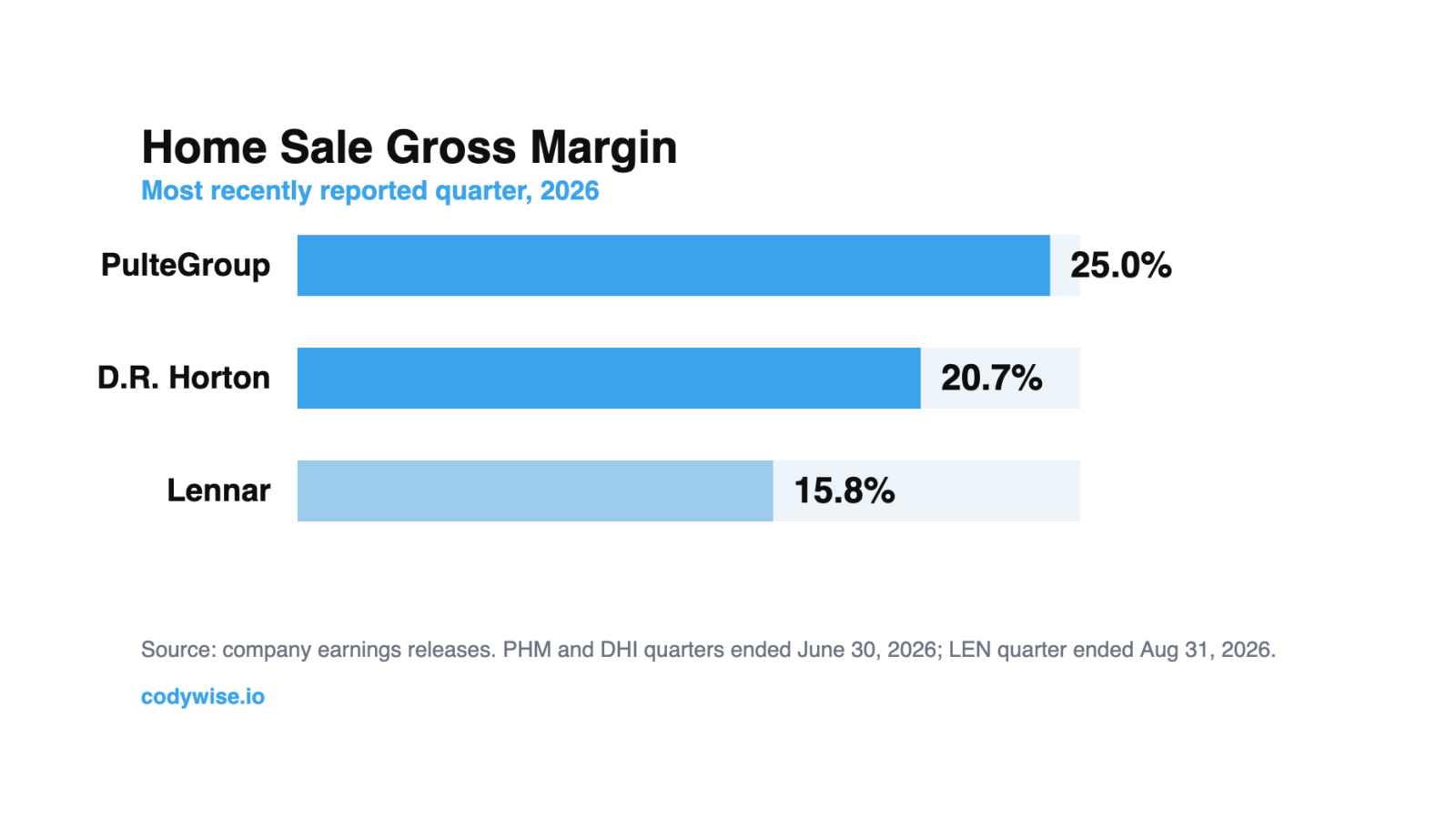
Nine percentage points of gross margin apart, as it turns out, with the same mortgage market in front of all of them.
PulteGroup reported a home sale gross margin of 25.0% for the quarter ended June 30, 2026, with incentives running at 10.4% of price (PulteGroup Q2 2026 release). D.R. Horton reported 20.7% for the identical quarter (D.R. Horton fiscal Q3 2026 8-K). Lennar reported 15.8% for its quarter ended August 31, 2026, on an average sales price of $372,000 with roughly 12.0% in incentives (Lennar Q3 2026 release).
Rates did not move nine points. Lumber did not move nine points. The builders chose, community by community, and the choices diverged.
Some of the gap is mix and not management. PulteGroup averaged $544,000 a home and sells heavily into move-up and active-adult buyers, who are less sensitive to the payment. Horton averaged roughly $362,000 and Lennar $372,000, both squarely entry-level, where the payment is the entire purchase decision. Mix explains part of the spread. It does not explain nine points of it.
The four variables that actually move the outcome
1. Where the discount sits. A price cut and a rate buydown feel identical to the buyer and behave nothing alike on the income statement. A price cut resets the comparable for every unsold home in that community, permanently. A buydown is a one-time payment to a lender that buys down one buyer’s rate and leaves the posted price intact. Builders have overwhelmingly chosen the buydown, which is why reported average sales prices have held up far better than reported margins. The price did not hold. The sticker did.
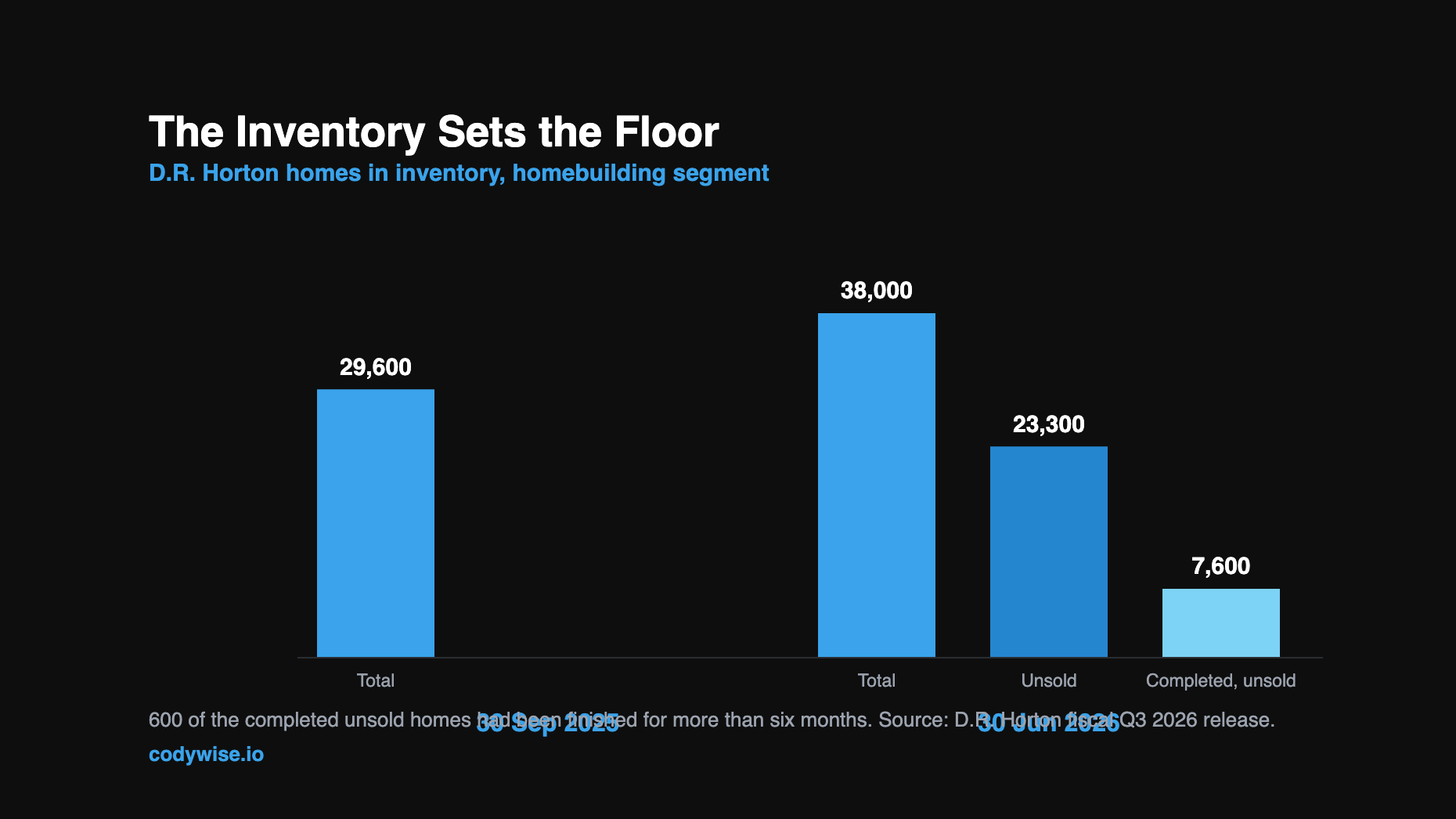
2. Standing inventory. Completed, unsold homes set the floor under how disciplined anyone can be. D.R. Horton finished its June quarter with 38,000 homes in inventory against 29,600 at its prior fiscal year end, of which 23,300 were unsold, 7,600 were already complete, and 600 had been sitting finished for more than six months. A finished house is a carrying cost with a roof on it. It does not negotiate.
3. Owned land versus optioned land. Horton controlled 568,500 lots at quarter end and owned only 22% of them outright, the rest held through purchase contracts and through Forestar. Option fees are the price of not owning, and they are cheap compared with carrying dirt through a slow year. An option can be walked away from. A balance sheet full of owned land cannot.
4. The captive mortgage arm. This is where the buydown actually lands. Horton’s financial services segment produced $220.7 million of revenue and $70.3 million of pre-tax income in the quarter, a 31.9% pre-tax margin, against a homebuilding pre-tax margin of 12.3%. The finance book is roughly two and a half times as profitable as building the house, which is its own quiet form of concentration worth watching. When the builder is also the lender, the incentive is not a cost paid to a stranger. It is a transfer between two of your own pockets, the same structural trick that makes a membership fee carry a retailer’s whole operating income, and only one of them is being scored by the market.
When the builder owns the mortgage company, the discount does not leave the building. It changes rooms.
Doing the arithmetic on one house
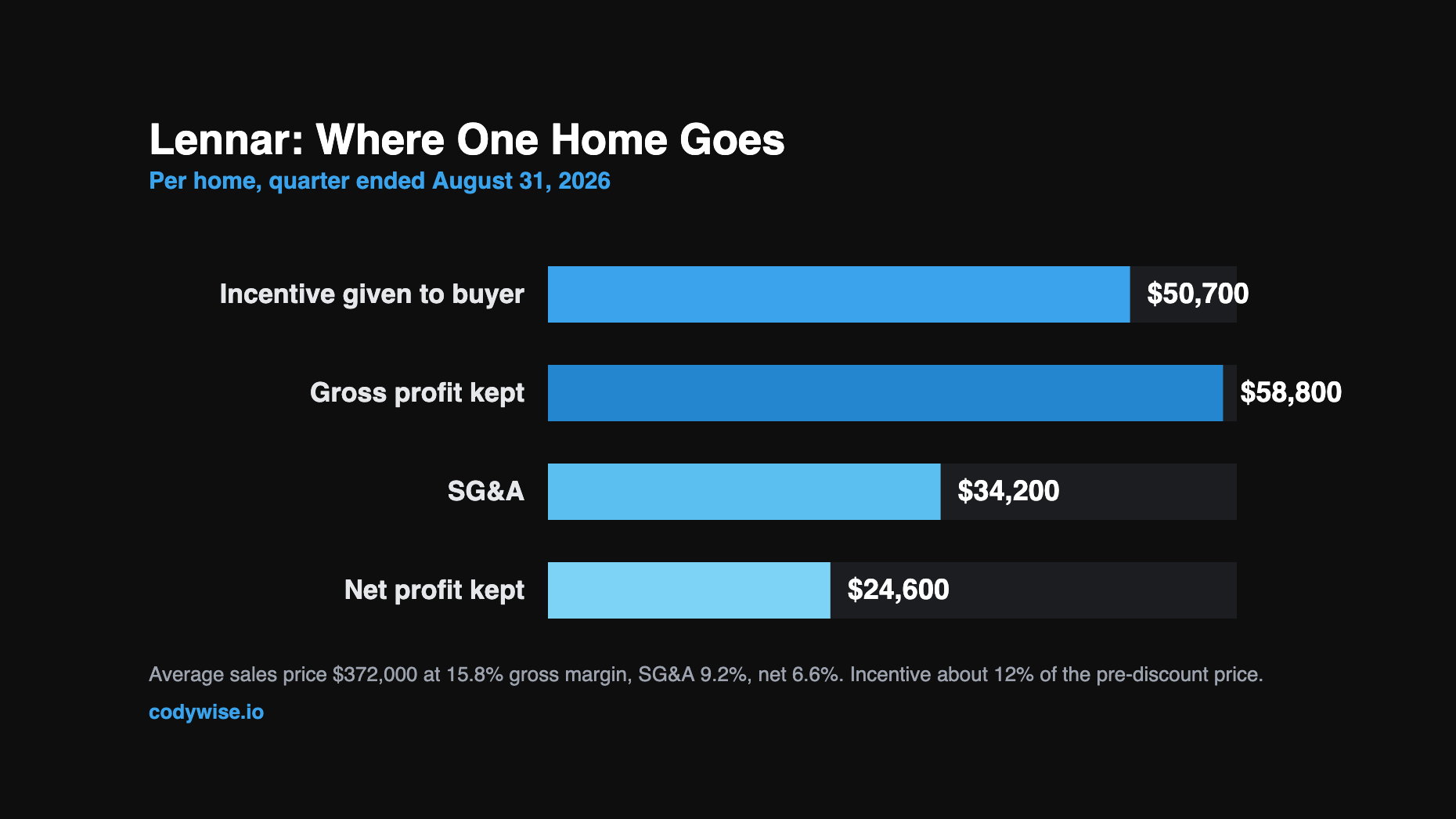
Take Lennar’s August quarter and run a single home all the way through. Average sales price $372,000 at a 15.8% gross margin is $58,776 of gross profit. SG&A at 9.2% of home sales revenue takes $34,224. The 6.6% net margin leaves about $24,552.
Now the incentive. Builders quote incentives against the pre-discount price, so 12.0% on a $372,000 net price implies a gross price near $422,700 and a giveback of roughly $50,700 per home.
That is the number worth sitting with. Lennar handed the buyer about $50,700 and kept about $24,552. Roughly two dollars out the door for every one retained. Measured against gross profit rather than net, the incentive is about 86 cents on the dollar.
Run the same arithmetic on PulteGroup. A $544,000 average price at a 25.0% margin is about $136,000 of gross profit, and a 10.4% incentive implies roughly $63,100 given back, or about 46 cents per dollar of gross profit. Same mortgage market. Nearly double the retention.
One caveat on method, because it matters and almost nobody states it. If you measure the incentive against the net price instead of the pre-discount price, Lennar’s figure comes out nearer $44,600 rather than $50,700. I ran it the first way, which is how the companies frame it. The ranking does not change under either convention, but any number you read in a headline that does not say which convention it used is worth ignoring.
Why this is a hundred-year-old pattern
General Motors set up the General Motors Acceptance Corporation in 1919 so that buyers could borrow the money to buy its cars. Henry Ford refused to follow, on principle. He believed installment credit was a character defect and that a man should save up and pay cash. Ford did not get a consumer finance arm until 1928, when Edsel Ford and Ernest Kanzler organised the Universal Credit Corporation, over his objection. By then General Motors had taken the volume lead.
The lesson was never that credit is virtuous. It was that once your competitor starts selling the payment, you are selling the payment too, whether you have admitted it to yourself or not. The only remaining choice is whether you price that financing deliberately or let it leak out of your margin one closing at a time.
Scenarios, and what would prove this read wrong
Bear. Rates hold where they are into 2027 and standing inventory keeps climbing. The trigger to watch is completed unsold homes rising again at the next print while cancellation rates stay above the 20% Horton recorded in June. At that point buydowns stop clearing houses and builders cut posted prices instead, which marks down every unsold unit in the community at once. Entry-level gross margins compress toward the low teens.
Base. Incentives stay elevated and roughly flat, which is what both companies told investors to expect. Horton said it expects sales incentives to remain elevated. Lennar guided fourth quarter gross margin to approximately 15.5% to 16.0%. Volumes hold, margins sit low, and the captive finance arms carry a growing share of reported earnings.
Bull. Mortgage rates fall far enough that buying down a rate gets cheap. This is the most violent operating leverage in the sector, because the cost coming off is purely financial. Nothing has to be built better or sold harder. Every 100 basis points of relief takes dollars directly off the incentive line and puts them back in gross margin with no offsetting expense.
What would falsify it. If a builder materially cuts its incentive rate and sales pace holds flat or improves, then the payment was not the product and the causality here is backwards. That is a specific, checkable thing: incentive rate down, net orders not down, in the same print. Watch for it over the next two quarters. If it shows up, this read is wrong and should be thrown out rather than defended.
Common questions
What are homebuilder incentives?
Homebuilder incentives are the concessions a builder gives a buyer to close a sale: mortgage rate buydowns, closing cost credits, design centre allowances and outright price reductions. In 2026 the dominant form is the rate buydown, where the builder pays a lender up front to reduce the buyer’s mortgage rate. Builders report incentives as a percentage of the home’s pre-discount price, and that percentage has been running between roughly 10% and 13% at the large public builders.
Why do homebuilders buy down mortgage rates instead of cutting prices?
Because a price cut is permanent and public, and a buydown is neither. Lowering the posted price resets the comparable value for every remaining home in that community and for every buyer who already closed there. A buydown is a one-time cost attached to a single transaction, leaves the sticker price intact, and can be withdrawn the moment demand returns. It is more expensive per home and far less damaging to the community.
Why is gross margin so different between homebuilders right now?
Partly mix and partly choice. Builders weighted toward move-up and active-adult buyers, such as PulteGroup at a $544,000 average sales price, serve customers who are less sensitive to the monthly payment and therefore need smaller incentives. Builders weighted toward entry-level buyers, such as Lennar and D.R. Horton at roughly $372,000 and $362,000, are selling to people for whom the payment is the whole decision. On top of that sits a genuine strategic difference: some builders are defending pace and some are defending margin, and in 2026 you cannot do both.
Does a homebuilder’s mortgage arm make the margin look better or worse?
It moves where the profit is reported rather than creating it. When the builder owns the lender, the cost of a rate buydown shows up in homebuilding cost of sales while the loan origination profit shows up in financial services. D.R. Horton’s financial services segment ran a 31.9% pre-tax margin in its June quarter against 12.3% in homebuilding. Looking only at the homebuilding line understates the economics of the whole transaction.
Everything above is an argument about one industry in one rate environment, and it will be stale soon enough. The part that will not be stale is the mechanism underneath it.
Whatever you have to give away to close the sale is the thing you are actually selling. You can name it a discount, an incentive, a bonus, a concession, or a courtesy, and the accounting will not care. Price it deliberately, in the open, where you can see what it costs you. That is the same discipline behind putting a fixed price on a service instead of quoting it fresh every time. Otherwise the market will price it for you, one closing at a time, and you will find out what your product really was when you read your own margin.
The discount is not a marketing expense. It is the price, told quietly.
Not investment advice. I am not a licensed financial advisor and nothing here is a recommendation to buy or sell any security. Analyst ratings and price targets referenced are the published views of the institutions named, not mine. Figures are accurate as of the publication date and will go stale. Do your own research, and speak to a licensed advisor before acting on anything you read here.