The Investor Read
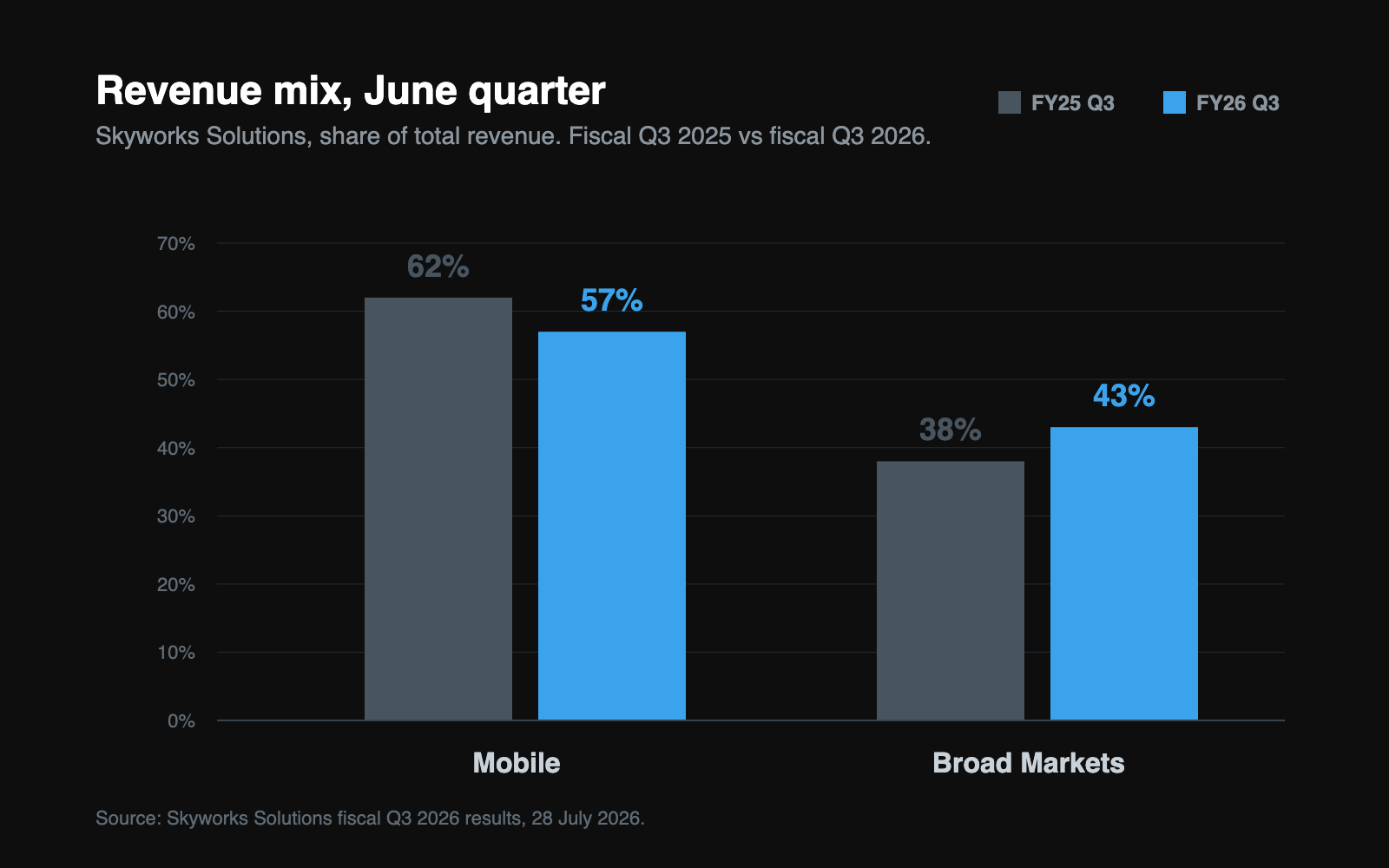
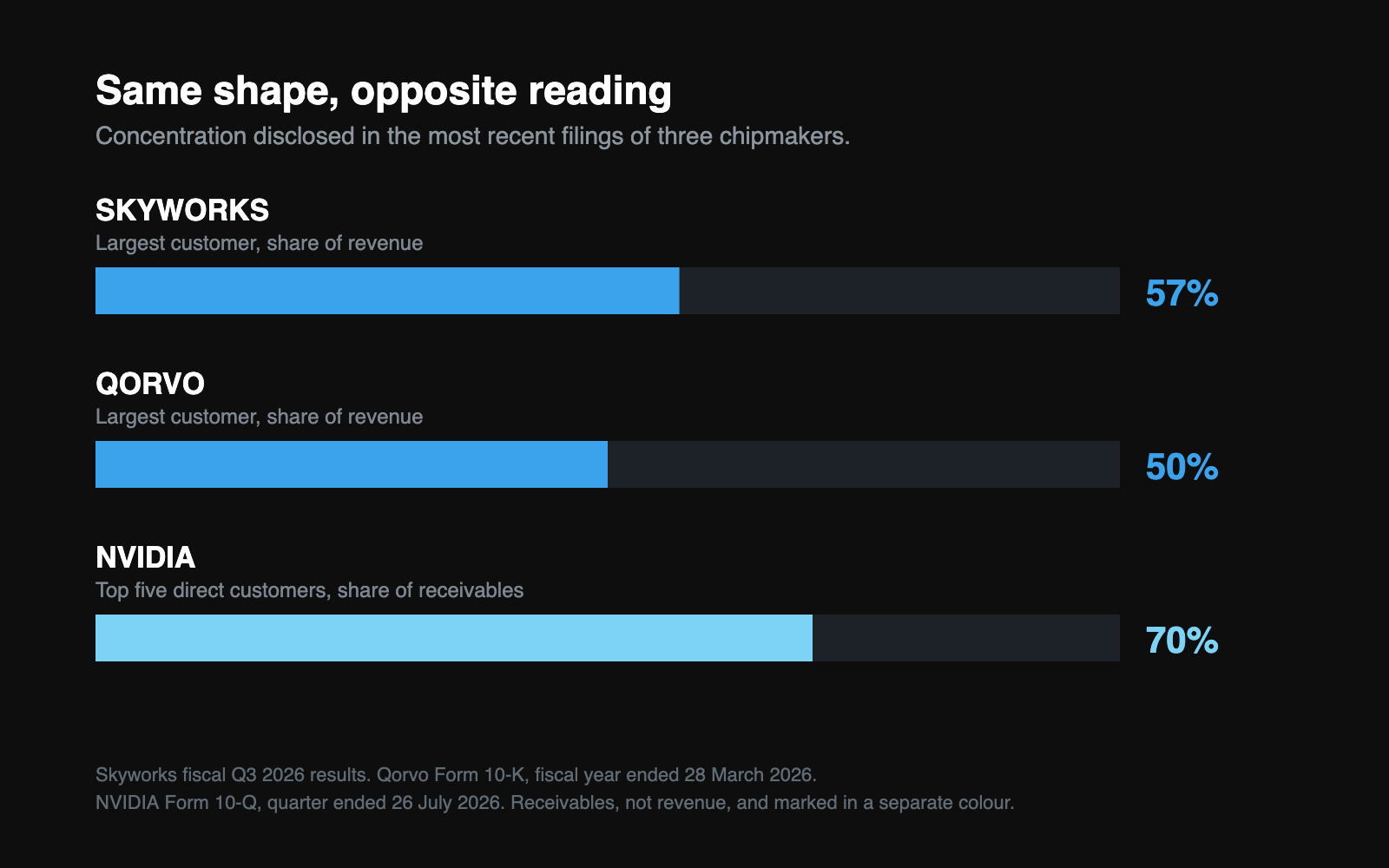
On 28 July 2026, Skyworks Solutions reported fiscal third-quarter revenue of $934.8 million and disclosed that its largest customer, Apple, accounted for roughly 57 percent of the total. A year earlier that customer was 63 percent. Skyworks did not lose the account. It lost six points of it, and the six points cost more than the sixty-three ever earned.
Concentration is not a risk you carry. It is an option you sold, and you collected the premium years ago.
Every risk-factors section in every annual report says roughly the same thing. A small number of customers account for a large portion of our revenue. The loss of any one of them would materially harm our results. Nobody reads it, because the sentence has been true and harmless for a decade.
It is not a warning. It is a description of a contract you already signed. When one buyer is most of your revenue, you have written that buyer a call option on your own margins, exercisable at their convenience, at a strike price of zero. You were paid for it. You were paid in volume, in operating leverage, in a factory that ran full, in a sales organisation you never had to build. The premium was real, and it cleared years before anyone exercised.
The exercise is what people mistake for the event.
What does customer concentration actually cost?
It costs gross margin, and it charges the bill long before the revenue line moves.
Skyworks is the live worked example, so use the numbers it published. Fiscal third-quarter revenue was $934.8 million, down 3.1 percent from $965 million a year earlier. That is the headline, and it is boring. Three percent is noise.
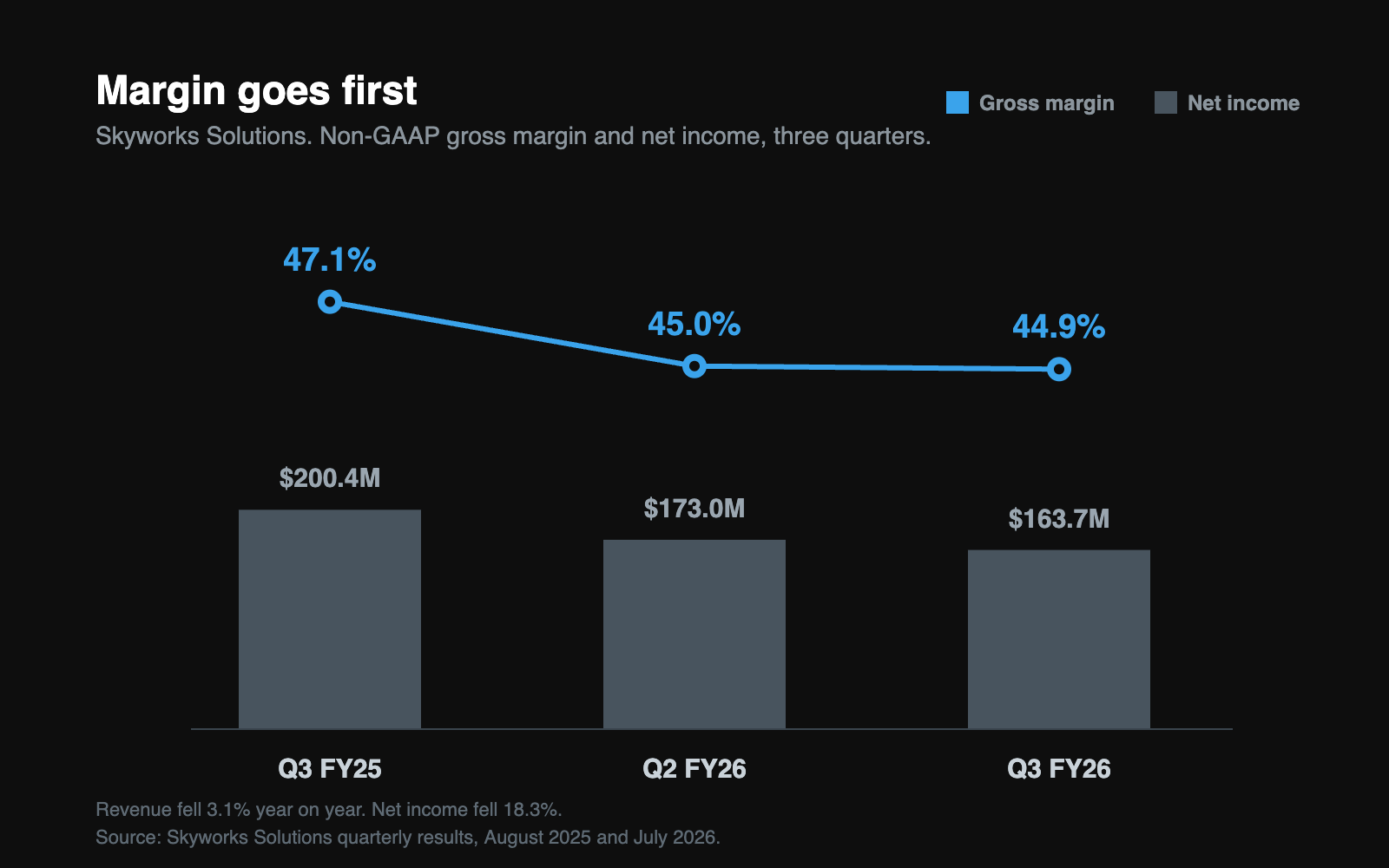
Now look one line down. Non-GAAP gross margin was 44.9 percent against 47.1 percent a year earlier. Net income was $163.7 million against $200.4 million. Revenue fell 3 percent. Net income fell 18 percent.
In February, Apple decided to dual-source a premier radio-frequency socket in the iPhone 17. Skyworks told investors to expect a 20 to 25 percent reduction in RF content per handset. Not a lost customer. A second supplier in one socket. Unit volumes held, which is why revenue only moved three points. The pricing did not hold.
That is the mechanism, and it is the part that gets missed. A concentrated customer almost never fires you. Firing you is slow and expensive. What they do instead is qualify a second source, and then they never have to negotiate again, because you will negotiate against yourself.
They do not take your revenue. They take your pricing power and let you keep the revenue at a worse price.
Which variables actually move the outcome?
Five, and only one of them is the concentration percentage itself.
- Who owns the specification. Skyworks does not decide what goes into an iPhone. If the customer writes the spec, the customer can rewrite it, and the rewrite is not a negotiation you are invited to. Qorvo’s Form 10-K for the fiscal year ended 28 March 2026 put Apple at roughly 50 percent of revenue and Samsung at about 10 percent. Two customers, two specifications, neither one written in-house.
- Whether the socket is single-sourced. Concentration at 57 percent with a sole-source position is a completely different asset from concentration at 57 percent with a qualified second source sitting beside you. The percentage is identical. The pricing power is not. Dual-sourcing is the exercise notice.
- Switching cost, measured in their currency. The question is never how hard it would be for them to replace you. It is how many quarters of their roadmap replacing you would cost. If the answer is under four, you are already priced as a commodity, whatever your margin says this year.
- Whether the second business is real yet. Skyworks’ Broad Markets segment, which is edge IoT, automotive, industrial and data centre, was about $403 million in the quarter, up 8 percent year on year, and 43 percent of revenue against 38 percent a year earlier. That five-point shift is the only durable answer to concentration on this list, and it took years, not quarters.
- What the balance sheet lets you do about it. In October 2025 Skyworks agreed to merge with Qorvo, its closest competitor, in a transaction valuing the combined company at roughly $22 billion. The FTC waiting period expired on 1 August 2026. China’s SAMR and the Korea Fair Trade Commission were still reviewing as of the company’s August update. Merging with the only other firm your customer could dual-source to is a structural answer to a structural problem. It is also the most expensive answer available, which tells you how the board priced the problem.
How do you do the math on a concentrated customer?
Multiply the concentration by the content change, not by the probability of losing the account.
The standard version is 57 percent of revenue times some probability the customer walks. That model is wrong, because the customer walking is the least likely thing on the list.
Do it the other way. Make content per unit the variable. Skyworks guided to roughly $7 of RF content in the iPhone 17 against $10 to $11 in prior cycles. Call it a 30 percent reduction on the affected sockets. Apply that to 57 percent of the business and you get a 17 percent hit to revenue at constant units, before any offset. Units held, so the realised number came in nearer three. But gross margin went from 47.1 to 44.9, and on roughly $935 million of revenue, two and a bit points of margin is around $20 million a quarter that no longer exists, taken from a customer who never left.
The revenue line is the wrong place to look for the damage. It is the last place the damage arrives.
You read about it in gross margin two years before you read about it in revenue.
Is customer concentration always a problem?
No. It is priced as an asset whenever the concentrated customer is growing faster than you are.
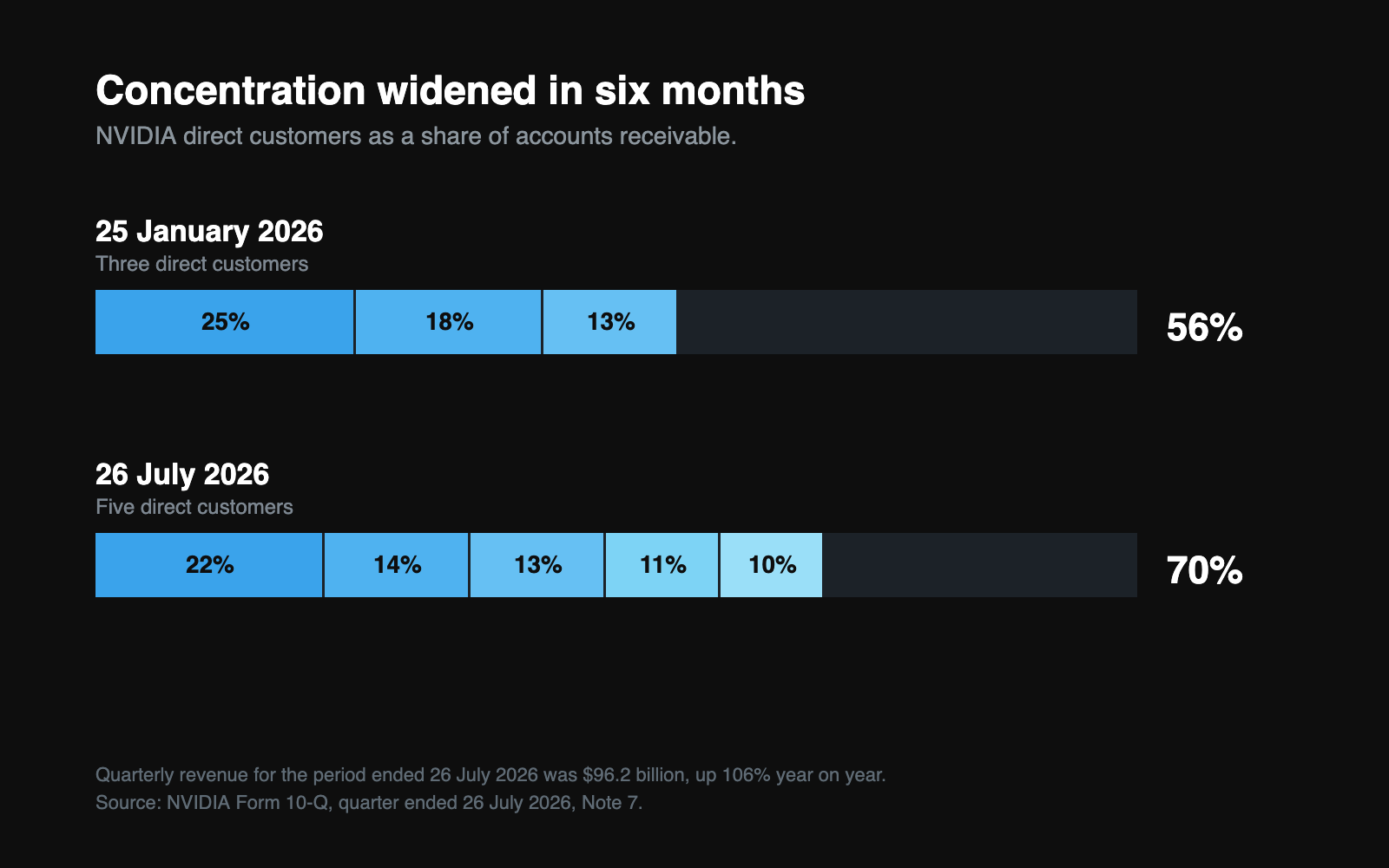
NVIDIA’s Form 10-Q for the quarter ended 26 July 2026 discloses that five direct customers accounted for 22, 14, 13, 11 and 10 percent of accounts receivable. Seventy percent of the receivable book sitting in five names. Six months earlier, at 25 January 2026, three direct customers accounted for 25, 18 and 13 percent, or 56 percent in three names. The concentration widened on both dimensions in half a year, against quarterly revenue of $96.2 billion, up 106 percent year on year.
Nobody files that under risk. They file it under demand.
Same structure, opposite reading, and the difference is not the number. It is who owns the shortage. Skyworks is one of several companies that can fill an RF socket. NVIDIA is, for now, the only company that can fill its socket at volume. Concentration is dangerous in proportion to how replaceable you are, and the concentration percentage tells you nothing at all about that. It is the wrong metric, and it is the only one anybody quotes.
Concentration is not the risk. Replaceability is the risk. Concentration is only the multiplier.
What would change this read?
Bear. The Broad Markets mix stalls below 45 percent and the September ramp lands at the low end of the $1.01 to $1.06 billion Skyworks guided to. Then the diversification is a slide, not a business, and the merger is the only remaining answer. Trigger: fiscal fourth-quarter revenue at or under $1.01 billion with Broad Markets flat sequentially.
Base. Mobile ramps into the autumn launch as guided, gross margin holds inside the 44 to 45 percent band the CFO indicated, and Broad Markets keeps compounding at high single digits. Concentration falls slowly, for the boring reason: the other business grows. Trigger: this is what the guidance already assumes.
Bull. The Qorvo combination closes inside calendar 2026, the stated $500 million or more of synergies proves credible on the cost line, and the data centre business keeps running ahead of the 50 percent annual growth Skyworks outlined. Then concentration falls by arithmetic in the denominator rather than by loss in the numerator. Trigger: SAMR clearance plus a data centre growth print above 50 percent.
What would falsify all of it. Gross margin recovering above 47 percent while the largest customer stays near 57 percent of revenue. That would mean the content loss was a one-time reset rather than a permanent repricing, and that pricing power was never actually transferred. I do not expect it. If it happens, this framework is wrong about which line item carries the information.
Common questions
What is customer concentration risk?
Customer concentration risk is the exposure a company carries when a small number of buyers account for a large share of its revenue. It is disclosed in annual filings as a risk factor. In practice it shows up first as lost pricing power rather than lost revenue, because a dominant customer is far more likely to qualify a second supplier than to leave.
What percentage of revenue from one customer is too much?
There is no universal threshold, and the percentage on its own is the wrong question. A supplier that is genuinely hard to replace can carry 60 percent from one customer safely for years. A replaceable supplier is exposed at 25 percent. The useful test is how many quarters of the customer’s own roadmap it would cost them to switch. Under four quarters and the concentration is dangerous at almost any level.
Why does customer concentration hit gross margin before revenue?
Because the dominant customer’s first move is to qualify a second source, not to cancel the relationship. Once a second supplier is qualified, price is renegotiated on the same or similar volume. Units and revenue can look almost unchanged while the margin on those units falls. Skyworks reported a 3.1 percent revenue decline year on year in its fiscal third quarter of 2026 alongside an 18 percent decline in net income.
Why did Skyworks and Qorvo agree to merge?
Skyworks and Qorvo announced a merger in October 2025 valuing the combined company at roughly $22 billion, with more than $500 million in targeted synergies. Both companies carried heavy exposure to the same customer, Apple, at roughly 57 percent and 50 percent of revenue respectively in their most recent filings. Combining removes the alternative supplier that customer would dual-source to, and builds a larger non-mobile business across defence, edge IoT, data centre and automotive.
Why is NVIDIA’s customer concentration not treated as a risk?
Because the direction of scarcity is reversed. NVIDIA disclosed that five direct customers made up 22, 14, 13, 11 and 10 percent of accounts receivable at 26 July 2026, a wider concentration than six months earlier, alongside quarterly revenue of $96.2 billion, up 106 percent year on year. When the supplier controls the shortage, concentration reads as demand. When the customer controls the shortage, the same number reads as exposure.
How does a business actually reduce customer concentration?
Only two ways, and both are slow. Grow a genuinely separate business so the denominator expands, or acquire scale that changes your bargaining position. Skyworks is doing both: Broad Markets moved from 38 to 43 percent of revenue in a year, and the Qorvo transaction is the structural version. Neither is a quarterly fix. Concentration is built over years and it unwinds over years.
Diversification is not a portfolio strategy. It is a pricing strategy. You are not spreading risk, you are buying back the right to say no.
Not investment advice. I am not a licensed financial advisor and nothing here is a recommendation to buy or sell any security. Analyst ratings and price targets referenced are the published views of the institutions named, not mine. Figures are accurate as of the publication date and will go stale. Do your own research, and speak to a licensed advisor before acting on anything you read here.
All company names, logos and trademarks are the property of their respective owners. Their use here is for identification and editorial commentary only and does not imply any affiliation with or endorsement by those companies.