Building in Public for Founders: Write Your Own Dispatches

Founder Notes

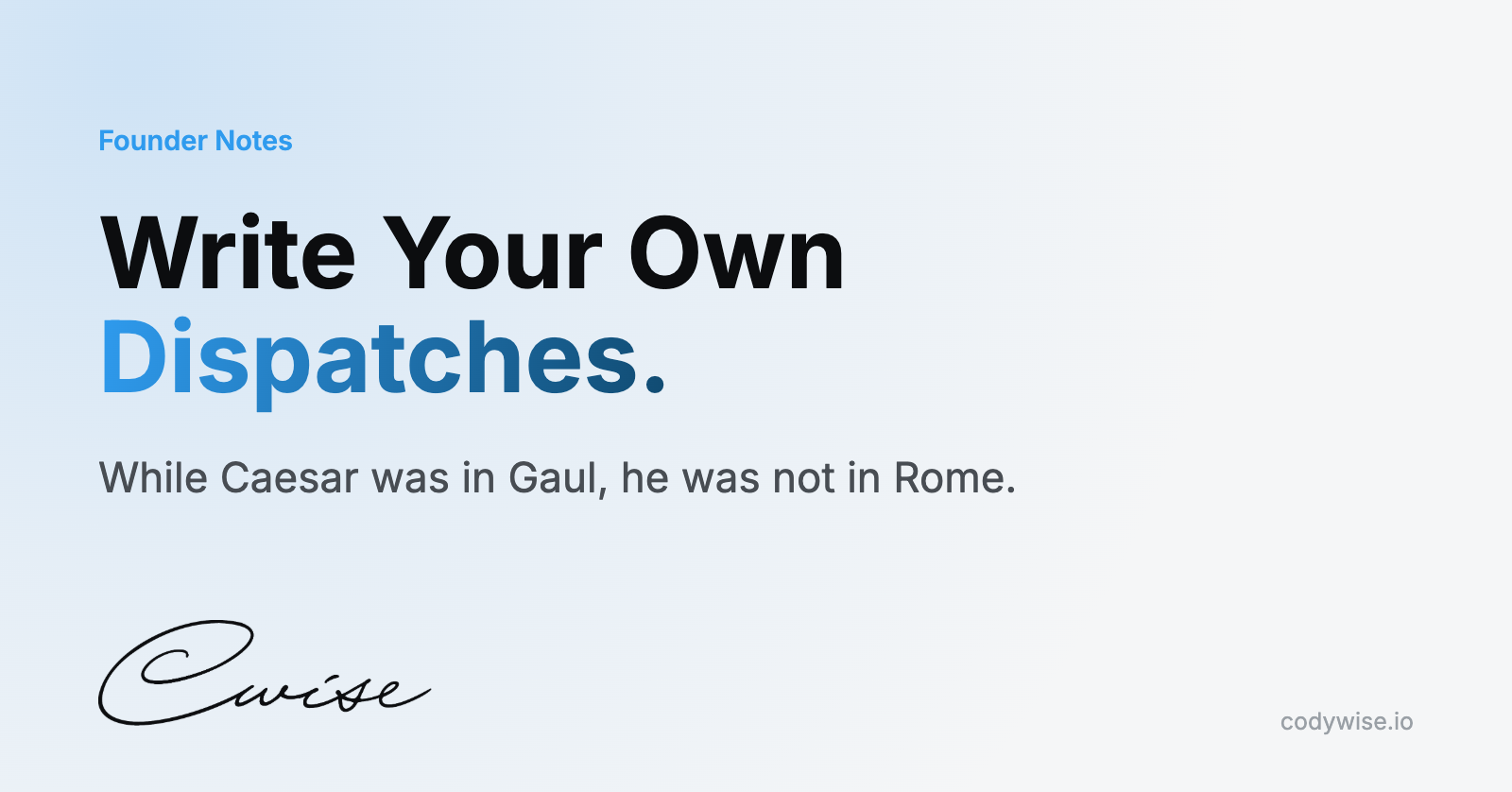
While Caesar was in Gaul, he was not in Rome. That was the problem. His reputation was being decided in a city he was nowhere near, by men who had every reason to shape the account in their favour. So he wrote his own and sent it back.

The work and the account of the work are two separate assets. Most founders only build one of them.

The Commentarii de Bello Gallico were dispatches, not memoirs. They went to Rome while the campaign was still running and the outcome was still open. Plain prose, no ornament, written in the third person so it read as record rather than as boast.

Rome got Caesar’s account of Caesar before any competing account existed. By the time his opponents organized a version, his was the one people already had.

Drafting table with compass and rule over gridded blueprint paper in blue light
The account written during, not after

Now look at how most founders handle the same problem. They wait. The project has to be finished, the numbers have to be good, the client has to approve the quote. Then they publish a case study.

A case study is a genre buyers discount on sight, and they are right to. It only ever exists when the outcome was good. Nobody publishes the one that went sideways, so the reader correctly treats the whole category as selected evidence.

A dispatch is different in one specific way: it is written while the result is still undecided. That is not a stylistic choice. That is the entire source of its credibility.

You cannot fake a dispatch retroactively. If you publish the decision before you know whether it worked, the reader can verify that you were not writing with the answer in hand. That verification is the whole asset.

Chain of stone signal towers burning blue along ridgelines to the horizon
Present in a room you are not in
You are absent from most of the rooms where you are discussed. Publishing is how you attend them anyway.

What to actually publish

The decision, not the result. Results are lagging and mostly luck-adjacent. Decisions are yours, they are current, and they are the thing a prospective client is actually evaluating. Write what you chose and what you gave up to choose it.

The constraint you were working inside. Advice with no constraint attached is worthless, and everyone can feel it. The budget, the timeline, the thing you could not change: that context is what turns a claim into evidence of judgment.

Antique printing press mechanism in sharp detail under blue light
Write it while it is still running

Third person on the ego, first person on the work. Caesar’s remove was a framing device. The modern equivalent is writing about the decision instead of about how you felt making the decision. Keep yourself in the sentence and keep your self-regard out of it.

The price

Publishing mid-campaign means you will occasionally document something that did not work. That is the cost of the instrument, and it is also precisely why the instrument works. A body of writing that contains a loss is a body of writing a reader will believe about a win.

Caesar had this cost too. He wrote about setbacks in Gaul, in the same flat register as the victories, and the flatness is what makes the whole account read as reporting. The man was running a political operation and he still understood that a record with no failures in it persuades nobody.

Empty Roman forum at blue hour with weathered marble columns in mist
The room decides without you in it
If you do not write the account of your own work, someone less informed will write it, and theirs will be the one that circulates.

The practical version is unglamorous. One piece a week, published while the work is live, describing a decision and its constraint. No polish pass, no waiting for the outcome, no approval cycle. The cadence is the strategy. Anything you hold back for a better version is a dispatch that never leaves Gaul.

Eleven years of running an agency has taught me that the clients who arrive already convinced read something I wrote three months before they ever contacted me. Not a case study. A note about a decision, published while I was still unsure it was the right one.

Cody Wise writing in a journal on a Mediterranean balcony in morning light
Do the work, then write the record. If you only do the first one, you are trusting your competitors to be fair narrators.

Pricing as Positioning: Your Price Is Copy

Founders obsess over the headline, the hero section, the brand voice. Then they let their price get set by whatever a competitor charges. Backwards. Your price is copy. For a serious buyer it is the first line they actually read and the only line they remember.

Price talks before you do. A $500 retainer says interchangeable, one of many, easy to cancel. A $3,333 retainer says selective, accountable, expensive to ignore. Same deliverables, different sentence. The buyer hears the sentence, not the scope document.

This is not a trick. Price is information. In any market where quality can’t be inspected up front — which is every service market — price is one of the few signals a buyer can read instantly. Machiavelli understood this five hundred years ago: everyone sees what you appear to be, few experience what you really are. Appearance is not dishonesty. It is the part of reality the market can see. Your number is an appearance you fully control, and most founders set it while apologizing.

Underpricing is not humility. It is a story you are telling about yourself, and the market believes you. The cheapest offer attracts the most expensive clients — expensive in support tickets, in scope creep, in churn. Low price funds no margin to over-deliver, so quality slips, so you compete on price again. That loop has no exit except volume, and volume is where craft goes to die.

When a prospect balks at your price, the price is rarely the problem. Either they are the wrong buyer or the offer is unclear. Fix positioning before you touch the number. Raising your price is useful mostly because it forces clarity: you have to be able to say exactly what someone gets, by when, and what happens if they don’t get it. Most cheap offers survive on ambiguity. Premium offers can’t.

A practical test. If you doubled your price tomorrow, what would you have to change to make it obviously worth it? Write that list down. That list is your product roadmap. Notice that almost nothing on it is cosmetic — it is guarantees, speed, proof, ownership of outcomes. The price pulled the standard up. That is the real function of a premium price: it is a commitment device pointed at yourself.

Solomon put it in one line: a good name is worth more than great riches. Pricing under your value quietly tells the market your name isn’t worth much, and the market takes you at your word. The discount you offer to close a deal today is a statement about every deal after it.

Charge like you are accountable. Then be accountable. The price sets the promise. The work keeps it.

Marketing Attribution Blind Spots: The Channel You Don’t Track

Every dashboard in your business is a confession of what you decided to measure. Not what mattered — what you could measure easily. That gap is where founders lose years.

I’ve run Wise Media long enough to watch this pattern repeat with nearly every client: the campaign that gets the case study is the one with clean UTM tags and a pixel that fires on schedule. The campaign that actually built the business — the referral from a happy client, the DM from someone who read a blog post eight months ago and finally reached out, the reputation that compounded quietly in a group chat you’ll never see — gets credited to “direct” or “organic” or nothing at all. It shows up as noise in the report. It’s actually the signal.

Attribution software wants a clean line from touch to close. Business doesn’t work that way. It works the way trust works — slowly, then all at once, through channels you can’t put a UTM parameter on. Marcus Aurelius kept a private journal, not a dashboard, because he understood the things worth tracking are usually the things that resist tracking. The metrics that are easy to capture are easy to capture because they’re shallow. Depth doesn’t leave a clean trail.

This isn’t an argument against measurement. Measure everything you can. But hold your model of the business loosely enough to notice when the numbers and the reality disagree — and when they do, trust the reality. If your best clients keep saying “someone told me about you” and your dashboard keeps saying paid search is your top channel, one of those is lying to you, and it’s not the client.

Solomon put it plainly: the eye is never satisfied with seeing. Neither is the marketer with reporting. There’s always one more dashboard, one more attribution model, one more tool promising to finally close the loop between spend and outcome. Most of that tooling is sold to you by people whose revenue depends on you believing the loop can be closed. It can’t — not fully. Anyone running two or three companies at once, the way I run Wise Media alongside the STR group, learns fast that the businesses growing fastest are usually the ones where you can’t fully explain why. You just know the phone keeps ringing.

The founder move isn’t to build a bigger attribution stack. It’s to build a business worth talking about even in rooms you’ll never be in — and then get comfortable not being able to prove exactly which room did the work. Every dollar you spend chasing perfect attribution is a dollar not spent making the product, the service, or the reputation good enough that people talk about it unprompted. That’s the actual growth engine. It predates pixels by a few thousand years and it’ll outlast the current attribution model too.

Practically: audit your intake. Ask every new client or lead one question — how did you really hear about us — and actually listen to the answer instead of matching it to a UTM tag. Do that for 90 days. You’ll find your real channel isn’t the one in the dashboard. It’s the one you’ve been underinvesting in because it doesn’t produce a clean report. Fund that one. Let the dashboard catch up to reality, not the other way around.

Honest Marketing Advice: What Nobody Selling You Something Will Say

Run a marketing agency long enough and you start noticing a pattern: most marketing advice comes from people trying to sell you marketing. Courses, gurus, agencies pitching their own services — all with an obvious incentive to make marketing sound more complicated and more urgent than it is.

Here’s the version nobody’s selling you. Most businesses don’t have a marketing problem. They have an offer problem. If people aren’t buying, the fix usually isn’t a better funnel, a better ad, or a better hook. It’s that the thing you’re offering isn’t different enough, isn’t clear enough, or isn’t valuable enough at the price you’re asking. No amount of traffic fixes that. It just gets you more people declining faster.

SEO is a compounding asset, not a campaign. Every client who treats it like a six-month sprint is disappointed. Every client who treats it like planting something that pays out for years is not. The content, the links, the technical foundation — none of it works on a sprint timeline, and pretending otherwise is how agencies burn client trust.

Paid ads amplify what’s already working. They don’t fix what’s broken. If your organic conversion rate is bad, paid traffic just gets you bad results faster and more expensively. Fix the page before you fund the traffic.

The best growth channel is usually the one you’re ignoring because it doesn’t scale neatly into a dashboard. Referrals, direct relationships, reputation — unscalable until suddenly they are, because they compound in ways platforms don’t.

None of this is complicated. It’s just not what gets sold, because “fix your offer and be patient” doesn’t convert nearly as well as “buy my $2,000 course on secret Facebook ad hacks.”

Direct beats clever. Every time.

Every Category

Founder notes, case studies, entrepreneurship, technology, crypto, estate and legacy planning, mindset, psychology, wisdom, lineage, fatherhood, and travel.