

Crypto · The Breakdown · SOL
The Issuance Curve
Just Got Steeper.
The bull case for Solana as the people who hold it actually make it, the supply schedule the validators just voted to cut twice as fast, and the case against, at the same weight.
Solana issues new SOL on a disinflation curve, currently 3.666% a year and falling toward a terminal 1.5%. On 28 August 2026 SIMD-0550 passed with 67% of participating stake, doubling the annual disinflation rate from 15% to 30% and removing an estimated 18.9 million SOL of issuance over six years. Half of every transaction fee is burned.

Inflation Today
Down from 8.000% at genesis. Source: Solana Compass, 3 Sep 2026.
Disinflation Rate
Doubled from 15% by SIMD-0550, 28 Aug 2026. Terminal is 1.5%.
Of Every Fee Burned
The rest goes to the validator that processed the transaction.
Below The High
$98.88 against $293.31 on 19 Jan 2025. Source: CoinGecko.
What Is Built On It Here
Two of the six sleeves in the book sit on this chain. Both have a hub, and both go a level deeper than a ticker.

Solana Memecoins
The sleeve sized to be written off. Twelve breakdown pages, ten of them running a dated timeline from the launch of the coin to the most recent event on the record, and a table of the ten largest refreshed hourly.

Solana NFTs
The ten busiest collections by volume, and written breakdowns of five of them, including the one I hold a token from.
The Same Ledger, Everywhere
Solana is one ledger that every country reads the same way. No local version, no business hours, and no counter to be turned away from. What follows is what that costs, how fast it lands, and what it does not protect you from.

No Permission To Join
A wallet is a keypair, not an account somebody grants you. There is no application, no country field and no approval step, which is the part that actually crosses a border. The same software runs the same way on a phone in Lagos and a phone in Calgary.
A Fee Fixed In Lamports
The base fee is 5,000 lamports per signature, which is 0.000005 SOL, set by the protocol rather than by the market. Half is burned and half goes to the validator that processed it. Priority fees sit on top and are the part that moves when the network is busy. Source: Solana docs.
A Block Every Third Of A Second
Slot time measured about 0.318 seconds on 1 September 2026. That is how fast a block lands, not how fast it is final, and full finality today takes longer, which is what Alpenglow is for. It begins activating on mainnet on 28 September 2026 targeting roughly 150 milliseconds to finality, rolling out across epoch boundaries into October. Source: CryptoTicker, 1 September 2026.
Secure Is Not The Same As Safe
Stake secures the chain. It does not secure you: lose the key and the balance is gone, with nobody to call. The network has also stopped producing blocks four times, and that record is further down this page. The validator set is thinner than it was, 675 validators and a Nakamoto coefficient of 18 against 2,560 and 31 in March 2023. Sources: Chainspect, 4 September 2026, and Solana Compass reported by Cointelegraph, 29 January 2026.
The Whitepaper
Seven sections, one new idea, and a headline number that is a division rather than a measurement.
What It Is
Solana: A new architecture for a high performance blockchain, version 0.8.13, by Anatoly Yakovenko. It opens: “This paper proposes a new blockchain architecture based on Proof of History, a proof for verifying order and passage of time between events.” Seven numbered sections.
The One Idea
Proof of History is not a consensus mechanism. It is a clock: a verifiable delay function that lets every node agree on the order and spacing of events without talking to each other about it first. Consensus still comes from proof of stake in section five. Ordering is the thing PoH removes from the critical path, and ordering was Bitcoin’s whole problem.
Where 710,000 Comes From
The paper claims “throughput up to 710k transactions per second is possible with todays hardware”. That number is one gigabit per second divided by a 176 byte minimum transaction. It is a bandwidth ceiling on stated hardware, not a measured result, and the paper says so. This site publishes no live throughput figure, because any number printed here is wrong within the hour.
What Shipped After It
Solana Labs was founded by Anatoly Yakovenko and Raj Gokal in San Francisco. Mainnet beta launched in March 2020, with the first block on 16 March 2020. The gap between a 2017 architecture paper and a live network is about two and a half years, which is fast for this category.
The Part The Paper Did Not Price
Availability. Solana went fully offline four times on the public record: about seventeen hours from 14 September 2021, roughly seven hours on 1 May 2022, about four and a half hours on 31 May 2022, and six hours on 1 October 2022. A design optimised for throughput was tested on liveness instead, and that is the honest reading of its first three years.
The Community, And How It Decides
The youngest change process of the three, and the only one of them moving toward an on chain vote.
The SIMD Process
A Solana Improvement Document runs Idea, Draft, Review, Accepted, Implemented, Activated, with Living, Stagnant and Withdrawn as the other endings. Stagnant is six months of silence. Withdrawn is final. Source: SIMD-0001.
Who Actually Decides
Core contributors have to reach consensus during Review to accept or reject. Full agreement from everyone is not required, only that no strong objection stands outside that group. SIMD-0001 states the goal as identifying design issues early, alerting the community, scaling newer contributors on the architecture, and acting as “a historical record of the design decisions that have gone into Solana”.
And Then Stake Votes
Solana is the only one of the three that puts a protocol change to a stake weighted on chain vote. SIMD-0550 is the worked example already on this site: it passed on 28 August 2026 with 67 percent of participating stake and doubled the annual disinflation rate. Bitcoin and Ethereum have nothing equivalent.
What That Trades Away
A vote is faster and legible, and it is also a smaller number of larger holders. Stake weighting means the people with the most SOL decide what SOL does. That is a real answer to a real coordination problem and it is a real concentration of power, and anyone selling you only one of those halves is selling you something.
The Bull Case, As Bulls Make It
Five arguments, stated at their strongest. This is the case the people who hold it make, not a forecast from this site.
The Supply Curve Was Just Bent Down
SIMD-0550, authored by Helius contributors Lostin and 0xIchigo, doubled the annual disinflation rate from 15% to 30%. It closed on 28 August 2026 with 67% of participating stake and 176.29 million SOL voting in favour. Terminal inflation of 1.5% now arrives in about 2.8 years instead of 5.7, and roughly 18.9 million fewer SOL get issued over six years. The bull argument is that a chain which votes to pay itself less is a chain whose holders are setting policy.
Half Of Every Fee Is Destroyed
Fifty percent of every transaction fee is burned rather than paid out. The chain does 2.222 billion dollars of DEX volume in a day and carries 15.767 billion of stablecoins, and every one of those transactions removes SOL from existence. Issuance is the tap and the burn is the drain, and only one of the two is falling by design.
Alpenglow Is A Consensus Rewrite, Not A Patch
SIMD-0326 passed in September 2025 with 52% of total stake participating. It replaces Proof of History and Tower BFT outright and targets 100 to 150 milliseconds of finality against roughly 13 seconds today, with mainnet deployment targeted for Q3 or Q4 2026 alongside the Agave 4.1 client. Moving votes off chain also frees the block space validator voting currently consumes.
The ETF Bid Stakes What It Buys
Bitwise launched BSOL on 28 October 2025 and it crossed 1.018 billion dollars of assets by 26 August 2026, taking roughly 79% of cumulative net flows into Solana ETF products. It holds about 9.33 million SOL and stakes about 96% of it, passing through a 5.80% yield. That is a buyer whose position is locked into the validator set rather than sitting on an exchange.
The Activity Is Not Hypothetical
DefiLlama shows 5.729 billion dollars of TVL, 15.767 billion of stablecoins on the chain, 2.222 billion of DEX volume in twenty four hours and 4.64 million dollars of application revenue in the same day. Whatever anyone thinks of the assets being traded, the throughput is real and it is being paid for.
The Case Against, At The Same Weight
The other half. If you skip it you are reading an advertisement.
A Billion Dollars Of ETF Buying Did Not Hold The Price
BSOL took in over a billion dollars and SOL still trades at $98.88 against a January 2025 high of $293.31, about 66% below it. The cleanest test of the institutional bid ran for ten months and the chart did not care.
It Is Still Inflationary, And Terminally So
Even after SIMD-0550, the floor is 1.5% a year forever. Not zero, not capped, not a schedule that ends. The comparison to a fixed supply asset is one Solana does not qualify for.
The Vote Is Not The Feature
SIMD-0550 passed but remained under review, and validator clients still have to add and support a feature gate before it activates at an epoch boundary. Until that ships, the faster disinflation is an intention.
Forty Eight Million SOL Have Not Reached The Market
585.292 million of 633.362 million is circulating. The other 7.6% exists and arrives eventually, on top of the ongoing issuance.
The Chain Earns Less Than The Apps On It
612,579 dollars of chain fees in a day against a 57.87 billion dollar market cap. The applications took 4.64 million in the same day. Value is being created on Solana faster than it is being captured by SOL.
What I Take From It
Not advice. How the argument reads to someone who builds businesses rather than trades tokens.
A System That Votes To Charge Itself Less Is Unusual
Most things with an issuance dial turn it up when conditions get hard. Two thirds of participating stake voted to turn it down while the price sat two thirds off its high. That is a governance signal, and governance signals are slower and more durable than price signals.
Fee Capture Is The Whole Question
Four point six million dollars of app revenue against six hundred thousand of chain fees is the same problem every platform has. The rails are cheap and the businesses on top are not. Whether SOL is a good asset comes down to whether that ratio moves, and nothing in the supply argument answers it.
Shipped Beats Voted
Alpenglow has been approved for a year and is targeted for a client release. SIMD-0550 has passed and is waiting on a feature gate. Both are real and neither is live. I price a roadmap at what has shipped, not at what has been agreed.
How Solana Gets Pictured
Three images of the mark at three scales. What is in each frame, and what none of it tells you about the chain.
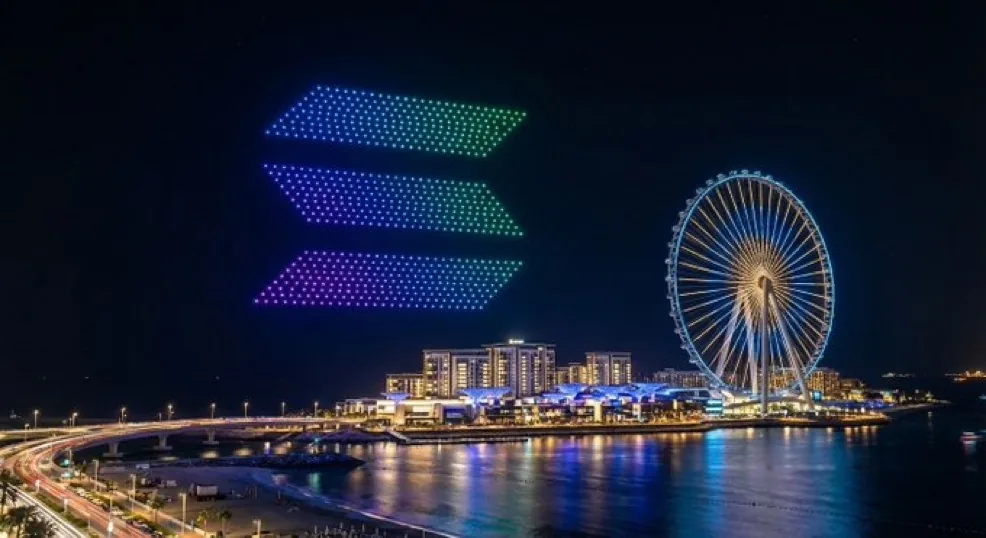
The Drone Formation
The three bar mark flown over Bluewaters Island in Dubai, the Ain Dubai wheel lit beside it. No publication I could reach documents a Solana drone show at this location, so it sits here as brand imagery and not as a record of a dated event.
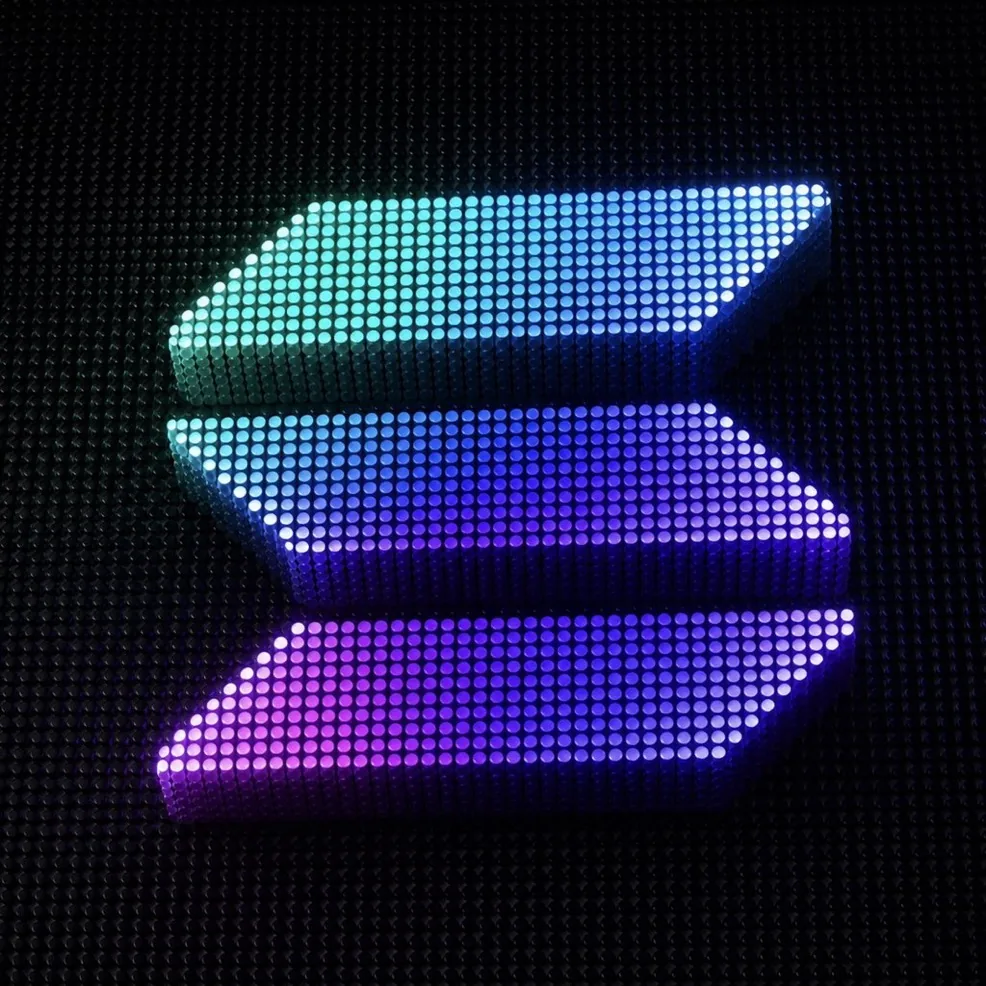
The Mark Itself
Three parallel bars in a gradient running green to purple, here as a grid of LEDs. Nothing in the mark encodes anything about the network. Worth saying plainly, because a lot of what gets written about this chain is really written about its branding.
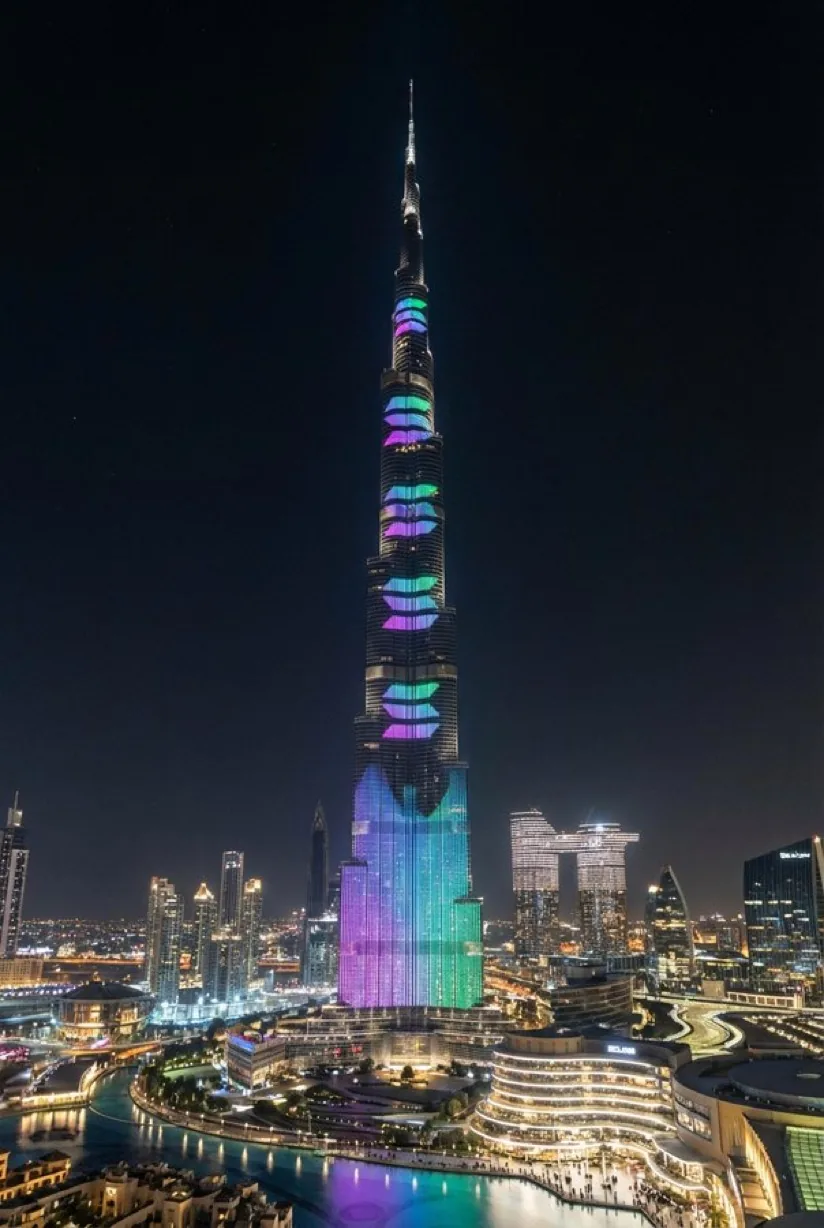
The Tower
The Burj Khalifa in the Solana gradient. Breakpoint 2025 was held at the Etihad Arena in Abu Dhabi in December 2025, the first in the Middle East, but nothing I could find ties this lighting to that week or to any dated event. Same rule as the two frames beside it.
Solana, In Their Own Words
The network’s own post, embedded from X rather than copied. It plays here, it stays theirs.
Source: Solana on X, 23 September 2026. Embedded, not rehosted.
Prices, market caps, supplies, all time highs and all time lows from CoinGecko, read 3 September 2026. Solana issuance and burn figures from Solana Compass, SIMD-0550 from crypto.news, Alpenglow from Kiln, BSOL from CryptoBriefing. Sui architecture and history from Sygnum Bank, the Mysticeti v2 figures from the Sui blog, the unlock schedule from Tokenomist. Zcash halving schedule from CoinDataFlow, the shielded pool and the Ironwood upgrade from Phemex, the Orchard bug from KuCoin, the NU7 vote from CryptoSlate. Render tokenomics from the Render Network knowledge base, RNP-006 and RNP-018, and from RenderCon 2026 coverage. Jupiter protocol figures from DefiLlama, the net zero emissions vote from SolanaFloor, the Litterbox Trust and the 70% proposal from the Jupiter Research forum. Chain level TVL, stablecoin and fee figures from DefiLlama. A snapshot on one day, not a live feed, and not a price prediction. Whitepapers read directly: bitcoin.org/bitcoin.pdf, the Ethereum whitepaper on ethereum.org, and solana.com/solana-whitepaper.pdf. Governance from BIP-2, EIP-1 and SIMD-0001 in their own repositories. The 31 October 2008 announcement from the Satoshi Nakamoto Institute archive of The Cryptography Mailing List. Ethereum founding dates, crowdsale and launch from ethereum.org. Solana founders, launch date and the outage record from Wikipedia. Read September 2026. Claims about what a document does not contain were checked against the document.
The Other Positions
Same shape, same rule: the bull case and the case against, at the same weight, with every figure sourced and dated.



The ETF Route
If you would rather hold this in a brokerage account than a wallet, the listed funds are compared on fee and on whether they stake.
Common Questions
That the validator set just voted to halve the time it takes to reach terminal inflation, cutting an estimated 18.9 million SOL of issuance over six years, that half of every transaction fee is already burned, that Alpenglow targets 100 to 150 millisecond finality against roughly 13 seconds today, that the Bitwise BSOL ETF holds about 9.33 million SOL and stakes 96% of it, and that the chain moves 2.222 billion dollars of DEX volume a day.
3.666% a year as at 3 September 2026, down from 8.000% at genesis. It falls on a disinflation curve toward a terminal rate of 1.5%. SIMD-0550, which closed on 28 August 2026 with 67% of participating stake, doubles the annual disinflation rate from 15% to 30%, reaching that terminal rate in about 2.8 years instead of 5.7. It still requires a validator client feature gate before it activates.
Yes. Fifty percent of every transaction fee is burned and the remaining half goes to the validator that processed the transaction. Whether the chain is net deflationary in any period depends on whether that burn exceeds issuance, and at 3.666% inflation it currently does not.
SIMD-0326, a replacement for Solana’s Proof of History and Tower BFT consensus. It passed in September 2025 with 52% of total network stake participating and targets 100 to 150 milliseconds of finality against roughly 13 seconds today, with full mainnet deployment targeted for Q3 or Q4 2026 alongside the Agave 4.1 validator client. It also moves validator votes off chain.
That over a billion dollars flowed into the Bitwise BSOL staking ETF between October 2025 and August 2026 and SOL still sits about 66% below its January 2025 high, that terminal inflation is 1.5% and never zero, and that the chain captured 612,579 dollars of fees on a day the applications running on it captured 4.64 million.
A Thesis You Cannot
Argue Against Is Not One.
Every position on this site is published with the reasoning and the counter argument attached. That is the whole standard.
Not financial advice.