
Crypto · Hard Assets · BTC
Twenty One Million.
That Is The Whole Argument.
The bull case for Bitcoin as the people who hold it actually make it, the supply schedule underneath it, and the case against, at the same weight.
Bitcoin is a fixed supply digital asset capped at 21,000,000 coins, of which over 94% has already been mined. New coins arrive at roughly 450 a day, and that rate halves about every four years. The subsidy is 3.125 BTC and falls to 1.5625 at block 1,050,000, estimated 17 April 2028.
Maximum Supply
Fixed in the protocol. Not a policy, a rule.
Already Mined
The remainder arrives over the next hundred years. Source: CoinGecko.
BTC Per Block
Halved from 6.25 in April 2024. Next cut 2028.
New BTC Per Day
The entire daily supply. It only ever goes down.
Where Bitcoin Sits Here
No memecoin branch and no NFT branch under this one, unlike the other two chains on this site. Here is what it does connect to.
The Hard Assets Sleeve
Bitcoin is grouped with gold and silver rather than with the smart contract chains, because the argument for holding it is the argument for holding metal: fixed supply, no counterparty, no cash flows. Two of the six sleeves in the book are the metals, and this is the third leg of the same idea.
The Chains With Branches Under Them
Solana and Ethereum both carry a memecoin branch and an NFT branch on this site, with a written breakdown per token and per collection. Bitcoin has neither, and that is a fact about Bitcoin rather than a gap in the coverage.
The Allocation It Sits In
Where Bitcoin sits against everything else in the book, at what weight, and why. Published position by position, with no balances and no returns.
The Whitepaper
Nine pages, twelve numbered sections, eight references. Still the shortest document in this category and still the one the rest of it answers to.
What It Is
Bitcoin: A Peer-to-Peer Electronic Cash System, by Satoshi Nakamoto. It opens with the sentence the whole thing is built on: “A purely peer-to-peer version of electronic cash would allow online payments to be sent directly from one party to another without going through a financial institution.”
Where It Appeared
Announced to The Cryptography Mailing List on 31 October 2008 under the subject “Bitcoin P2P e-cash paper”. The email opens “I have been working on a new electronic cash system that is fully peer-to-peer, with no trusted third party.” Source: the Satoshi Nakamoto Institute archive of that list.
What It Actually Solves
It is not a paper about money. Sections three, four and five are about ordering: a timestamp server, proof of work, and a rule that the longest chain wins. Double spending is a sequencing problem, and the chain is the answer to it. The economics get one section out of twelve.
What Is Not In It
No supply cap. The figure twenty one million does not appear in the paper, and neither does a halving schedule. Section six says only that the first transaction in a block starts a new coin and that this “provides a way to initially distribute coins into circulation, since there is no central authority to issue them”. The scarcity everyone cites lives in the code, not the document.
Three Words It Never Uses
Blockchain. Wallet. Mining. None of the three appear anywhere in the paper. The vocabulary the industry runs on was built afterwards, by other people, on top of nine pages that never used it.
The Community, And How It Decides
Bitcoin has no company, no foundation with authority and no vote. What it has instead is a process that is explicit about not being one.
The BIP Process
A Bitcoin Improvement Proposal is a design document, in one of three types: Standards Track for anything touching the protocol, Informational for guidance that binds nobody, and Process for how the work itself runs. It moves Draft, Proposed, Final, and can be Rejected, Withdrawn, Replaced or Obsolete. Source: BIP-2.
The Editors Cannot Decide Anything
Six volunteer editors check submissions for completeness, assign numbers and merge. They cannot determine adoption. BIP-2 says it out loud: “The BIP process does not aim to be a kind of forceful governance of Bitcoin, merely to provide a collaborative repository.”
What Counts As Adopted
The thresholds are written down and they are different per type. A soft fork needs a clear miner majority shown on chain. A hard fork needs merchants and holders actually using the new rules. A peer services change needs one percent of listening nodes for a month. An application change needs two independent compatible implementations. Source: BIP-2.
Where The Power Actually Sits
Not with the editors, and not with the miners. It sits with the economy that accepts and spends the coin, which is the slowest and least glamorous answer available, and the reason changes to Bitcoin take years rather than quarters.
The Bull Case, As Bulls Make It
Five arguments, stated at their strongest. This is the case the people who hold it make, not a forecast from this site.
The Supply Cannot Respond To Demand
Every other asset answers a price rise with more of itself. Gold miners drill, oil rigs restart, companies issue shares. Bitcoin issuance is a fixed schedule that ignores price entirely. Demand has only one place to go, and that is the price.
The Halving Is Scheduled, Not Announced
Issuance drops by half at block 1,050,000, an estimated 17 April 2028, and the subsidy goes from 3.125 to 1.5625 BTC. Nobody votes on it and nobody can defer it. The bull argument is that a scheduled supply cut into steady demand only resolves one way.
The Access Ladder Is Still Being Built
Spot ETFs turned Bitcoin from something you had to self custody into a line item any brokerage account can hold. Each rung widens who can buy without changing anything about the asset. This is the same mechanic that moved WIF, at institutional scale.
It Has Survived Every Obituary
Fifteen years, several drawdowns above seventy percent, multiple exchange collapses, and repeated national bans. The network has never stopped producing blocks. Bulls read that as the asset passing a test that cannot be run any other way than by waiting.
It Is The Only One With No Issuer
There is no company, no foundation with a treasury, and no team allocation that unlocks. There is nobody who can be pressured into printing more. That absence is the entire product.
The Case Against, At The Same Weight
Every argument above has an answer. If you only read the half you agree with you have not read anything.
Scarcity Is Not Demand
A fixed supply guarantees nothing on its own. There are thousands of fixed supply tokens worth nothing at all, and the reason Bitcoin is not one of them is demand, which is not fixed and not scheduled. The supply argument only works if the demand holds, and that half is an assumption.
Four Halvings Is Not A Data Set
The halving cycle argument rests on four events, two of which were during periods of near zero interest rates. Drawing a schedule out of four observations is the kind of thing that looks obvious right up until the fifth one behaves differently.
The ETF Cuts Both Ways
The same access that lets money in lets it out, faster and with less conviction than self custody ever did. An asset held in brokerage accounts is an asset that gets sold to meet margin calls in things that have nothing to do with it.
There Is No Floor Under It
No cash flow, no book value, no coupon. There is no level at which the maths says it is cheap, which means there is no level at which a drawdown has to stop. Every price is sentiment, all the way down.
Security Has To Be Paid For Eventually
The subsidy that pays miners halves toward zero. At some point fees have to carry the security budget on their own, and whether they can is an open question with real disagreement among people who understand it far better than most holders do.
How I Actually Hold This
Not advice. The rules the position runs under, which is the only part that transfers.
Sized So The Argument Does Not Matter
If a position needs the bull case to be right in order for the year to work, the position is the mistake. Size it so you can read the bear case without flinching and you will read the bear case honestly, which is the only way it is any use to you.
Held In The Corporation, Not Personally
The crypto sits in Wise Capital Inc. That is a structure decision, not a market view, and it is published on the corporate page with the reasoning attached.
The Schedule Is The Only Thing I Trust
Prices, narratives and cycle theories all change. The issuance schedule does not. When I want to know something about Bitcoin that is still true next year, I read the schedule and ignore everything else.
A Thesis You Cannot Argue Against Is Not A Thesis
If you cannot state the strongest version of the case against your own position, you do not hold a position, you hold an identity. That is true here and it is true of every line in the book.
How Bitcoin Gets Pictured
Two photographs and one joke, and what none of them is.

The Symbol
Bitcoin has a logo, a ticker and no physical form, so every photograph of it is a photograph of something somebody made to stand in for it. This one is the mark, machined and lit.

The Coin
A minted souvenir in front of a trading screen. The coin is a novelty item, the chart behind it is stock imagery and not a chart of anything on this site, and neither one is what you own when you own bitcoin. What you own is a balance in a ledger and the key that can move it.
The Joke
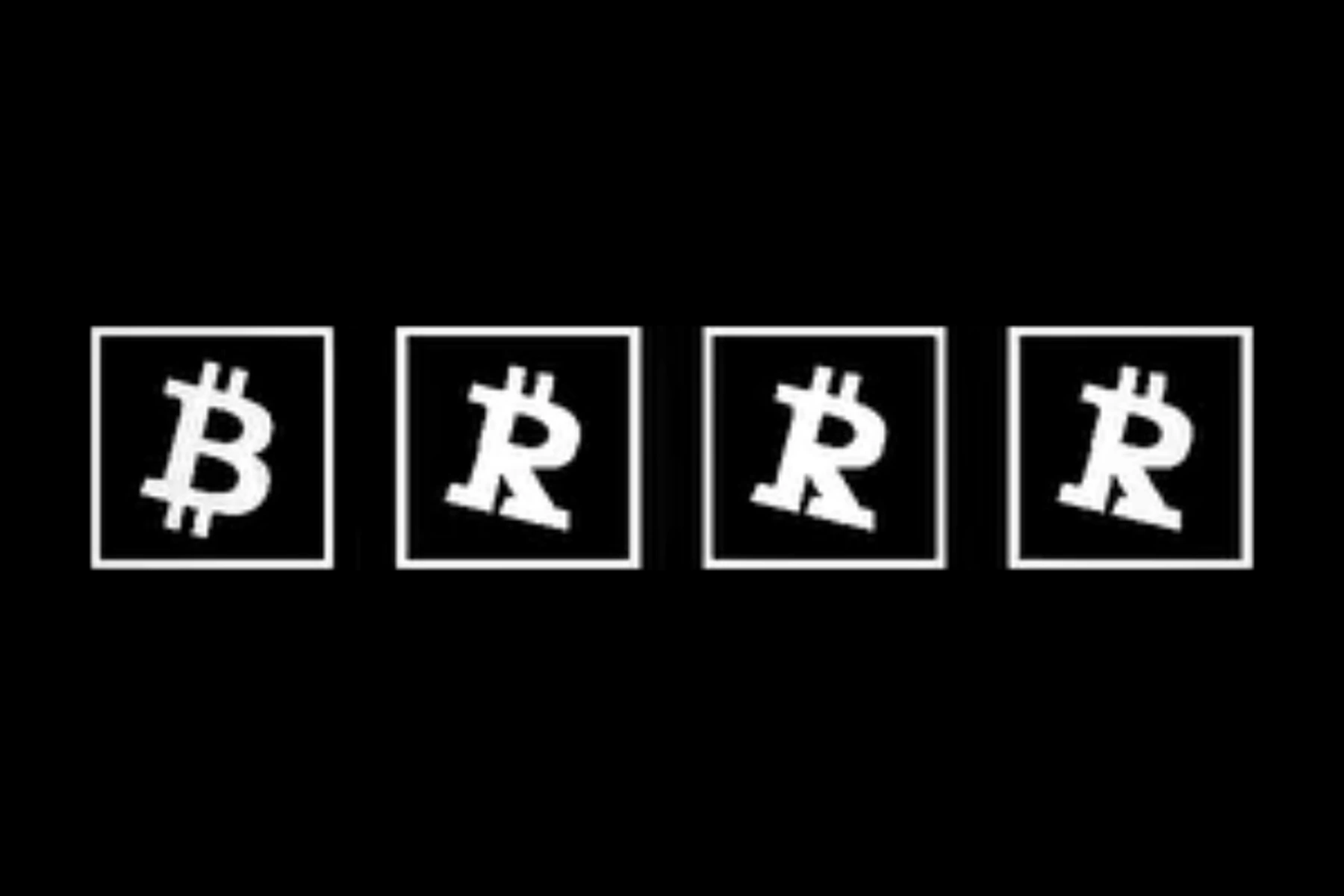
Four panels, one letter each, the Bitcoin mark standing in for both the B and the R. It is the community’s reply to money printer go brrr, and it is an argument about supply rather than about price. A meme is not evidence. This one is here as a piece of the culture, and because supply is the only part of the case on this page that does not rest on anybody’s forecast.
Bitcoin figures from CoinGecko. Gold figures from the World Gold Council, Gold Demand Trends full year 2025 and the Goldhub above ground stocks series as at Q2 2026. Silver figures from the Silver Institute, World Silver Survey 2026 and its 2025 market review. Read on the date shown against each figure, and none of it is a price. Whitepapers read directly: bitcoin.org/bitcoin.pdf, the Ethereum whitepaper on ethereum.org, and solana.com/solana-whitepaper.pdf. Governance from BIP-2, EIP-1 and SIMD-0001 in their own repositories. The 31 October 2008 announcement from the Satoshi Nakamoto Institute archive of The Cryptography Mailing List. Ethereum founding dates, crowdsale and launch from ethereum.org. Solana founders, launch date and the outage record from Wikipedia. Read September 2026. Claims about what a document does not contain were checked against the document.
The Other Two
Same shape, same rule: the bull case and the case against, at the same weight.
Gold
The bull case for gold as gold buyers make it, the supply arithmetic that sits under it, what central banks have actually been doing, and the case against at the same weight..
Silver
The bull case for silver as silver buyers make it: a market in its sixth straight annual deficit, industrial demand that does not care about the price, and the case against at the same weight..
The ETF Route
If you would rather hold this in a brokerage account than a wallet, the listed funds are compared on fee and on whether they stake.
Common Questions
That supply is fixed at 21 million and cannot respond to demand, that issuance halves on a schedule nobody can defer, that spot ETFs keep widening who is able to buy it, that the network has survived fifteen years of attempts to kill it, and that it is the only asset in the category with no issuer who could be pressured into creating more.
At block height 1,050,000, estimated 17 April 2028 by CoinGecko. The block subsidy falls from 3.125 BTC to 1.5625 BTC. The previous halving was April 2024, when it fell from 6.25 to 3.125.
Less than 6% of the 21 million cap. Over 94% has already been mined and roughly 450 new coins arrive per day, a figure that halves about every four years, so the remainder is issued over roughly the next hundred years.
That scarcity guarantees nothing without demand, and demand is neither fixed nor scheduled. There is no cash flow, no book value and no coupon, so there is no level at which the arithmetic says it is cheap and therefore no level at which a drawdown has to stop.
No. It is a breakdown of the arguments on both sides. Cody Wise is not a licensed financial advisor and nothing here is a recommendation to buy or sell anything.
A Thesis You Cannot
Argue Against Is Not One.
Every position on this site is published with the reasoning and the counter argument attached. That is the whole standard.
Not financial advice.