John Ternus became CEO of Apple on September 1, 2026, replacing Tim Cook after fifteen years. He is a 25 year Apple hardware engineer, not a supply chain or finance operator, and that single fact is what investors are actually repricing. The stock rose about 3% on his first day while the Nasdaq fell.
Summary
- Ternus took over September 1, 2026. Tim Cook moved to Executive Chairman and stays on policy and government relations.
- Apple posted record fiscal Q3 2026 revenue of $109.4 billion, up 16% year over year, with gross margin at 50.1%.
- Company guidance for fiscal Q4 2026 calls for 9% to 11% revenue growth and gross margin of 47% to 48%. That margin step down is the memory chip crunch showing up in the model.
- Four variables decide the next three years: memory cost inflation, whether the Gemini powered Siri lands, the Google search payment under appeal, and whether new categories ship.
- BofA Securities carries a Buy with a $380 price target, roughly 20% above where the stock traded into the transition.
- The September 9, 2026 event is the first real test. A foldable iPhone at a reported $1,999 starting price is the highest stakes hardware launch since the original iPhone.
Table Of Contents
- What Actually Changed On September 1
- Who John Ternus Is, In Numbers
- The Balance Sheet He Inherits
- The Four Variables That Decide AAPL Through 2028
- The Product Calendar That Prices The Stock
- Three Scenarios Through 2028
- What Investors Get Wrong About A Hardware CEO
- Frequently Asked Questions
- The Bottom Line
What Actually Changed On September 1
Less than the headlines suggest, and more than the market has priced.
Apple announced the transition on April 20, 2026, four and a half months before it took effect. That is not a scramble. That is a governance handoff planned to the week. Tim Cook did not leave the building. He became Executive Chairman with a defined remit that includes engaging policymakers globally, which matters more than it sounds when tariffs, the EU Digital Markets Act, and a live antitrust appeal are all open files.
The board moved too. Arthur Levinson stepped from non executive chairman to lead independent director. Ternus joined the board of directors. So Apple now has a sitting CEO on the board, an Executive Chairman who ran the company for fifteen years, and an independent director structure sitting on top of both. For investors, that reads as continuity with a safety rail, not a clean break.
The market’s first vote was positive. Apple gained about 3% on Ternus’s first day as CEO while the Nasdaq declined. A one day move is noise, but the direction told you the transition was not being treated as a risk event.
Who John Ternus Is, In Numbers
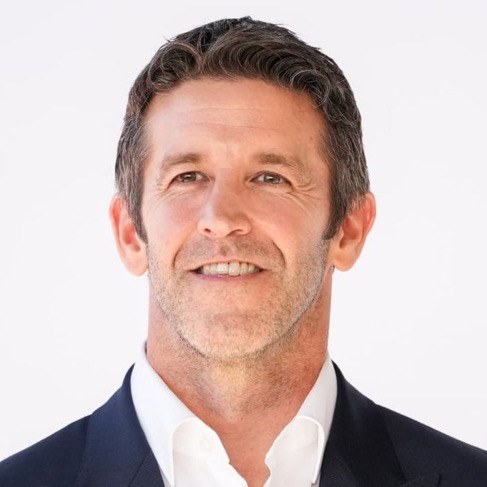
Ternus is 51. He joined Apple’s product design team in 2001, out of a mechanical engineering degree at the University of Pennsylvania, where he also swam competitively. He became VP of Hardware Engineering in 2013, joined the executive team as Senior Vice President in 2021, and took the CEO seat in 2026. Twenty five years, one company, one discipline.
What he actually shipped is the part that matters to a valuation.
| Program | Why It Matters To The Model |
|---|---|
| Intel to Apple silicon transition | Removed a third party dependency, lifted Mac margins, and gave Apple a chip roadmap it controls |
| Mac line under Apple silicon | Mac revenue grew 29% year over year in fiscal Q3 2026 |
| AirPods and hearing health features | Turned an accessory into a regulated health adjacent category |
| Apple Watch and Vision Pro | Proved Apple can stand up new hardware categories, expensively |
| iPhone 17 lineup | Drove 22% iPhone revenue growth in the quarter before he took over |
His stated priorities on day one were reliability, durability, repairability, and materials innovation. Read cynically, that is a hardware executive describing hardware. Read correctly, it is a margin and retention thesis. Products that last longer keep users inside an ecosystem that monetizes at $30.7 billion of Services revenue a quarter. Durability is not a sustainability talking point at Apple’s scale. It is customer lifetime value.
He has also started building his own bench. In August 2026 he brought Laura Legros, a hardware engineering VP who retired in 2022, back into a cross division role reporting directly to him. Bringing back a known operator ahead of a transition tells you he is optimizing for execution speed, not for a clean slate.
The Balance Sheet He Inherits
Ternus is inheriting the strongest set of quarterly numbers Apple has ever handed to an incoming CEO, and a guidance line that already flags the pressure point.
Fiscal Q3 2026, Reported July 30, 2026
| Line | Result | Year Over Year |
|---|---|---|
| Total revenue | $109.4B | +16% |
| Net profit | $29.8B | |
| Diluted EPS | $2.02 | from $1.57 |
| Gross margin | 50.1% | from 46.5% |
| iPhone | $54.3B | +22% |
| Services | $30.7B | +12% |
| Mac | $10.4B | +29% |
| Wearables, Home, Accessories | $7.9B | +6% |
| iPad | $6.2B | -6% |
| Greater China | +22.4% | |
| Europe | +22.4% |
Guidance for fiscal Q4 2026 was 9% to 11% revenue growth, mid teens iPhone growth, operating expenses of $19.1 billion to $19.4 billion, and gross margin of 47% to 48% including roughly one point of tariff benefit.
Read those two paragraphs together. Revenue accelerating, margin guided down two to three points in a single quarter. That gap is the whole story of the next eighteen months, and it has a name: memory.
On valuation, Apple has been trading around $325 a share for a market capitalization near $4.7 trillion, on trailing twelve month revenue of roughly $467 billion and net income near $129 billion. That is a trailing price to earnings ratio in the high thirties and a forward multiple in the mid thirties. Apple is not priced as a hardware company. It is priced as an ecosystem toll booth with a hardware distribution arm, and the multiple only holds if that story holds.
The Four Variables That Decide AAPL Through 2028
Ignore the succession narrative. Four things determine the outcome, and three of them were set before Ternus took the chair.
1. Memory Cost Inflation
DRAM and NAND pricing ran hard through 2026 as AI datacenter demand consumed supply. Cook flagged it publicly before leaving, saying Apple would evaluate a range of options, which is executive language for price increases. Reporting around the foldable iPhone suggests memory alone could add $150 to $200 of bill of materials per device.
Apple has three levers: eat the cost and compress margin, raise prices and risk upgrade cycles, or use scale and long term supply agreements to buy cheaper than anyone else. Historically Apple does all three at once. The question is the mix, and the fiscal Q4 margin guide of 47% to 48% is your first read on it.
This is the single most quantifiable risk in the model. Every point of gross margin at Apple’s revenue scale is roughly $4.7 billion a year of gross profit.
2. The Gemini Siri Bet
Apple is not winning the frontier model race and has stopped pretending otherwise. It contracted a custom 1.2 trillion parameter Google Gemini model to power the rebuilt Siri, reportedly for around $1 billion a year. John Giannandrea, who ran Apple’s AI and machine learning, announced his retirement in December 2025.
Renting intelligence and owning the interface is a defensible strategy. Apple owns the device, the operating system, the identity layer, and the personal context. Google owns the reasoning. BofA’s bull case is built on exactly this: Apple’s silicon, privacy positioning and on device processing translate into what the firm calls device dominance in an AI enabled era.
The risk is not technical, it is structural. Apple is now paying its largest competitor for the capability that will define the next platform. If Gemini powered Siri is good, Apple sells more phones and looks smart. If Google decides the terms should change in 2029, Apple has very little leverage. This is the same lesson that shows up anywhere infrastructure gets rented instead of owned, which I have written about in Own The Rails.
3. The Google Search Payment
Google pays Apple for default search placement in Safari. Court documents put those payments around $20 billion a year, and they are close to pure margin, which means they carry outsized weight in Services profitability.
The September 2025 antitrust remedy left the Apple arrangement largely intact while barring exclusivity. The Department of Justice appealed, and that appeal was live into 2026. JPMorgan has modelled a downside case where Apple takes a revenue hit in the $12.5 billion range.
This is the cleanest asymmetric risk in the name. No upside if it goes Apple’s way, since it is already in the numbers. Meaningful downside if it does not. Any investor buying Apple on the Ternus story needs to size this line item before anything else.
4. Whether New Categories Actually Ship
Apple’s multiple assumes a fifth act. Vision Pro was not it. BofA explicitly points at smart glasses, smart rings, camera equipped AirPods, home systems and robotics as the categories where a hardware CEO should outperform a supply chain CEO.
This is where Ternus’s appointment is a genuine input rather than a personnel note. Cook optimized an existing machine to extraordinary effect. Ternus is being asked to open a new revenue line. Those are different jobs and they reward different instincts.
The Product Calendar That Prices The Stock
Ternus does not get a honeymoon. His first keynote as CEO is eight days into the job.
| Window | Expected | Investor Question |
|---|---|---|
| September 9, 2026 | iPhone Ultra foldable, iPhone 18 Pro and Pro Max on a 2nm A20 Pro, Apple Watch Series 12 and Ultra 4 | Does a reported $1,999 starting price find a volume market? |
| Fiscal Q1 2027 print | First full holiday quarter under Ternus | Did memory costs land inside the 47% to 48% margin guide? |
| 2027 | Twentieth anniversary iPhone, smart glasses, AI AirPods, foldable iPad, OLED MacBook | Is there a category that reprices the multiple? |
The foldable is the highest variance product Apple has launched in a decade. Reported specifications point to a book style titanium design with an outer display near 5.3 to 5.5 inches, an inner display near 7.6 to 7.8 inches, and Touch ID in the power button replacing Face ID. Apple reportedly shelved a stylus accessory after finding the inner display could not take stylus pressure without permanent marking, and the ultra thin glass sits around Mohs 5 hardness, softer than standard iPhone glass.
That detail is the entire Ternus thesis compressed into one product. The man whose stated priority is durability is shipping Apple’s least durable display, at Apple’s highest price point, in his first week. Whether that device survives contact with real users is the most informative data point investors will get in the next two years.
Three Scenarios Through 2028
The following is an illustrative framework, not a forecast, and not investment advice. I am not a financial advisor. The point is to show which variable does the work, not to pick a number.
Apple’s trailing twelve month earnings per share sits near $8.85 on roughly 14.6 billion shares outstanding, against a share price near $325. So the market is paying a trailing multiple in the high thirties. Two inputs move the outcome: where earnings land, and what multiple the market is willing to pay for them.
| Bear | Base | Bull | |
|---|---|---|---|
| Revenue growth, annualized | 2% to 4% | 7% to 9% | 11% to 14% |
| Gross margin | 44% to 45% | 46% to 47% | 47% to 48% |
| Illustrative FY2028 EPS | ~$9.50 | ~$11.50 | ~$13.25 |
| Multiple applied | 26x | 33x | 36x |
| Implied share price | ~$247 | ~$380 | ~$477 |
| Implied market cap | ~$3.6T | ~$5.5T | ~$7.0T |
| What has to happen | Search payment cut, memory costs stick, foldable disappoints, no new category | Memory absorbed through pricing, Siri ships and holds, search deal survives appeal | Foldable drives an upgrade supercycle, Siri lifts Services attach, at least one new category ships at scale |
Note where the base case lands. Roughly $380, which is exactly where BofA Securities set its price target with a Buy rating, calling for close to 20% upside from the transition period price. That is not a coincidence. It is what the consensus model produces when you assume Apple executes and nothing structural breaks.
The uncomfortable part of the table is the multiple row. The spread between 26x and 36x moves the share price by roughly $230. Earnings are the story people discuss. The multiple is what actually determines the return, and the multiple is a sentiment variable dressed up as a valuation input. Anyone building a position should size the sentiment risk, not just the earnings risk. Related reading on how headline numbers mislead: Read The Cap, Not The Headline, and how I structure the equity side in Investing.
What Investors Get Wrong About A Hardware CEO
Mistake 1: Assuming An Engineer CEO Means Product Risk Taking
Ternus is a manufacturing and reliability executive, not a visionary in the Jobs mold. Above Avalon’s read is that he continues Apple’s existing push strategy of advancing every product category simultaneously rather than reordering priorities. Expect refinement and category expansion, not reinvention.
Mistake 2: Treating The Transition As The Catalyst
The transition was announced in April and executed in September. It is fully priced. The catalysts are the September 9 launch, the holiday quarter margin print, and the antitrust appeal. A CEO change with four months of notice does not move a $4.7 trillion company.
Mistake 3: Pricing Apple As An AI Loser
Apple lost the model race and is renting the model. It still owns an installed base measured in billions of active devices, plus the identity layer, the payment rails and the default position on the most valuable consumer hardware on earth. Distribution has historically beaten capability in consumer technology. That is the bull case in one sentence.
Mistake 4: Ignoring The Concentration Risk In Services
Services grew 12% and carries the margin story. A meaningful slice of Services profit is a single contract with Google that is subject to an active federal appeal. That is concentration risk, and it is the line most retail investors never model.
Frequently Asked Questions
Who is the new CEO of Apple?
John Ternus, who became Apple CEO on September 1, 2026. He is 51, joined Apple’s product design team in 2001, became VP of Hardware Engineering in 2013 and Senior Vice President in 2021. He holds a mechanical engineering degree from the University of Pennsylvania and led Apple’s transition from Intel processors to Apple silicon.
Did Tim Cook leave Apple?
No. Cook stepped down as CEO after fifteen years and became Executive Chairman. His remit includes engaging with policymakers globally. Arthur Levinson moved from non executive chairman to lead independent director, and Ternus joined the board of directors.
How did Apple stock react to the new CEO?
Apple rose about 3% on Ternus’s first day as CEO, September 1, 2026, while the Nasdaq declined. BofA Securities holds a Buy rating with a $380 price target, implying close to 20% upside from the price at the time of the transition.
What is the biggest risk to Apple stock under Ternus?
Two, ranked. First, the Google search default payment, reported at around $20 billion a year and largely pure margin, which is exposed to an active Department of Justice appeal. Second, memory chip cost inflation, which already shows up in guidance as a gross margin step down from 50.1% to a guided 47% to 48%.
What products is Apple launching under John Ternus?
The September 9, 2026 event is expected to bring Apple’s first foldable, reported as the iPhone Ultra at a starting price near $1,999, alongside the iPhone 18 Pro and Pro Max on a 2nm A20 Pro chip, and new Apple Watch models. Reporting points to smart glasses, AI AirPods, a foldable iPad and an OLED MacBook across 2027.
The Bottom Line
Apple did not hire a visionary. It hired the person who has shipped its hardware for twenty five years, gave him a board seat, kept the previous CEO as Executive Chairman on policy, and handed him a record quarter with a margin warning attached.
That is a continuity trade, not a turnaround trade. The upside is not that Ternus reinvents Apple. The upside is that a hardware operator opens a category Cook never did, while the ecosystem keeps compounding underneath. The downside is not that he fails at product. The downside is that a court decision removes $12 billion to $20 billion of near pure margin revenue that has nothing to do with him.
Watch three things: the foldable’s real world durability, the fiscal Q1 2027 gross margin print, and the antitrust appeal. Everything else is narrative.
This article is informational and is not investment advice. I am not a financial advisor. Figures cited are from public reporting and company disclosures as of September 2026. Verify current numbers before making any decision.
Build Systems That Outlast The Cycle
Apple’s succession worked because the system was bigger than the operator. That is the same principle behind every business I run. See how I hold public equities in Stocks And ETFs, or book a call.
Disclosure
Cody Wise is not a licensed financial advisor and nothing here is a recommendation to buy or sell anything. Every figure above carries the source it came from and the date it was reported. Share prices, analyst ratings and price targets move; the ones quoted here were accurate as at 4 September 2026 and this page is not updated when they change. Read the full disclaimer.