
Founder Notes
I have sent proposals that ran fourteen pages. Every one of them was a confession. Fourteen pages meant I did not know exactly what the client wanted, so I covered everything and let them find their own problem somewhere in the pile.
A long proposal is thinking you outsourced to the buyer.
The call is where the work gets sold. The proposal is where it gets recorded. Those are two different jobs, and most founders try to do the first one twice.
If the document has to convince, the conversation failed. Nobody reads page nine and changes their mind. They read page one to check that you were listening.

Length feels like effort. It reads like doubt. A price surrounded by three paragraphs of justification looks like a price that expects to be argued down.
The useful test is comparative, not absolute. Your proposal should be shorter than the call that produced it. If it is longer, you did not run a call. You ran an introduction, and now the document is doing the discovery work that should have happened live.
London, August 1940
On 9 August 1940, with the Battle of Britain in its opening weeks, Winston Churchill circulated a minute to the War Cabinet. It was titled Brevity. Britain was fighting for its existence and the Prime Minister took the time to tell his own government to write shorter reports.
“To do our work, we all have to read a mass of papers. Nearly all of them are far too long.”
The instructions were specific. Set out the main points in short crisp paragraphs. Move the detailed analysis and the statistics into an appendix. Where a full report is genuinely needed, submit a summary of headings and be ready to expand it verbally. He closed by arguing that the discipline of being concise is an aid to clearer thinking, not a shortcut around it.
That last line is the whole lesson. Churchill was not asking for less thinking. He was asking for the thinking to be finished before it reached his desk. A long report shifted the work of separating signal from noise onto the most expensive reader in the building.
Your client is that reader. Every page you send is a page of your job they now have to do.

What to cut
- The company history page. They hired the person who was on the call, not the founding year.
- The process diagram. Process is a comfort object for the seller. The buyer wants the outcome and the date.
- Three tiers, when the call named one problem. Options are a polite way of asking the client to diagnose themselves, which is the job you are being paid for. Narrow the offer and the tiers disappear on their own.
- The case studies they already read before they booked.
- The glossary. If a word needs defining inside a proposal, it does not belong in the proposal.
- Stock photography.
- The terms restated in prose above the actual terms.
What to keep
- The problem, in their words, quoted from the call.
- The outcome, written so they could verify it themselves.
- What you will do.
- What they owe you, and by when. Most projects die here, not on price.
- The price. Once. No ranges, because the number is the message.
- The start date.
- What happens the moment they say yes.
Seven lines. One page, two if the scope genuinely has phases. Everything else is an appendix, and an appendix exists for the people who were not on the call.

The proposal is a receipt for a decision, not an argument for one.
There is a real exception. Some buyers cannot sign a page. Legal needs the clauses, procurement needs the line items, a board needs the deck. Do not fight that, and do not average it either. Split the document the way Churchill did: the decision on page one, the detail behind it. The decider reads the page, the process reads the rest. What kills the deal is the nine-page compromise that serves neither of them.
The deeper fix is upstream. A proposal gets long because the explanation inside it has never been written down properly, so it gets rebuilt from scratch every time and grows with each rebuild. The explanation you keep repeating is not a proposal problem. It is an unbuilt product.
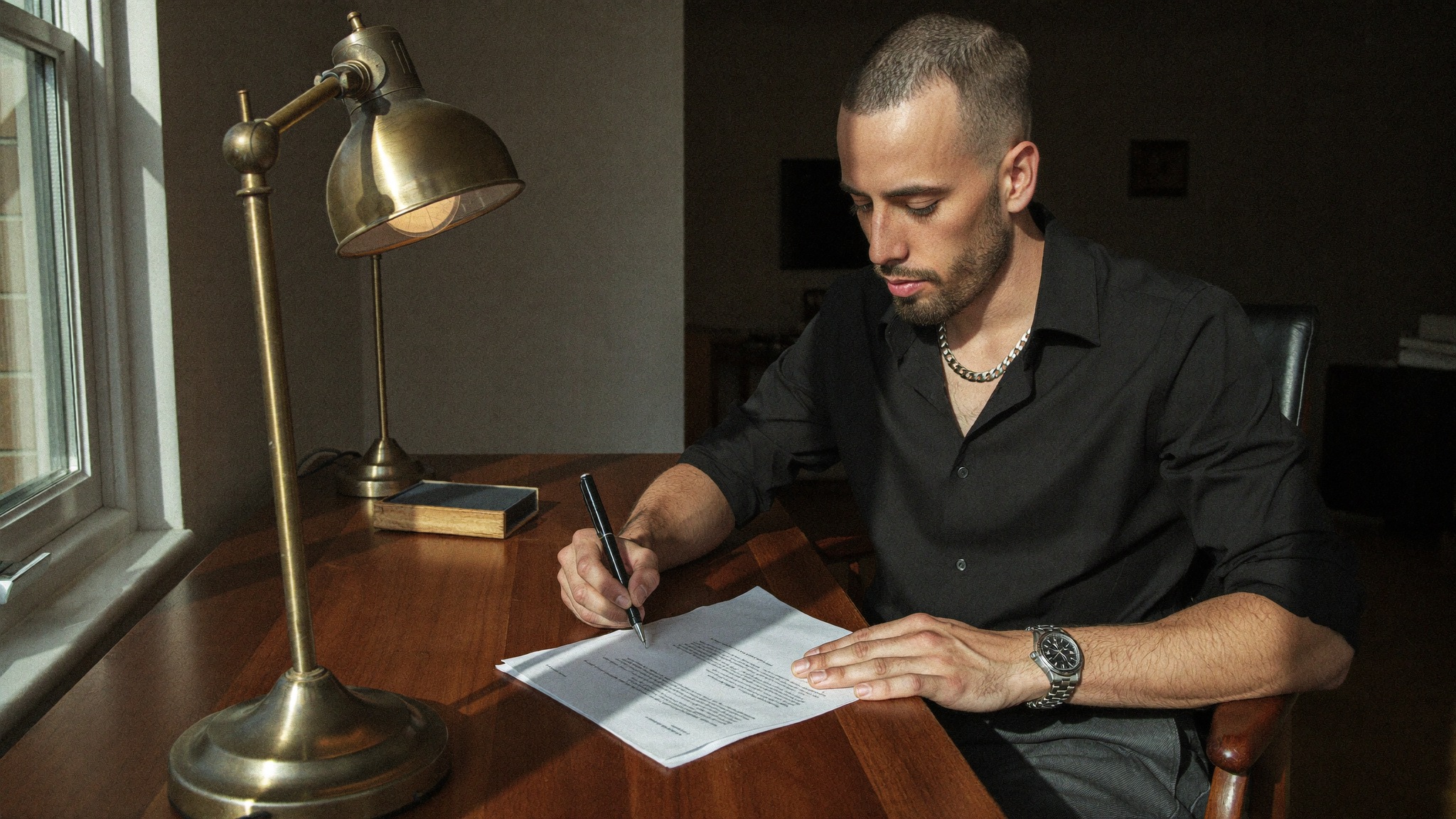
Brevity is not a style choice. It is the receipt that proves the thinking was already done.