
Travel
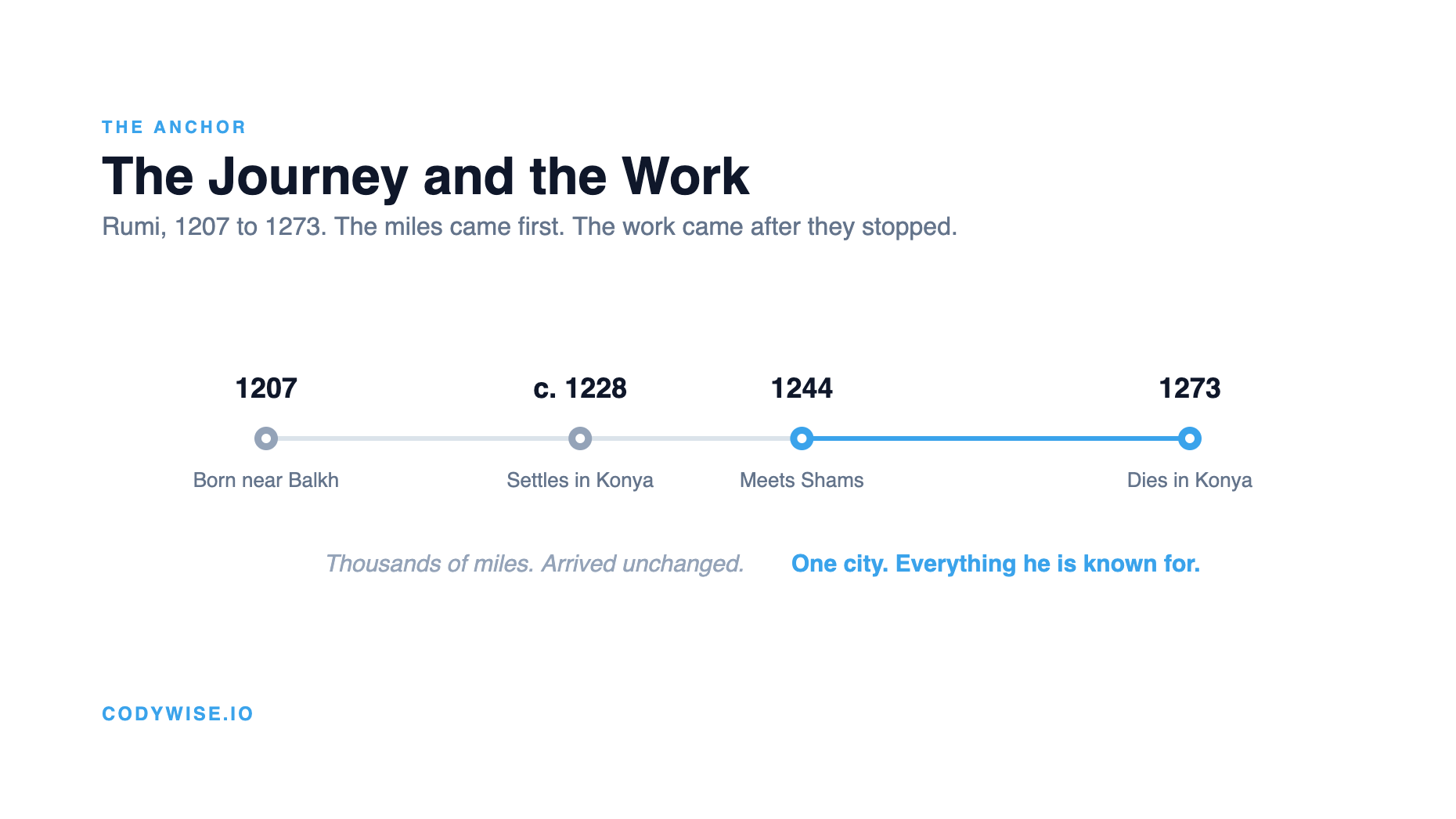
Rumi’s family crossed most of the known world. Thousands of miles on the move ahead of the Mongol armies, out of Balkh, through Baghdad and Damascus, ending in a provincial Anatolian city called Konya. It took years. By any measure it is the most dramatic journey in his biography, and it produced nothing. He left as a scholar’s son and arrived as a scholar. The man we quote eight centuries later did not exist yet, and would not for another sixteen years.
The journey that changed him happened while he was sitting still.
By 1244 he was in his late thirties, a respected jurist with a teaching post, a professional explainer of other men’s ideas. Then a wandering dervish named Shams of Tabriz walked into Konya and into a conversation with him, and the jurist came apart. Almost everything Rumi is known for, the Divan, the Masnavi, tens of thousands of couplets, was written after that meeting, in the city he had already been living in for years.
Shams vanished in 1248. Rumi stayed. He died in Konya in 1273, roughly forty-five years in one town, having produced the work that outlived the empire that chased his family out of Balkh.
The most respectable form of avoidance
I bring this up because travel is the most respectable form of avoidance available to a founder. Nobody questions it. You are not stalling, you are getting perspective. You are not dodging the call where you tell a client the scope has changed, you are working from Lisbon for a month. The calendar looks full. The photos look like progress. The business is exactly where you left it.
Seneca named this nineteen centuries ago in four words. Lucilius had gone abroad hoping the trip would settle him, and Seneca wrote back: animum debes mutare, non caelum. You must change your mind, not your sky. (Letters to Lucilius, 28.)
A flight changes your inputs. It does not change your structure.

Inputs versus structure
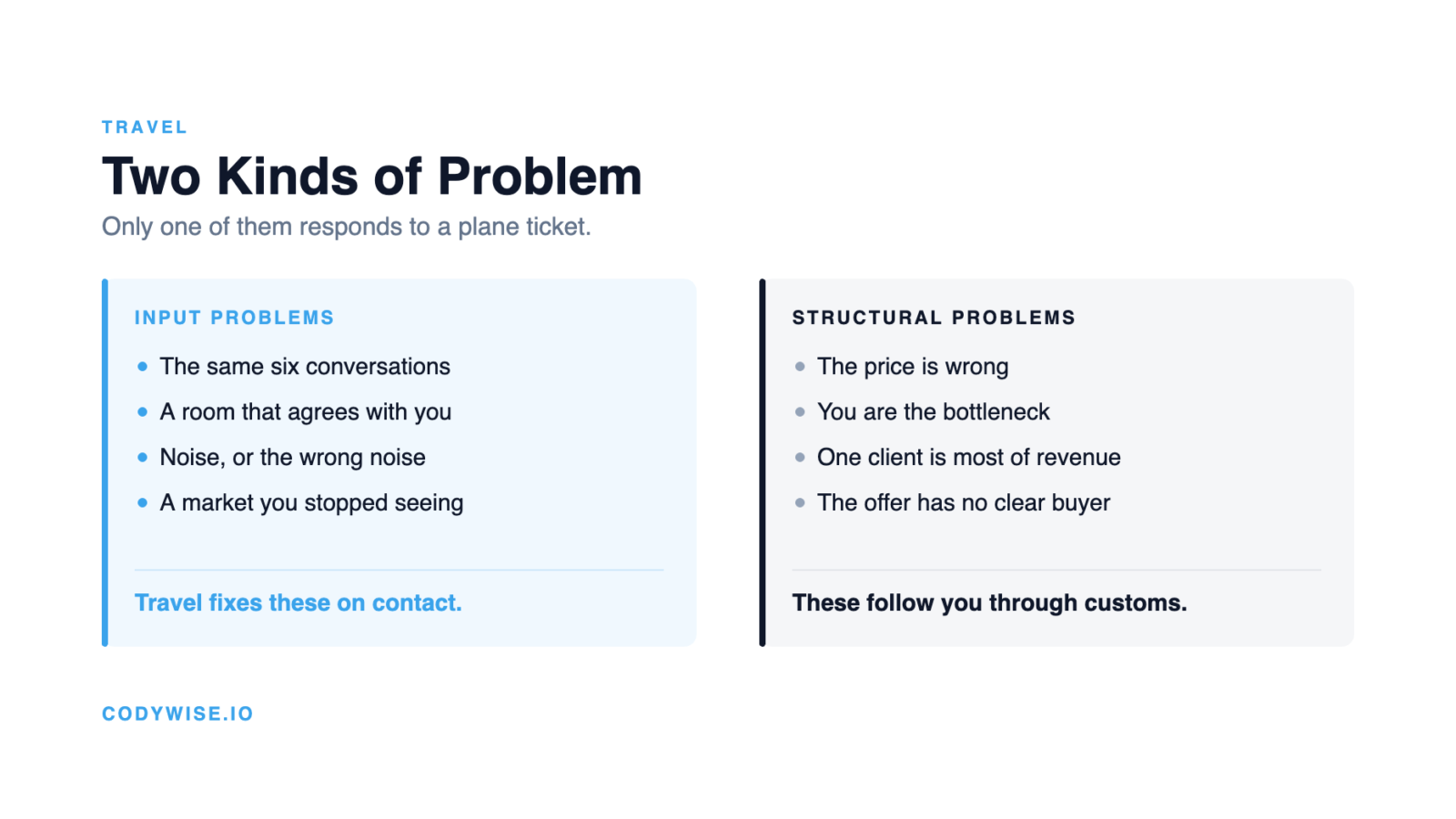
There are two categories of problem here, and travel is genuinely powerful against one and completely useless against the other.
Input problems are about what is reaching you. The same six conversations. A room where everybody already agrees with you. A market you have stopped being able to see because you are standing inside it. Too much noise, or the wrong noise entirely. Travel fixes these on contact, because new inputs are the one thing a plane reliably delivers.
Structural problems are about how the thing is built. Your price is wrong. You are the bottleneck on delivery. One client is most of the revenue, which is an option you sold without noticing you wrote it. Your offer has no clear buyer. None of that cares where you are sitting. Every one of them follows you through customs and behaves identically in better light.
A bad quarter in Calgary becomes a bad quarter in Tulum with a worse connection.

So the test before you book anything: say the problem out loud, then ask whether a different sky would touch it. If the answer is no, the trip is not a solution. It may still be a reward, and a reward is a perfectly good reason to get on a plane. It is just a different line item. Calling it strategy is how a founder lies to himself for a year at a time.
Travel as method
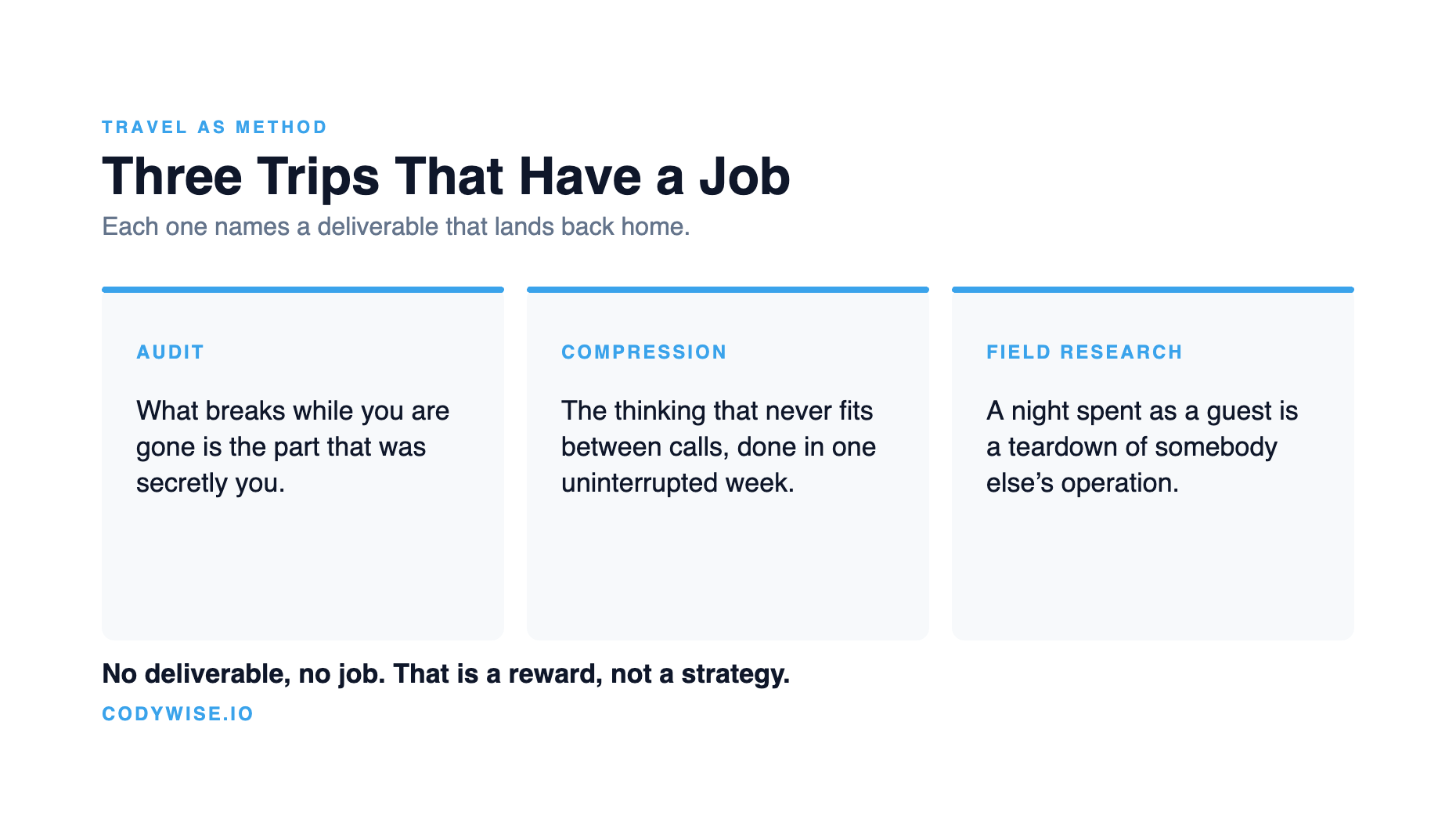
When travel is method rather than escape, it has a job written down before departure, and the job produces something that lands back home.
Leaving is the best audit a business will ever get, because absence exposes every process that was secretly you. That is one job. Compression is another, because a week outside the operating rhythm is the only reliable way I know to do the thinking that never fits between calls. Field research is a third, and in hospitality it is unavoidable: every night you spend as a guest is a teardown of somebody else’s operation, whether you meant it that way or not. Even the distance itself can be a management tool rather than a tax, if you set it up on purpose.
Each of those names a deliverable. That is the whole distinction. An instrument aimed at a business that already exists, not a substitute for building one.
What you get for staying
The part of the Rumi story nobody repeats is that he was a working professional with institutional obligations in a city he had not chosen. He was not out searching for it. He was available when it arrived, because he was there, doing the work, in one place, long enough for something to find him.
Depth is what staying pays. Reputation, a referral network that starts feeding itself, a body of published work, a team that knows how you think without being told. All of it only pays out if you are still standing in the same spot when it matures. Distribution is geography-free now. Trust never was.
You can build from anywhere. You cannot build from everywhere.
So the question is not whether to go. Go. The question is whether you are moving toward inputs you need, or away from a conversation you owe somebody.

A different sky is a beautiful thing. It has never once fixed a broken business model.