Tulum runs an hour ahead of Calgary in summer, two in winter. It is not a dramatic gap. There is no heroic story in it, no working through the night to make a call, no eighteen hours of separation to write home about. One hour. And that hour has done more to clean up how my companies operate than any software I have ever bought.
Most people treat a time difference as friction to be engineered away. They schedule around it, apologize for it, install the tool that shows everyone’s local hour in a neat row of flags. The goal is always the same: get back into the same room, just virtually.
That instinct is backwards. The gap is not the problem. The gap is the audit.
What the same room actually costs you
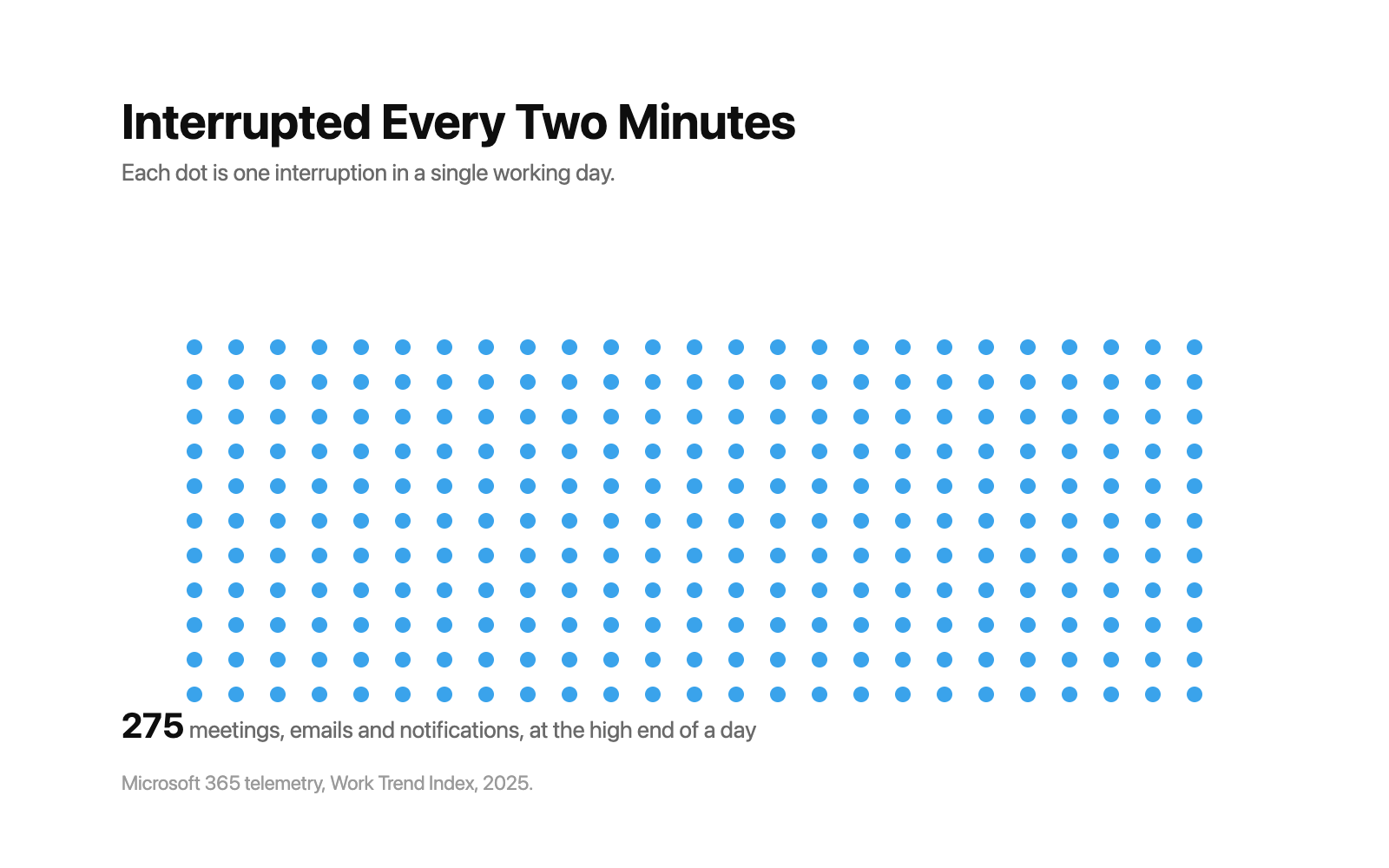
Being reachable is not free, and the size of the bill is now measured. Microsoft published telemetry from Microsoft 365 in its 2025 Work Trend Index, drawn from a survey of 31,000 knowledge workers across 31 markets. The average user is interrupted roughly every two minutes across meetings, emails and notifications. At the high end that is 275 interruptions in a single working day, against 153 Teams messages and 117 emails.
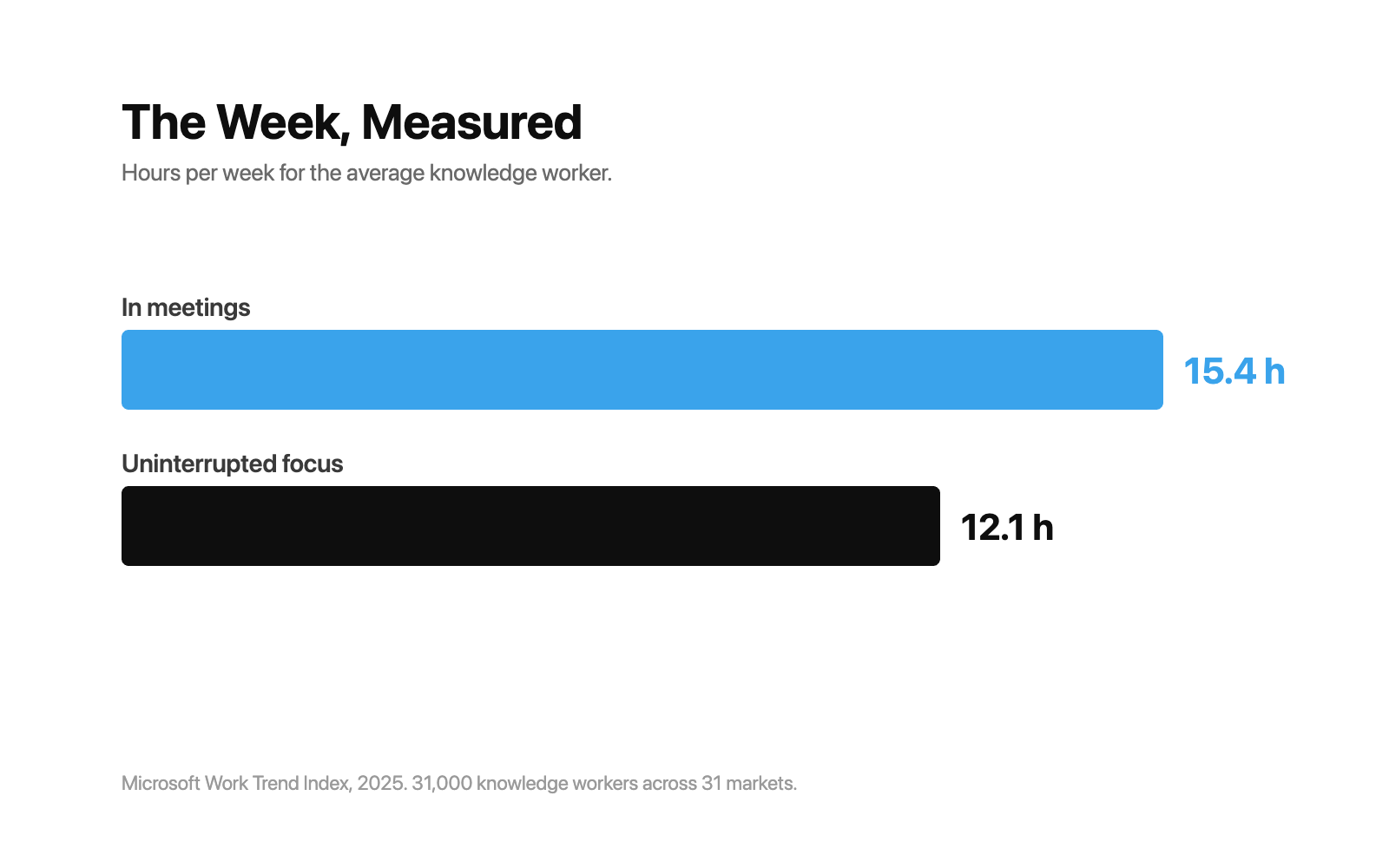
The same research puts the average week at 15.4 hours in meetings against 12.1 hours of uninterrupted focus. Meetings now outrank the work. Sixty percent of them are ad hoc, and thirty percent span multiple time zones, which is why meetings starting after eight in the evening rose sixteen percent year over year.
Forty eight percent of employees and fifty two percent of leaders describe their work as chaotic and fragmented. That is not a scheduling problem. It is what happens when availability becomes the operating system.
Availability is not a system, it just looks like one
When you are awake at the same moment as everyone who works with you, availability quietly substitutes for process. A cleaner has a question, they text, you answer in ninety seconds. A client asks for a change, you reply before they have closed the tab. It feels like responsiveness. It reads, from the inside, like being good at your job.
It is actually a business that cannot run unless you are sitting inside it.
Introduce even one hour of separation and the substitution stops working. The question arrives and you are not there to absorb it. From that point there are only two outcomes. Either the answer already exists somewhere in writing, or the work stops and waits for you.
Both outcomes are useful. One confirms the system holds. The other marks, with a timestamp, the exact place where a decision lives in your head and nowhere else.
You cannot get that information any other way. Ask your team what they need documented and they will tell you what they think you want to hear. Leave for an hour and the gaps report themselves.
The statistic everybody quotes here is not real
You have seen the claim that it takes 23 minutes and 15 seconds to recover from an interruption. It gets cited constantly. It is not in a paper. The number traces back to a 2006 Gallup interview with Gloria Mark rather than to published research, and the studies usually offered as the source do not contain it.
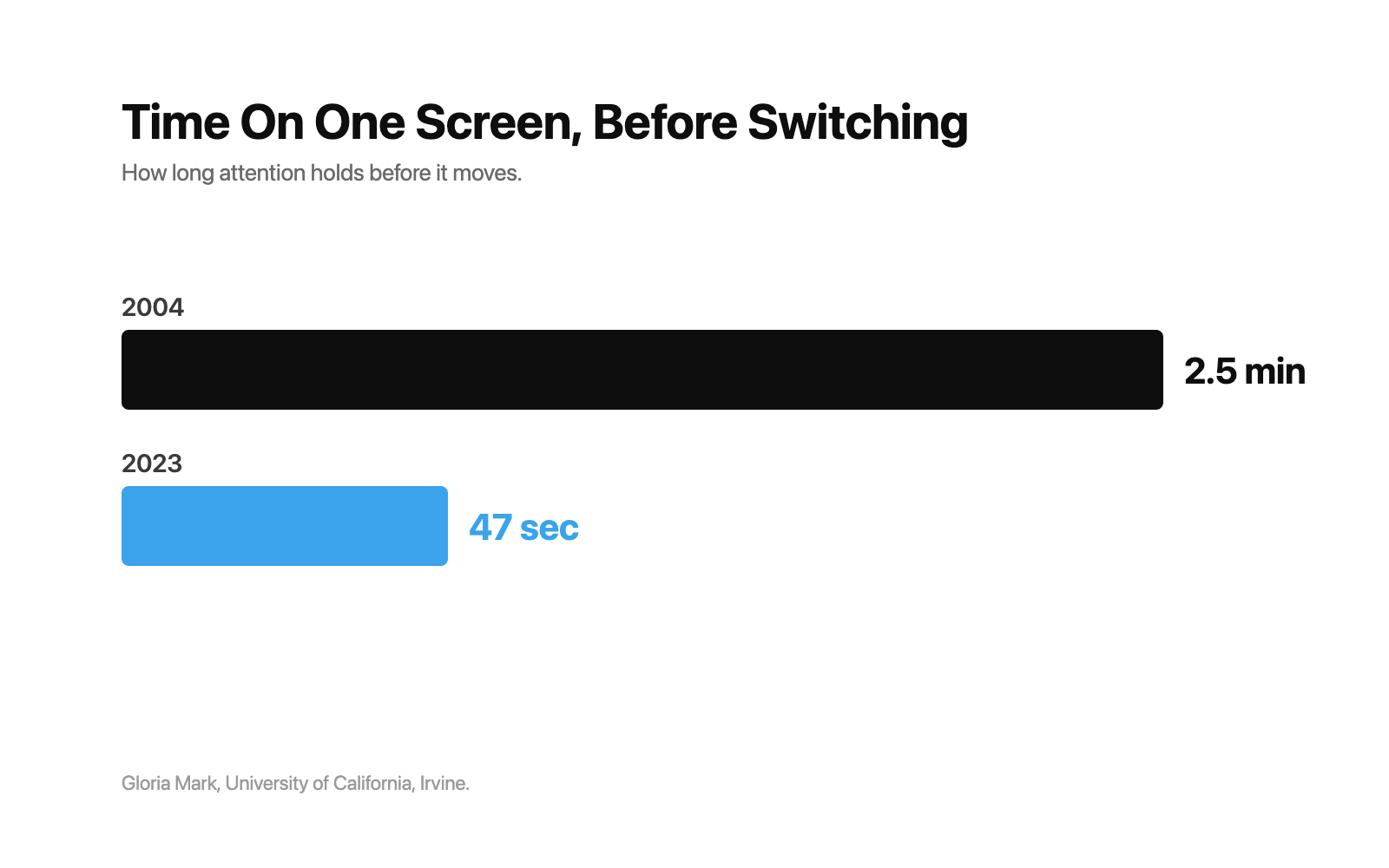
What her work at the University of California, Irvine does show is worse, and better documented. Average time on a single screen before switching fell from roughly two and a half minutes in 2004 to 47 seconds by 2023. When people are interrupted they typically handle two other tasks before returning to the original one.
I am pointing at the fake number on purpose. If your argument only works with a statistic that turns out to be invented, you did not have an argument. The real finding is enough: attention is now measured in seconds, and every question you personally absorb is spending someone else’s.
The hour does the work
I did not sit down one afternoon and decide to write an operations manual. Nobody does. What happened was that the same three questions kept arriving during a window when I could not answer them, and I got tired of watching the work stall in the same three places.
So the standards got written. What a turnover has to look like before it is called done. What counts as urgent enough to interrupt someone and what holds until morning. Who decides when a guest asks for something outside policy, and what the ceiling is on that decision before it comes to me.
None of that was strategic. It was maintenance, forced by a gap I could not talk my way around.
Seneca practiced poverty on scheduled days, plain food and rough clothes, so he could ask whether the thing he feared was actually survivable. A time zone is the same instrument, pointed at a company instead of a man. You are not testing whether you can be reached. You are testing whether the business notices when you cannot be.
Does the separation cost you output?
The honest answer is that the best available evidence says no. The largest randomised controlled trial on hybrid work followed 1,612 employees at Trip.com and was published in Nature in 2024. Half the group kept five days in the office, half moved to three. There was no measurable difference in performance reviews, promotion rates, or lines of code written. Resignations fell by 33 percent.
That study is about hybrid work rather than time zones, so I will not stretch it further than it goes. What it does retire is the assumption that physical and temporal proximity are load bearing. They are not. Process is.
You do not have to leave to do this
The mistake is assuming this only applies if you travel, that the lesson is about geography. It is not. Anyone can build the gap deliberately, from home, this week.
Block the first three hours of the day and take no messages inside them. Turn off the phone on Saturdays. Pick any window that is real and hold it. The mechanism is identical and it costs nothing but the discomfort of the first month.
What matters is that the boundary is genuine. A rule you will break the moment somebody pushes is not a boundary, it is a preference, and preferences do not produce systems. They produce a slightly more organized version of the same dependency.
The tell
Come back from the gap and count.
Forty messages and a stalled project means you did not buy a business. You bought a job with better scenery and a worse desk.
Four messages, and three decisions somebody already made correctly without you, means the thing you built actually exists independent of your attention.
Distance does not create good operations. It only reveals whether you built any.
Common questions
Does working across time zones actually hurt productivity?
Not on the evidence available. The largest randomised controlled trial on hybrid work, run on 1,612 Trip.com employees and published in Nature in 2024, found no effect on performance reviews, promotion rates or lines of code written, while resignations fell by 33 percent. Separation is not the variable that breaks output. Undocumented process is.
How much time do knowledge workers actually lose to interruptions?
Microsoft 365 telemetry published in the 2025 Work Trend Index shows the average user is interrupted roughly every two minutes during the working day, up to 275 times, across meetings, emails and notifications. The same research puts the average week at 15.4 hours in meetings against 12.1 hours of uninterrupted focus.
Is it true that it takes 23 minutes to refocus after an interruption?
That figure is not supported by a published paper. It traces to a 2006 Gallup interview rather than to peer-reviewed research, and the studies usually cited for it do not contain the number. What is measured is that average time on a single screen fell from about 2.5 minutes in 2004 to 47 seconds in 2023, and that workers typically handle two intervening tasks before returning to the original one.
Do I need to travel or relocate to get this benefit?
No. The mechanism is the enforced gap, not the geography. Blocking the first three hours of the day, or a full day each week, produces the same diagnostic effect. What matters is that the boundary holds when someone pushes against it.
What should I document first?
Whatever question arrives most often during the window when you are unavailable. The gap surfaces the ranking for you. In short-term rental operations that is usually the turnover standard, the urgency threshold, and the spending ceiling below which someone else decides.