Zcash is up roughly 133% in thirty days and crossed $1,000 for the first time since 2016, driven by the first US spot ETF for a privacy coin. Two days ago a Solana memecoin called ZCAT launched priced against ZEC instead of SOL, paid holders in ZEC, and ran to a $135 million market cap. The first is an institutional flow story. The second is a structural change in how tokens can launch, and almost nobody is talking about that part.
Summary
- ZEC trades near $1,193 with a market cap around $20.2 billion, up 12% in a day, 42.7% in a week and 133.6% in thirty days.
- The catalyst is the Grayscale Zcash ETF, ticker ZCSH, which began trading on NYSE Arca on August 25, 2026. It is the first US spot ETF for a privacy coin.
- Roughly $34.4 million of net inflows since launch, with a $12.6 million single day on September 2, plus a short squeeze reported around $45 million.
- ZCAT launched September 5, 2026 and became briefly the second largest cat-themed memecoin, behind CASHCAT.
- The mechanism worth understanding: ZCAT is quoted against ZEC, not SOL or USDC, and distributes transfer fees to holders in ZEC.
- That makes it a leveraged, reflexive bet on the ZEC narrative rather than an independent meme. When ZEC stops moving, the yield and the story both stop.
- Three separate Solana addresses are circulating under the name Anonymous Cat. Major data sources quote its market cap anywhere between $65 million and $143 million at the same moment. Verify the contract before doing anything.
- Pool liquidity is around $1.9 million against a quoted market cap north of $140 million. That ratio is the single most important number in this article.
- Figures below were captured September 7, 2026. They will be wrong soon.
Table Of Contents
- The Numbers, Dated
- Why ZEC Actually Moved
- The Structural Change Nobody Is Naming
- What ZCAT Actually Is
- The Numbers Do Not Agree, And That Is The Story
- The Risk That Is Not Being Priced
- How I Frame This Kind Of Trade
- Frequently Asked Questions
- The Bottom Line
The Numbers, Dated
Everything here is a snapshot from September 7, 2026. In this corner of the market a week-old number is archaeology, so treat the figures as a timestamp rather than a level, and check live data before acting on any of it.
| Zcash (ZEC) | |
|---|---|
| Price | ~$1,193 |
| Market cap | ~$20.2B, rank 9 |
| 24 hour | +12.3% |
| 7 day | +42.7% |
| 30 day | +133.6% |
| 24 hour volume | ~$1.91B |
| Circulating supply | 16.92M of 21M max |
| All-time high | $3,191.93, October 28, 2016. Still about 63% below it |
| Anonymous Cat (ZCAT) | |
|---|---|
| Chain | Solana, trading on Raydium |
| Launched | September 5, 2026 |
| Quote asset | ZEC, not SOL or USDC |
| Price | $0.073 to $0.147 depending which source you ask |
| Market cap | $65M to $143M depending which source you ask |
| 24 hour | Reported anywhere from +75% to +427% |
| Pool liquidity | ~$1.9M |
| All-time high | $0.1755, September 7, 2026 |
| All-time low | $0.02244, September 5, 2026 |
| Supply | ~969M circulating of 1B max |
Read those two tables together. ZEC has a low and a high that are ten years apart. ZCAT’s are two days apart, and the low is a sixth of the high. That is the entire difference in risk profile, stated in four numbers, before anyone opens a chart.
You will also notice the ZCAT rows do not contain single numbers. That is not sloppiness on my part. It is the finding, and the next section is about it.
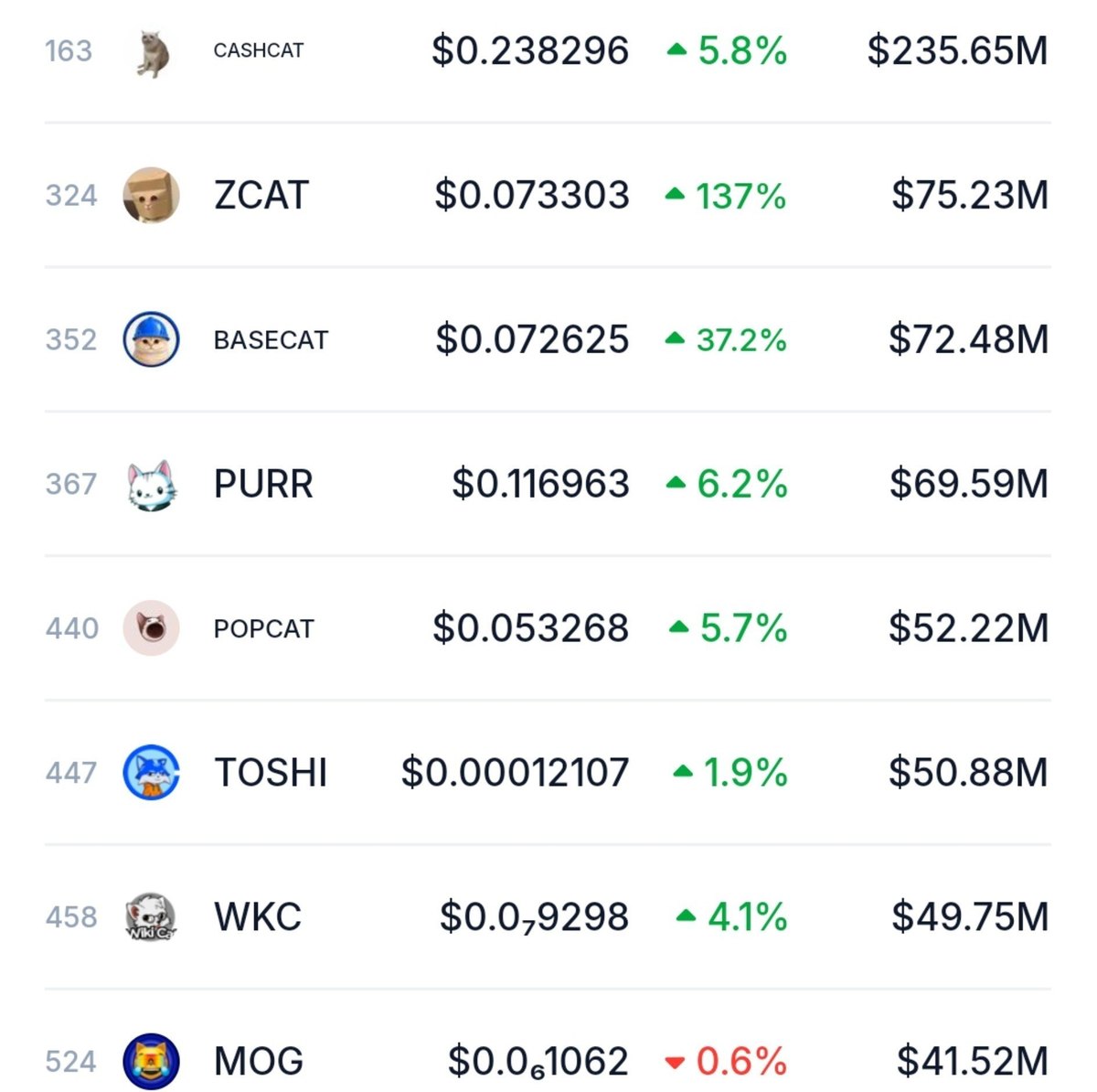
That screenshot is a picture, so here are the same numbers as text. Search engines, screen readers and answer engines cannot read a table trapped inside an image, and this ordering is the single clearest evidence for what is actually happening.
| Rank | Token | Price | 24h | Market cap |
|---|---|---|---|---|
| 163 | CASHCAT | $0.238296 | +5.8% | $235.65M |
| 324 | ZCAT | $0.073303 | +137% | $75.23M |
| 352 | BASECAT | $0.072625 | +37.2% | $72.48M |
| 367 | PURR | $0.116963 | +6.2% | $69.59M |
| 440 | POPCAT | $0.053268 | +5.7% | $52.22M |
| 447 | TOSHI | $0.00012107 | +1.9% | $50.88M |
| 458 | WKC | $0.000000093 | +4.1% | $49.75M |
| 524 | MOG | $0.00000011 | -0.6% | $41.52M |
Now read the 24 hour column, because it says something the headline does not.
ZCAT is up 137%. BASECAT is up 37%. Every other cat token on the board is between negative 0.6% and positive 6.2%. CASHCAT, the largest of them at $235 million, moved 5.8%.
So this is not a cat meta. There is no sector rotation into cat-themed tokens happening here. Eight coins in the same category, six of them flat, one up 137%. That is a single-token event with a specific cause, and the cause is the ZEC pairing plus the attention it bought.
This matters for how you read the trade. If the whole category were bid, you could argue a rotation was underway and ZCAT was the highest-beta way to play it. It is not. ZCAT is running alone on a mechanic and a narrative, which means when either fades there is nothing underneath it. A token moving with its sector has company on the way down. A token moving alone does not.
One more thing worth flagging: the ZCAT price in this table is $0.073303. That is roughly half what CoinGecko and DEX Screener showed in the same window. Which brings us to the next section.
Why ZEC Actually Moved
Four things stacked, in this order. The order matters, because it tells you which part is durable.
1. The ETF
Grayscale’s Zcash ETF, ticker ZCSH, began trading on NYSE Arca on August 25, 2026. That is the first US spot ETF for a privacy coin, which means a regulated wrapper now exists for an asset class that American institutions previously had no compliant way to touch.
Net inflows have been reported around $34.4 million since debut, with a single-day high of $12.6 million on September 2. Those are not enormous numbers against a $20 billion market cap. What matters is not the size of the flow, it is that the channel now exists and did not before. New buyer categories are structural. Momentum is not.
2. The Squeeze
Reporting points to roughly $45 million in short liquidations around the move. Privacy coins had been a comfortable structural short for years on the assumption that regulators would eventually strangle them. An ETF approval is the single cleanest refutation of that thesis, and positioning had to unwind fast.
Squeezes produce the steepest part of any candle and none of the durability. Do not confuse the two.
3. Derivatives Piling In
ZEC futures volume was reported around $6.38 billion, up roughly 114%, with open interest up about 35% to $2.16 billion. Rising open interest into a rising price means new leveraged longs, not just shorts closing.
That is the part that cuts both ways. The same leverage that accelerated the move up is what makes the retrace violent when it comes.
4. The Technical Break
ZEC spent months consolidating and broke through the $700 to $800 band, then $900, then $1,000. Miners followed the price: network solrate went from about 25 GSol/s in late August to over 30 GSol/s, and per-unit miner revenue fell roughly 3% as a result. Hashrate chasing price is a lagging confirmation, not a leading one.
Of those four, only the first is structural. The ETF changes who is allowed to buy. Everything else is positioning, and positioning reverses.
The Structural Change Nobody Is Naming
Here is the part of this story that will still matter in a year, long after ZCAT is a chart nobody opens.
Almost every Solana token in history launched paired against SOL or USDC. That was not a design choice, it was a default. The launchpads only supported those quote assets, so every new token was, mechanically, a bet expressed in SOL terms.
ZCAT launched paired against ZEC. Custom quote assets are now supported, which means a creator can denominate a new token in whatever asset the narrative is actually about.
Think about what that unlocks. A meme is no longer just a meme. It becomes a leveraged, high-beta expression of a specific parent asset’s thesis, with the parent asset sitting in the liquidity pool. If you believe the privacy narrative, you can now buy the narrative at 10x the volatility, denominated in the thing you believe in, and get paid in it while you wait.
That is a genuinely new primitive. Whether it is good for anyone is a separate question, and I would argue it mostly is not, for reasons in the risk section. But structurally it is the most interesting thing that happened this week, and the coverage is all price screenshots.
What ZCAT Actually Is
Anonymous Cat. A cat in a paper bag. Launched September 5, 2026 on Solana.
Two mechanics define it, and both are more interesting than the artwork.
It is quoted in ZEC. The pool pairs ZCAT against Zcash rather than SOL. So the token’s price is structurally tethered to the asset whose narrative it is riding.
It pays holders in ZEC. Transfer fees are continuously distributed to holders as Zcash. That is a hold-to-earn design where the yield is denominated in a real asset with a real market, not in more of the meme token itself.
That second mechanic is the interesting one, because it inverts the usual memecoin problem. Most reflexive token designs pay you in the token, which means the yield evaporates precisely when you want to realise it. Paying in ZEC means the yield is separable from the token’s own price.
It went from a $0.02244 low on launch day to $0.1755 two days later, briefly becoming the second largest cat-themed memecoin by market cap, and it got the usual accelerant of large accounts posting the ticker. None of that is a fundamental. It is a distribution event.

For context on where this sits in the wider category, I keep a live table of the largest Solana memecoins with written breakdowns of each at Solana Memecoins. ZCAT is two days old and is not on it. That is deliberate.
The Numbers Do Not Agree, And That Is The Story
I went to write this piece with a single market cap figure. I could not get one. Checking four sources within the same window produced four different answers.
| Source | Price | Market cap | 24h move |
|---|---|---|---|
| Aggregator screenshot | $0.073303 | $75.23M | +137% |
| CoinGecko | $0.1400 | $135.4M | +75.7% |
| DEX Screener, pool page | $0.1472 | $142.6M | +427% |
| DEX Screener, listing title | $65.56M |
A spread of roughly $65 million to $143 million on the same asset at the same time is not normal noise. There are two explanations and both matter.
There Is More Than One ZCAT
At least three distinct Solana addresses are indexed under the name Anonymous Cat across major venues. CoinGecko lists one contract. Phantom lists a different one. Coinbase’s price page lists a third, whose address ends in the suffix typical of a pump.fun launch.
I am not going to tell you which is canonical, because I cannot verify it and neither can most people posting the ticker. What I will tell you is that a name collision at this scale is the exact condition copycat tokens are designed to exploit. When a ticker trends, clones launch within minutes and get indexed by aggregators that check the symbol, not the provenance.
If you are going to touch this, get the contract address from the pool that actually has the liquidity, paste it into the swap yourself, and ignore every ticker symbol you see. That is not general caution, it is the specific failure mode here.
The Liquidity Ratio Is The Real Number
Pool liquidity sits around $1.9 million. Against a quoted market cap of roughly $142 million, that is about 1.3%.
Market cap is price multiplied by supply. It is not money in the building. The only figure that tells you what can actually exit is the depth of the pool, and here it is one and a third cents on the dollar of the headline number. A holder trying to sell one percent of the notional is moving the price against themselves the entire way down.
That is also why the sources disagree. When depth is that thin, price is whatever the last trade said, and different snapshots catch different last trades. The disagreement between aggregators is not a data problem. It is the thinness expressing itself.
One more detail from the pool page worth stating plainly: the project maintains no official social media presence. Combine that with three contracts and 1.3% depth and you have the full picture without needing an opinion about the mascot.
The Risk That Is Not Being Priced
Four specific things, none of which show up in a green candle.
1. The Correlation Is The Product
Being quoted in ZEC is sold as a feature. It is also a single point of failure. If ZEC retraces, ZCAT takes the ZEC drawdown and its own drawdown simultaneously, in the same direction, with no diversification anywhere in the structure. Correlated leverage is the thing that liquidates people.
2. The Yield Depends On The Churn
Fee-distribution tokens pay out of transfer volume. Transfer volume is highest during the launch frenzy and collapses afterward. So the advertised yield is at its maximum on the day it is least meaningful, and decays toward zero exactly as the holders who bought for yield start checking it. Anyone modelling current distribution rates forward is modelling the peak of a curve as if it were a line.
3. Two Days Of History
There is no holder distribution history, no test of what happens when early wallets exit, and no observed behaviour in a drawdown. A token that has only ever gone up has not been tested, it has just been lucky about timing. The wider category has an ugly record here: a separate Solana cat token drew accusations of team hacking and price manipulation, and that pattern is common enough that it should be assumed until disproven, not the reverse.
4. The ZEC Move Itself Is Mostly Positioning
Go back to the four drivers. One is structural, three are positioning. If the ETF flow stays modest and the squeeze is done, the leverage that carried ZEC from $700 to $1,193 unwinds against it. ZCAT is a levered claim on the durability of a move that is itself substantially levered.
How I Frame This Kind Of Trade
My published allocation has three buckets: crypto as the base position, equities for market exposure, and a small memecoin allocation sized to be written off. That third phrase is not a joke and it is not humility. It is a position-sizing rule that removes the need to be right.
The reason it works is that it kills the two failure modes that actually cost people money in this category. You do not average down into a dying token, because there was never enough there to defend. And you do not sell your base position to chase a two-day chart, because the memecoin bucket is capped by rule rather than by conviction.
The distinction I would draw between these two assets is not which one is better. It is that they are different instruments requiring different decisions.
| ZEC | ZCAT | |
|---|---|---|
| What it is | A ten year old protocol with a regulated US wrapper | A two day old token with a fee mechanic |
| What drives it | Institutional access plus positioning | Attention plus the ZEC narrative |
| Time horizon | Measured in quarters | Measured in days |
| Worst case | Deep drawdown, asset persists | Goes to approximately zero |
| Correct question | Does regulated privacy demand compound? | Am I sized to lose all of this? |
Two different questions. Answering the second one with the first one’s reasoning is how people end up with a memecoin position they are emotionally defending. More on reading past the headline number in Read The Cap, Not The Headline.
Frequently Asked Questions
Why is Zcash going up right now?
Primarily the Grayscale Zcash ETF, ticker ZCSH, which began trading on NYSE Arca on August 25, 2026 as the first US spot ETF for a privacy coin. Around $34.4 million of net inflows followed, alongside roughly $45 million in short liquidations, futures volume up about 114%, and a technical break above the $700 to $800 consolidation band. As of September 7, 2026 ZEC trades near $1,193, up 133.6% in thirty days.
What is ZCAT?
Anonymous Cat, a privacy-themed cat memecoin launched on Solana on September 5, 2026. Two things make it unusual: it is quoted against ZEC rather than SOL or USDC, and it distributes transfer fees to holders in ZEC. As of September 7, 2026 it trades near $0.14 with a market cap around $135 million.
Is ZCAT related to Zcash officially?
It is thematically inspired by Zcash and mechanically tied to ZEC through its trading pair and its fee distributions. Treat it as an independent Solana token that references Zcash, not as anything issued or endorsed by the Zcash project, unless the Zcash side says otherwise directly.
Why do different sites show different ZCAT prices?
Two reasons. At least three separate Solana addresses are indexed under the name Anonymous Cat across CoinGecko, Phantom and Coinbase, so some sites are quoting different tokens. And pool liquidity is only around $1.9 million against a market cap quoted north of $140 million, so price is whatever the last trade said and snapshots taken minutes apart diverge. Verify the contract address from the pool that holds the liquidity rather than trusting the ticker symbol.
What does it mean that a token is paired against ZEC instead of SOL?
The quote asset is what the token is priced in and what sits on the other side of the liquidity pool. Historically Solana launches defaulted to SOL or USDC. Custom quote assets let a creator denominate a token in whichever asset the narrative is about, which turns the token into a higher-volatility expression of that asset’s thesis rather than an independent bet.
Has Zcash reached a new all-time high?
No. ZEC’s all-time high is $3,191.93, set on October 28, 2016. At roughly $1,193 it remains about 63% below that level, despite trading at an eight year high.
The Bottom Line
ZEC’s move is one structural change wrapped in three layers of positioning. The ETF is real and permanent. The squeeze, the leverage and the momentum are not, and they are doing most of the work in the price right now.
ZCAT is the more interesting object and the worse asset. The custom quote asset mechanic is a real innovation that will get copied across every narrative on Solana within a month. The specific token expressing it is two days old, correlated by design to something that has already run 133%, paying a yield that structurally decays from here, sharing its name with at least two other contracts, and backed by $1.9 million of depth against a nine-figure headline valuation.
The useful takeaway is not a call on either. It is that the mechanism is now the thing to watch. When a launchpad changes what a token can be denominated in, it changes what memecoins are for. That outlives every chart on this page.
This article is informational and is not investment advice. I am not a financial advisor. All figures were captured on September 7, 2026 from public market data and will be out of date quickly. Crypto assets, and memecoins in particular, are extremely volatile and can go to zero. Verify every number against live sources and never risk money you cannot afford to lose entirely.
Where I Track This
Live tables and written breakdowns for the largest tokens in this category sit under Solana Memecoins and Crypto. The full allocation logic is under Investing.