Zcash crossed a $23 billion market cap on September 16, 2026, after coinholders voted overwhelmingly to cut block times from 75 seconds to 25. ZEC trades near $1,365, up 23.3% on the day, now the tenth largest crypto asset. The vote does not change issuance, the halving rhythm or the 21 million cap. What it changes is throughput, and what it proves is turnout.
Summary
- 99.9% backed cutting block time from 75 seconds to 25 seconds.
- 98.9% voted to keep Bitcoin-style halvings and rejected a smoothed issuance curve.
- Turnout was ~2.4 million ZEC of ~3.6 million eligible, about 67%. February’s poll drew 7.25% of circulating supply.
- The economics are unchanged. ZIP 218 cuts the per-block subsidy and extends the halving interval in blocks. Same daily issuance, same 21 million cap.
- Shielded throughput goes from an estimated 2.9 TPS to 6.6 TPS. Light-wallet sync drops from ~271 MB to ~169 MB a day.
- The polls are advisory. Nothing has shipped. The features still need building, testing and consensus activation.
- ZEC is at a multi-year high and still roughly 57% below its 2016 all-time high of $3,191.93.
Table Of Contents
- Where ZEC Actually Is
- What Was Voted On
- The Economics Did Not Change
- What Genuinely Changes
- The Turnout Is The Story
- Three Things To Be Careful About
- What I Am Watching
- Frequently Asked Questions
- The Bottom Line
Where ZEC Actually Is
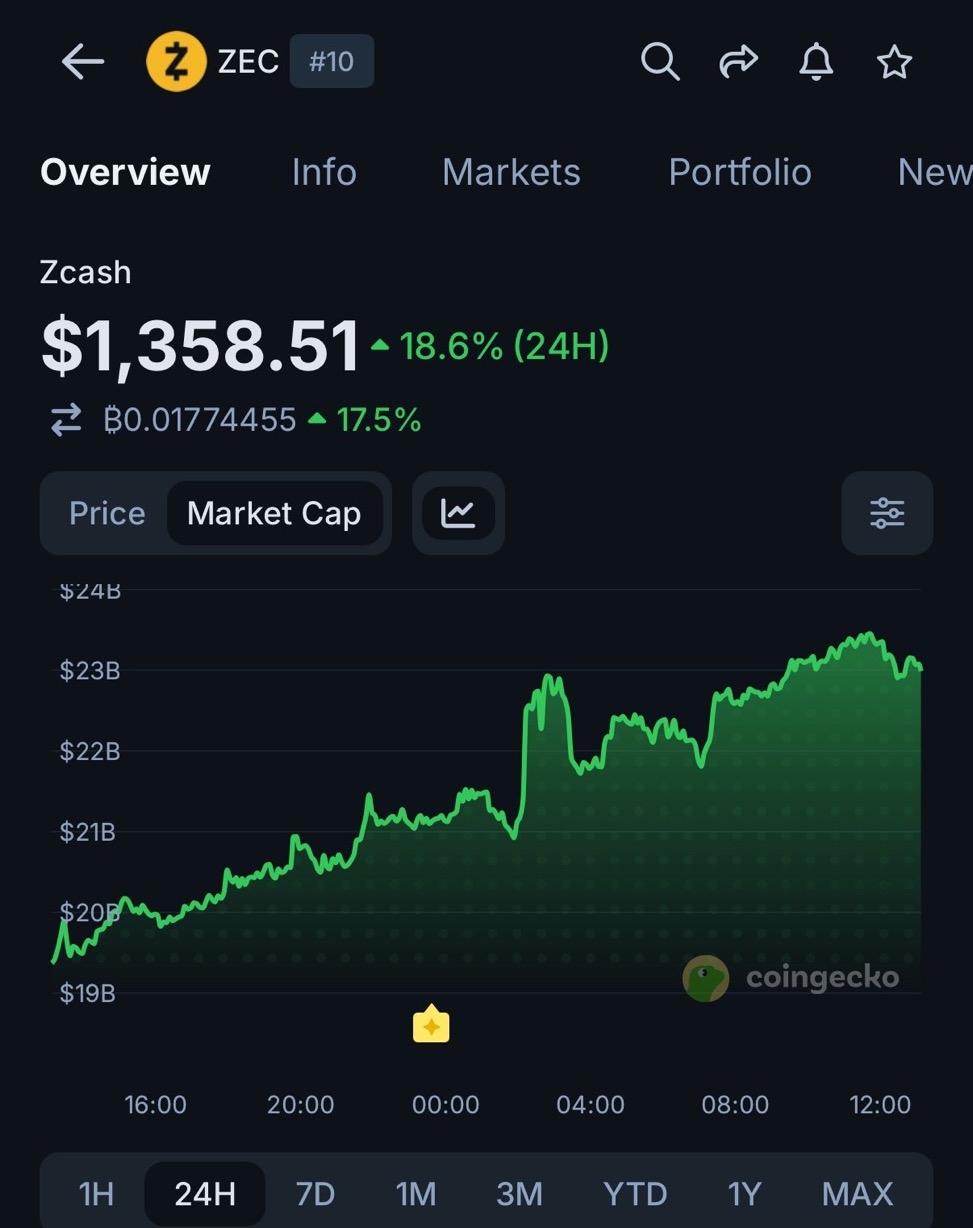
Live ZEC chart: TradingView or CoinGecko. The figures above are timestamped to September 17, 2026.
| Metric | Value |
|---|---|
| Price | $1,365.27 |
| 24 hour change | +23.3% |
| 7 day change | +10.8% |
| Market cap | $23.135B |
| Rank | #10 |
| 24 hour volume | $2.467B |
| 24 hour range | $1,101.78 to $1,374.45 |
| Circulating supply | 16.934M of 21M |
| All-time high | $3,191.93, October 28, 2016 |
Two weeks ago I wrote about why Zcash was ripping when it first crossed $1,000. The argument then was that the Grayscale spot ETF was the structural driver and the rest was positioning. That has held up. ZEC has since taken the number ten slot, and over 30% of supply now sits in shielded addresses, an all-time high.
Worth keeping in frame: this is a multi-year high, not an all-time high. ZEC peaked at $3,191.93 in October 2016. At $1,365 it is still around 57% below that.
What Was Voted On
This was the NU7 coinholder poll. Only ZEC held in the Ironwood shielded pool was eligible. Ballots were encrypted and split into sixteen pieces, which is a reasonable flex for a privacy chain running a public vote.
| Question | Result | What It Means |
|---|---|---|
| Cut block time to 25 seconds | 99.9% for | Down from 75 seconds, three times the block rate |
| Keep Bitcoin-style halvings | 98.9% for | Rejected a smoothed, gradual issuance taper |
| Ship NU7 as soon as possible | 99.3% for | Against a September 30 readiness deadline |
| Disable Sprout transactions | 99.3% for | Retires the oldest shielded pool |
| Delay NSM reissuance to Feb 2031 | 96.6% for | Pushes back recycling of removed coins |
The Economics Did Not Change
This is the part that gets mangled in the headlines, and it is the part that matters if you hold the asset.
Faster blocks do not mean more coins. ZIP 218 reduces the subsidy attached to each block and extends the halving interval when that interval is measured in blocks. Three times as many blocks, roughly one third the reward each. Daily issuance is approximately unchanged. The four-year halving rhythm is unchanged. The 21 million cap is unchanged. The next halving is still expected in late 2028.
So if you are reading a 23% daily move as the market repricing Zcash’s monetary policy, the monetary policy did not move. Voters were offered a smoothed issuance curve, which would have been a genuine change, and rejected it 98.9% to the contrary.
That rejection is itself the signal. Given the option to make Zcash’s supply schedule gentler and more modern, holders chose to stay maximally Bitcoin-shaped. A privacy coin competing for the store-of-value conversation has an obvious reason to keep the halving narrative intact.
What Genuinely Changes
Two things, and both are usability rather than monetary.
- Shielded throughput. Estimated to go from about 2.9 transactions per second to about 6.6 for common two-action Orchard transactions. Roughly 2.3 times.
- Light-wallet sync cost. Worst-case bandwidth drops from around 271 MB per day to around 169 MB, because the proposal caps how many shielded actions a block can contain.
That second one is underrated. The practical barrier to privacy-coin adoption has never been ideology, it has been that shielded wallets are slow and heavy to sync. Cutting a third off daily sync bandwidth does more for real usage than a price candle does.
Faster confirmations mostly help smaller payments and exchange deposits, where a service waits for a fixed number of confirmations before crediting. Three times the block rate means that wait shrinks proportionally.
The Turnout Is The Story
Everyone is quoting 99.9%. A near-unanimous result is not interesting on its own, because unanimity usually means nobody showed up or nobody disagreed. Here is the number that is interesting.
| Poll | Participation |
|---|---|
| February 2026 | 7.25% of circulating supply |
| NU7, September 2026 | ~2.4M of ~3.6M eligible ZEC, about 67% |
| Minimum threshold for a representative result | 1M ZEC |
Turnout went up roughly nine times, and cleared the representativeness threshold more than twice over. That is a governance result, not a feature result. A chain that can get two thirds of its eligible stake to vote on a technical upgrade has something most chains do not, and it did it through an encrypted, split-ballot mechanism rather than a show of hands.
If you want an argument for why ZEC deserves a re-rating, that is a better one than 25-second blocks. Capable governance is a durable asset. A block time is a parameter.
Three Things To Be Careful About
The Polls Are Advisory
They do not change the network. The selected features still have to be implemented, tested and folded into the upgrade, then activated through the ZIP process. No activation date has been published. Treat this as a strong mandate, not a shipped feature.
The Electorate Was Self-Selected
Only ZEC in the Ironwood shielded pool could vote. Those are, almost by definition, the holders most committed to the shielded roadmap. 99.9% of a constituency that opted into the privacy pool is not the same as 99.9% of all holders, and the gap is not measurable from here.
A 23% Day Is Not A Thesis
ZEC traded a 24 hour range of $1,101.78 to $1,374.45. That is a 25% band in a single session. Moves that size cut both ways and they liquidate people in both directions. The structural case here is the ETF channel and the shielded-supply trend, both of which I wrote about two weeks ago. The vote is a catalyst layered on top, and catalysts fade faster than channels.
What I Am Watching
- Whether NU7 actually ships. The mandate is 99.3% for speed. The test is whether implementation matches it.
- Shielded supply share. Over 30% and at an all-time high. That trend is the real adoption metric, not price.
- ETF flows. The regulated channel is the structural driver. If inflows stall while price holds, the move is positioning.
- Realised throughput after activation. 2.9 to 6.6 TPS is an estimate. Estimates and mainnet disagree regularly.
- Whether the halving narrative gets used. Late 2028 is far away, and a coin that just voted to keep halvings will be marketed on them.
Frequently Asked Questions
Does the Zcash vote change ZEC’s supply or halving schedule?
No. ZIP 218 cuts the per-block subsidy and extends the halving interval measured in blocks, so three times as many blocks each carry roughly one third the reward. Daily issuance, the roughly four-year halving rhythm and the 21 million cap all stay the same. The next halving is still expected in late 2028. Voters were offered a smoothed issuance curve as an alternative and rejected it with 98.9% backing halvings.
Is the NU7 vote binding?
No. These are advisory coinholder polls. They signal community preference but do not alter the network. The chosen features still require implementation, testing and formal consensus activation through the ZIP process, and no activation date has been announced.
What do 25-second blocks actually improve?
Confirmation speed and shielded capacity. Block time drops from 75 seconds to 25, tripling block frequency. Shielded throughput is estimated to rise from about 2.9 to about 6.6 transactions per second for common two-action Orchard transactions, and worst-case light-wallet sync bandwidth falls from roughly 271 MB to 169 MB per day because of new per-block limits on shielded actions.
Is ZEC at an all-time high?
No. ZEC is at a multi-year high near $1,365 with a $23.1 billion market cap and a number ten ranking, but its all-time high is $3,191.93 set on October 28, 2016. Current price is roughly 57% below that level.
The Bottom Line
A $23 billion market cap and a top ten slot are real. The vote behind the move is more modest than the headline suggests: it speeds up blocks, leaves the money supply exactly where it was, and has not shipped.
The durable finding is that two thirds of eligible stake turned out, against 7.25% seven months earlier, through an encrypted ballot on a privacy chain. Most networks cannot organise that. When a governance system suddenly works, that is worth more than the parameter it happened to change.
The operator version of the same lesson: a decision that gets near-unanimous support from two thirds of the people who have to live with it is not really about the decision. It means you built the mechanism for making decisions before you needed it. Most teams try to build that mechanism during the argument, which is exactly when it cannot be built.
This is analysis, not financial advice. I am not a licensed financial advisor. Figures are timestamped because crypto data moves within hours. Verify before acting.