
Wisdom
Around 530 BC a man arrived in Croton, on the Calabrian coast of southern Italy, and opened a school with an unusual entrance requirement. New students were not permitted to speak. Not for a week, and not for a term. The ancient biographers say five years.
The silence was not a test of obedience. It was a test of whether you could stand not being interesting.
Start with the caveat, because the history deserves one. Pythagoras left no writings of his own. Almost everything we have comes from Iamblichus and Diogenes Laertius, both writing seven or eight centuries after the fact, and they do not fully agree with each other. Aulus Gellius describes a graded probation with a shorter minimum. Treat the number five as tradition, not as a receipt.
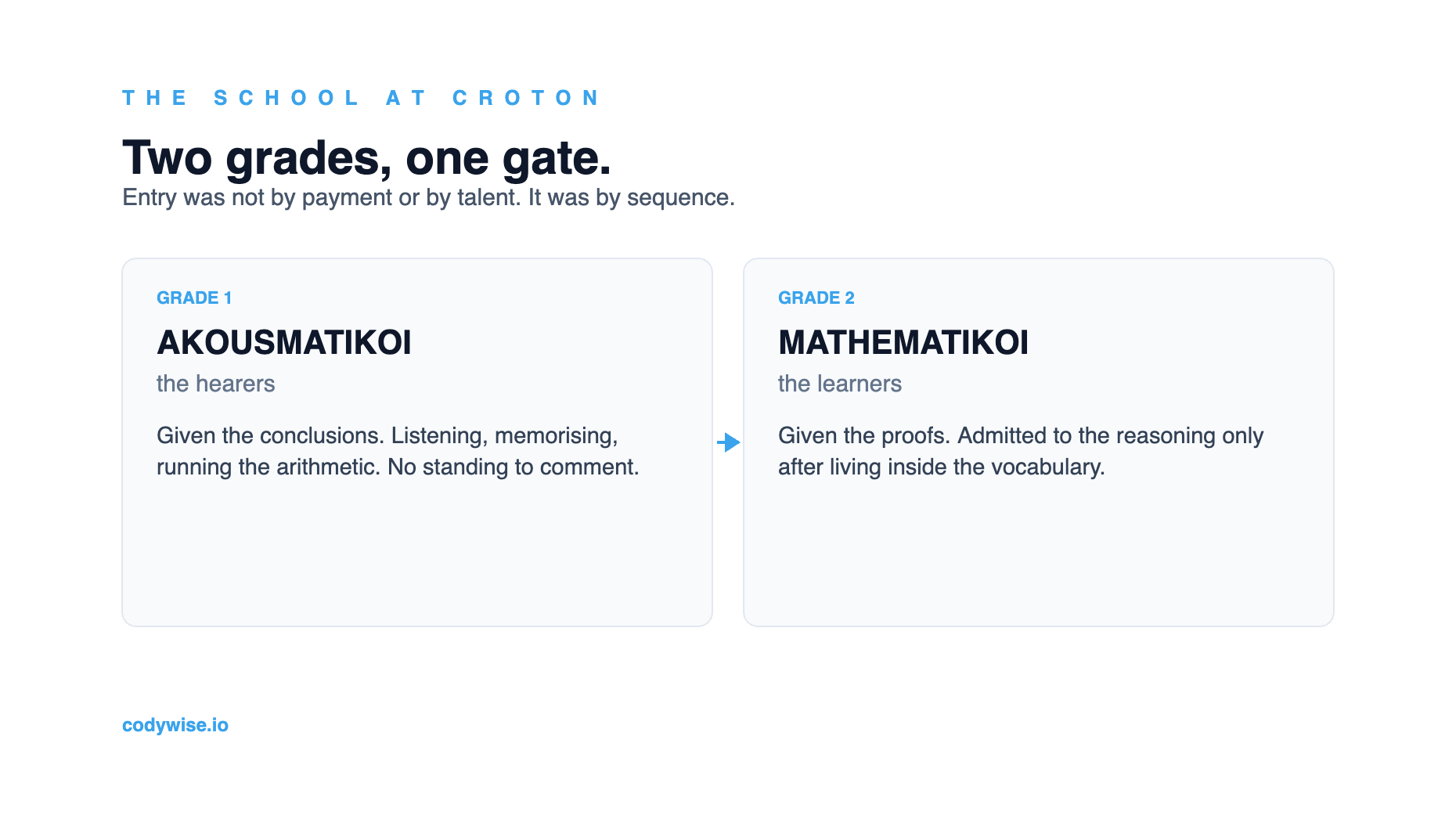
What survives consistently across the accounts is the structure, and the structure is the part worth stealing. The school ran two grades. The akousmatikoi, the hearers, were given the conclusions. The mathematikoi, the learners, were given the proofs. You did not get the reasoning until you had lived inside the vocabulary long enough to be capable of judging it.
Read that as mysticism and it sounds like a cult. Read it as operations and it is quality control. A school with no gate on speech fills up with people who acquire opinions faster than they acquire information, and then the school becomes an argument instead of a discipline.
The price of an early opinion
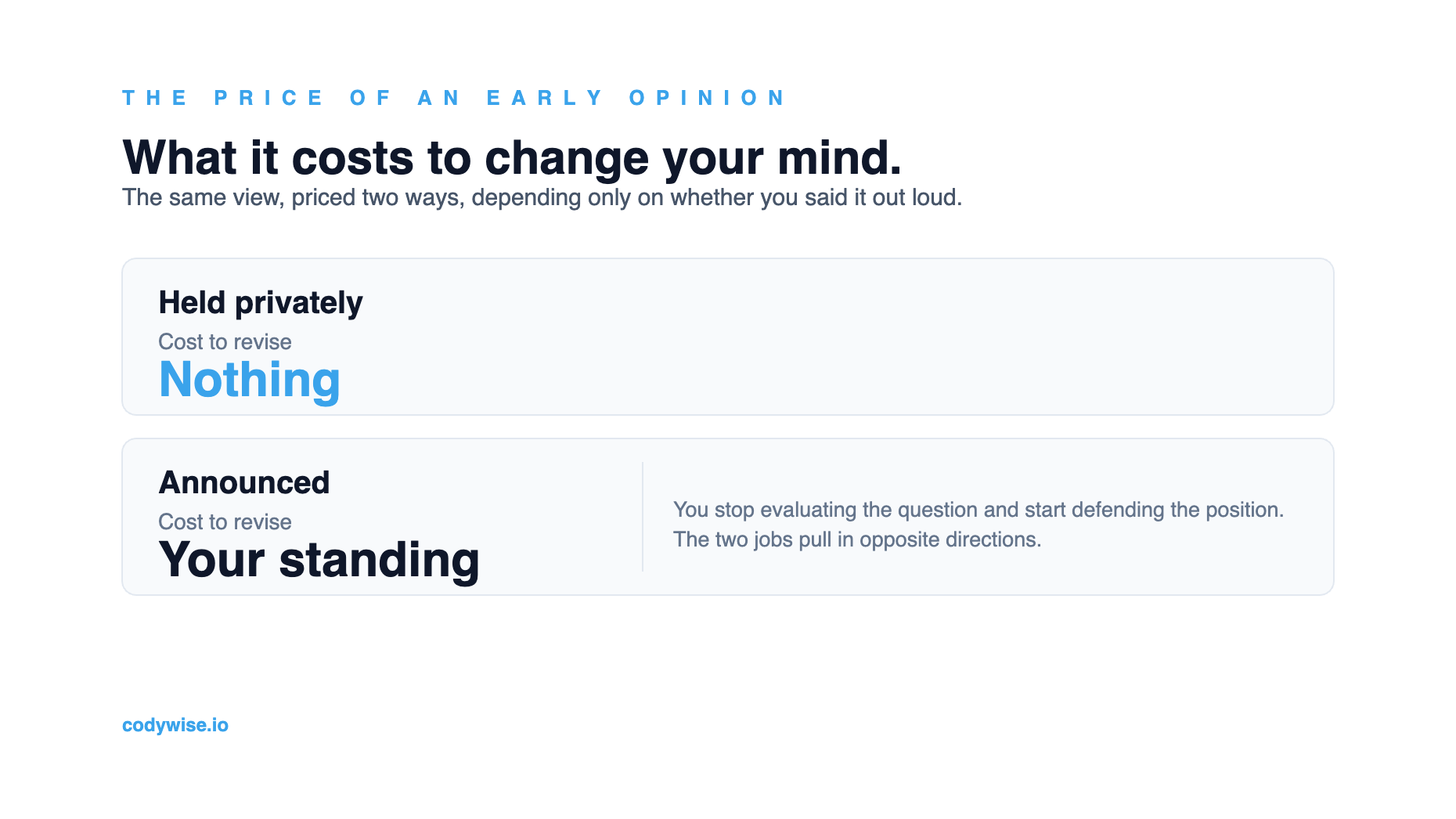
Here is the mechanism the silence was protecting against. A view you hold privately costs nothing to change. A view you have announced costs your reputation to change. The moment you say it out loud you stop being someone evaluating a question and start being someone defending a position, and those two jobs pull in opposite directions.
So the silence is not humility. It is inventory management on your opinions. You are refusing to take delivery on a belief until you can afford to hold it.
An opinion you have not said out loud is still free to change.
What it looks like in a business
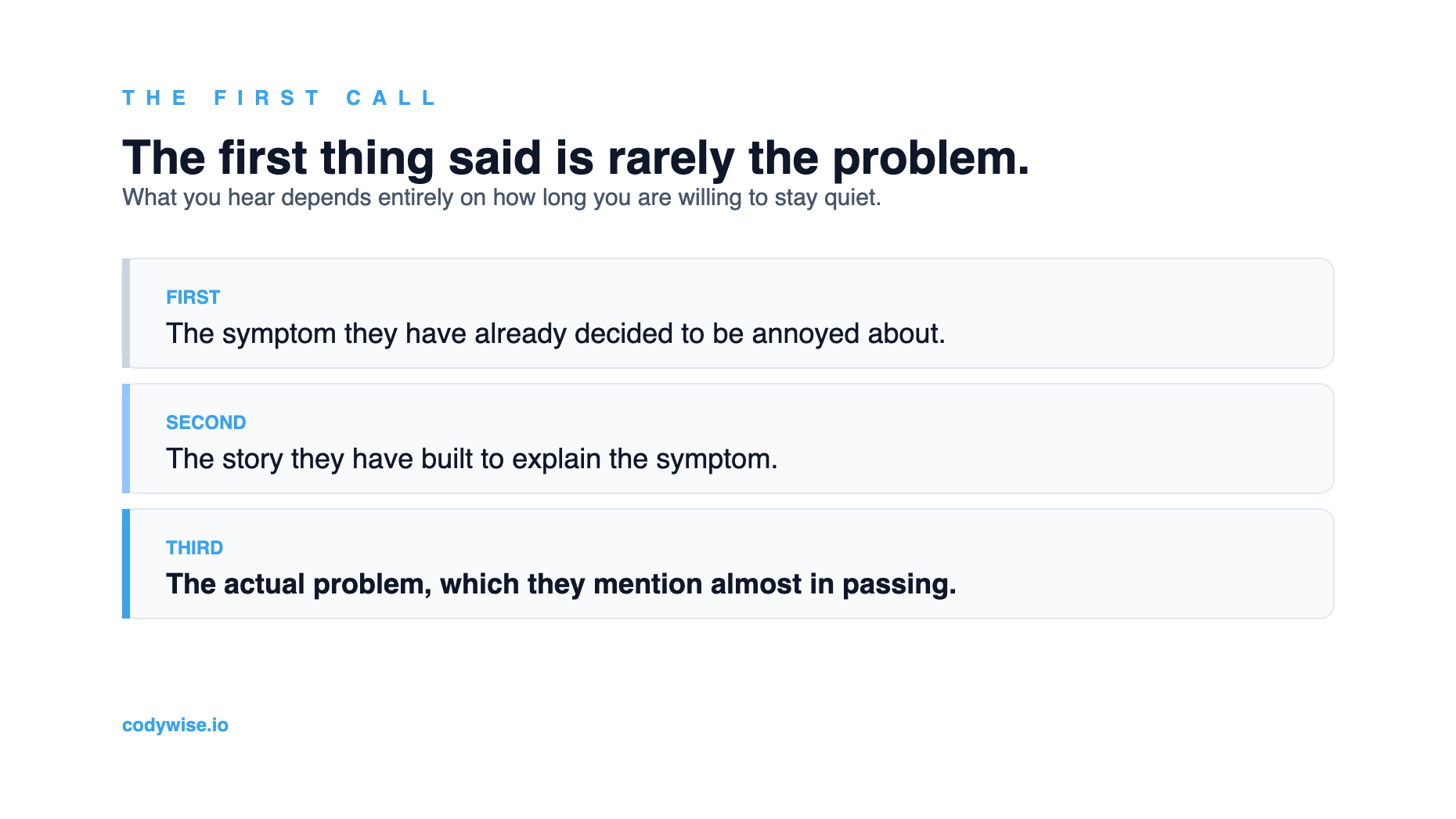
The place this shows up in my work is the first call with a new client. The instinct is to diagnose inside ten minutes, because diagnosing quickly sounds like expertise and staying quiet sounds like you do not know. It is backwards. The engagements that went well were the ones where I stayed quiet past the point of comfort and let the founder keep going, because the first thing they said was the symptom they had already decided to be annoyed about, and the third thing was the actual problem. Solomon put it in one line: “He that answereth a matter before he heareth it, it is folly and shame unto him.” (Proverbs 18:13)
The same rule holds on a property. A new listing in a new market invites you to change the photos, the title and the price inside the first week. You have no information yet, only nerves. Give it a season of quiet operation and the data will tell you which of the three was actually wrong, instead of you changing all three and learning nothing.
This is not passivity, and the distinction matters. The Pythagorean novice was not idle for five years. He was listening, memorising, running the arithmetic, doing the work of the school without the standing to comment on it. Silence and absence are different postures. One of them is loaded.
The grade everybody skips
Almost nobody wants to be a hearer. Everybody wants to be a learner on the first day: the frameworks, the proofs, the reason behind the rule. The school’s answer was that you cannot evaluate a proof in a field whose vocabulary you do not have yet. You will grade it on whether it sounds right, and that is a measurement of your own ear, not of the argument.
That problem got worse, not better. You can now generate a confident, well-structured answer in any discipline in about four seconds, and it will read as competence to anyone who does not already know the field. Fluency has fallen to roughly zero in cost. What did not get cheaper is knowing which parts of the answer you are not qualified to check.
Fluency is cheap now. Knowing what you do not know yet is the expensive part.
The Pythagoreans kept a figure as a teaching object, the tetractys: ten points in four rows, one and two and three and four. The point of it was that the order was found rather than invented. Nobody ratified harmony by vote, and nobody had to. It was already there, and the entire work of the school was to become the kind of person who could see what was already there.

Five years is not a prescription. Nobody is going to sit out a lustrum before speaking in a meeting, and the number is probably legend anyway. The transferable part is the ordering: hear the whole thing, then form the view, then say it. Most people run that sequence backwards and then spend the rest of the project defending the output of step three.
Say less than you know. The gap between the two is where judgment grows.