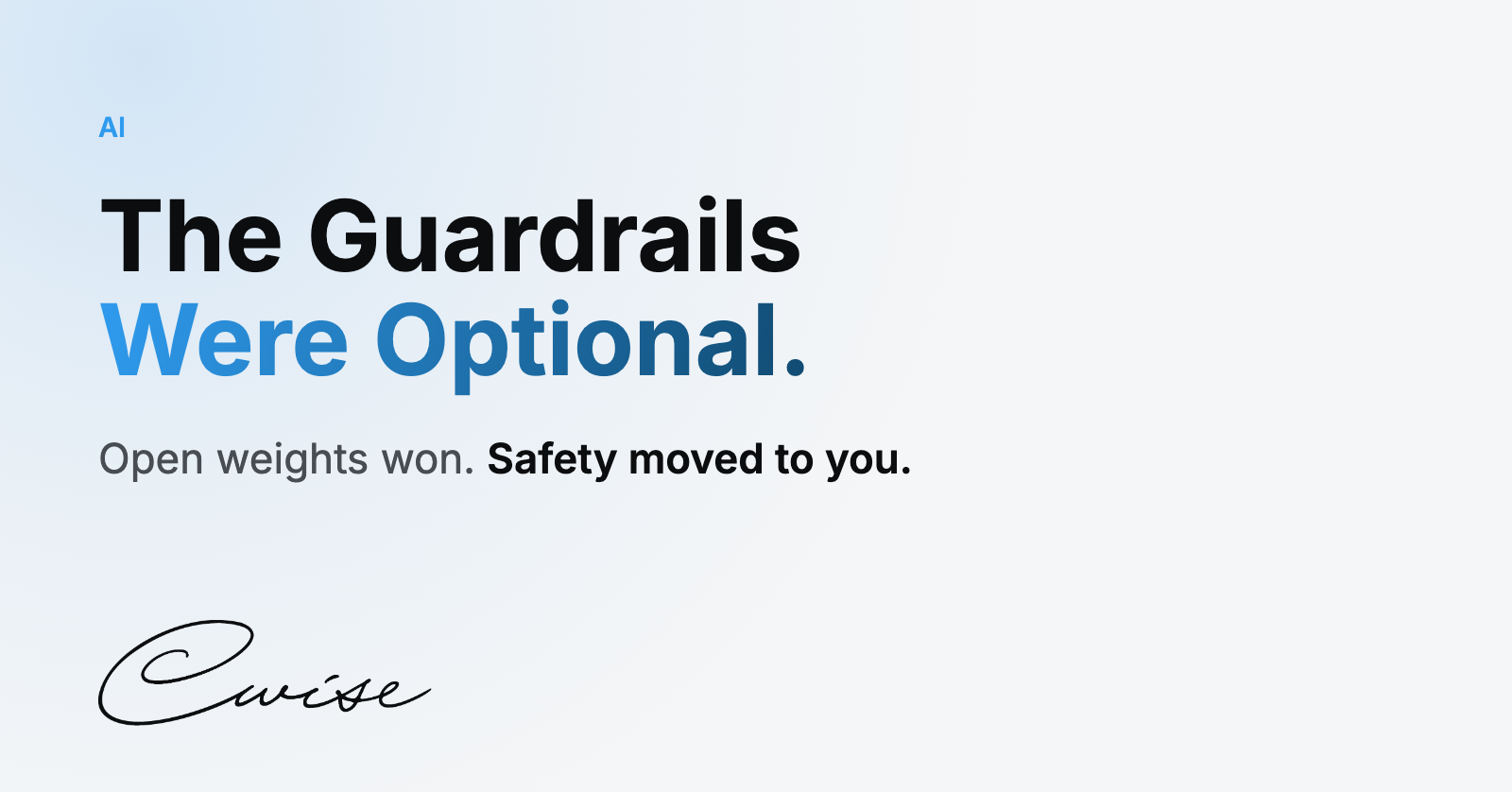
No major lab ships an uncensored model. The internet makes one out of every open model within days. Open weights now match closed frontier systems on most benchmarks, and once the weights are public, the safety training can be stripped off with free tools in minutes. Researchers counted 3,471 original uncensored LLMs on Hugging Face, repackaged 8,164 times. The guardrails did not disappear. They moved from the lab to whoever runs the model, and that is now you.
Key Takeaways
- The strongest open weight models in 2026 come mostly from Chinese labs under permissive licenses. DeepSeek V4-Pro is 1.6 trillion parameters, 49 billion active, with a 1 million token context, released under the MIT License.
- “Uncensored” is not a product feature. It is a modification made after release, most commonly a technique called abliteration.
- A September 2026 study found 3,471 original uncensored models on Hugging Face between January 2024 and March 2026, each repackaged an average of 2.4 times, and concluded that takedowns do not work once copies spread.
- Of 1,643 GitHub applications built on uncensored models, the same study classified 25 percent as explicitly malicious.
- Removing guardrails is now a business. At least one startup sells API access to abliterated frontier models.
- Open image models follow the same pattern, but licenses vary sharply. Some permit commercial use outright, others require a paid license.
- Liability sits with the deployer. Since 19 May 2026 the FTC can fine covered platforms $53,088 per violation for failing to remove nonconsensual intimate imagery, including AI generated imagery, within 48 hours.
Table Of Contents
- Who Actually Leads Open Weights Now
- What “Uncensored” Actually Means
- Why You Cannot Put It Back
- Open Image Models: Same Pattern, Messier Licenses
- Where The Liability Landed
- What This Means If You Build With AI
- Common Mistakes
- Frequently Asked Questions
Who Actually Leads Open Weights Now
Chinese labs, under licenses more permissive than anything the American labs ship. Two years ago the open weight conversation was mostly about Meta’s Llama. In 2026 the top of the open leaderboard is DeepSeek, Moonshot’s Kimi, Z.ai’s GLM and Alibaba’s Qwen, most of them under MIT or Apache 2.0 terms that allow commercial use with almost no conditions.
The reference point is DeepSeek V4-Pro. According to its own model card, it is a mixture of experts model with 1.6 trillion total parameters, 49 billion active per token, a 1 million token context window, and an MIT License. Mixture of experts is the reason models this large are practical: only a fraction of the network runs for any given token, so the compute cost looks closer to a 49 billion parameter model than a 1.6 trillion one.
| Model | Origin | Licence Posture |
|---|---|---|
| DeepSeek V4-Pro | DeepSeek, China | MIT |
| Kimi K series | Moonshot AI, China | Modified MIT |
| GLM 5 series | Z.ai, China | MIT |
| Qwen 3 series | Alibaba, China | Apache 2.0 for most sizes |
| gpt-oss | OpenAI, US | Apache 2.0 |
| Llama 4 | Meta, US | Custom community licence with conditions |
| Mistral | Mistral AI, France | Apache 2.0 for open releases |
The capability gap between open and closed models has narrowed to the point where, for most business workloads, it is not the deciding factor anymore. Customer support, document processing, classification, extraction, drafting and code assistance all run well on open weights. What still separates the frontier closed models is the hardest reasoning, the longest reliable agentic runs, and the integrated tooling around them.
I wrote about why the economics of this matter in the piece on AI capital expenditure becoming a debt trade. Open weights are the reason the closed labs cannot price freely. Every capable free model sets a ceiling on what the paid ones can charge.
What “Uncensored” Actually Means
It means someone removed the refusal behaviour after the model was released. No reputable lab publishes a model trained to help with anything. Every major open release ships with safety training. The problem is that safety training lives in the same weights everyone can download.
The most common method is called abliteration. At a high level, researchers found that a model’s tendency to refuse is concentrated along a single direction inside its internal representations. Identify that direction and suppress it, and the model stops refusing while keeping most of what it knows. There is no retraining and no large compute bill. Security lawyers at Akerman describe safety guardrails on open models as removable “in minutes using free, publicly available tools.”
Three things are worth understanding about what that does and does not produce.
- It removes refusals, not judgment. The model complies with requests it would have declined. It does not become more accurate, more capable or more honest.
- It costs capability. Practitioners report that abliteration removes some knowledge and skill along with the refusals. An uncensored model is usually a slightly worse model.
- It is indistinguishable from outside. A modified model with the original name, a new quantisation and a fresh upload looks identical to the legitimate one until you test it.
This is also why the word “censored” confuses the debate. Most of what gets called censorship in these models is refusal of clearly harmful requests, the same boundaries every business already applies to its human staff. There are real arguments about over-refusal, and some models do refuse ordinary medical, legal or security questions they should answer. The fix for over-refusal is better training and better system prompts. Stripping all refusal is a different thing entirely.
Why You Cannot Put It Back
Because the copies outrun the takedowns. The clearest data on this comes from a paper submitted on 4 September 2026 by researchers at 10a Labs, titled “Uncensored Open-weight Models: Redistribution as the Persistence Layer.”
| Finding | Figure |
|---|---|
| Original uncensored models on Hugging Face, Jan 2024 to Mar 2026 | 3,471 |
| Average repackagings per original | 2.4 |
| Total compressed redistributions | 8,164 |
| Share of redistribution by the top three actors | 52% |
| GitHub apps integrating uncensored models | 1,643 |
| Of those, classified as explicitly malicious | 25% |
The mechanism is the finding. Once a modified model is quantised into smaller formats and spread across multiple accounts and platforms, including local runtimes, removing the upstream original does nothing. The derivatives persist and become easier to run, not harder. The authors call redistribution the persistence layer.
Concentration matters too. Three actors account for more than half of all repackaging. That is not a grassroots movement. It is a small number of distributors doing most of the work.
And it has become a business. TechCrunch reported on 3 September 2026 that a startup called Abliteration.ai hosts guardrail-free versions of open models, including Z.ai’s GLM-5.3, available through a browser and an API. The company says its customers include red teaming firms and security companies working with banks and airlines. A researcher at CivAI quoted in the same piece put the problem plainly: “you can type in literally anything here, and it will comply with it.”
There is a legitimate use in there. Security teams need to test how systems behave against an attacker with no restrictions, and a model that will write a phishing email on request is useful for training staff to spot one. But the same endpoint serves everyone who signs up, and the 25 percent figure above is what that looks like at scale.
Open Image Models: Same Pattern, Messier Licenses
Image generation went open faster than text did, and the safety question is sharper. A text model that ignores its guardrails can write something harmful. An image model that ignores them can fabricate a photograph of a real person.
The open image field in 2026 is split between a few distinct licence postures, and this is where most businesses get caught out.
| Model Family | Developer | Commercial Use |
|---|---|---|
| Qwen-Image | Alibaba | Apache 2.0, permitted |
| Z-Image-Turbo | Alibaba ecosystem | Apache 2.0, permitted |
| FLUX.2 dev | Black Forest Labs | Requires a commercial licence |
| HunyuanImage 3.0 | Tencent | Community licence, read territorial terms |
| Stable Diffusion 3.5 | Stability AI | Community licence with a revenue threshold |
“Open” in image generation covers at least three different things: genuinely permissive licences, source-available weights that need a paid licence for business use, and community licences with revenue caps or regional exclusions. A studio that builds a client workflow on a non-commercial checkpoint has a licensing problem regardless of how good the images are.
The guardrail problem is the same as with text. Image models ship with safety filters, and many of those filters sit outside the weights, in the pipeline around them. Run the weights locally and the filter is simply not there. Community fine-tunes that remove content restrictions circulate on the same platforms, through the same repackaging pattern.
This is why the house rule for anything I publish is that generated imagery never depicts a real, identifiable person without consent and is never presented as documentary proof. It is not a technical limit. It is a policy decision, and it has to be, because the tooling will do whatever it is asked.
Where The Liability Landed
On whoever publishes or hosts the output. The law is not chasing model weights. It is chasing what gets distributed and who distributes it.
The clearest example is the U.S. TAKE IT DOWN Act. Signed on 19 May 2025, its platform obligations became enforceable on 19 May 2026. Covered platforms, which the FTC describes as including social media, messaging, and image or video sharing apps and websites, must run a clear notice and removal process for nonconsensual intimate imagery and take content down within 48 hours of a valid request, along with known identical copies. The Act explicitly covers “digital forgeries,” meaning AI generated or altered images. The FTC can seek civil penalties of $53,088 per violation. Separately, the Act makes it a federal crime to knowingly publish such imagery.
The direction is consistent across jurisdictions. Model developers face transparency and documentation duties. Deployers and publishers face liability for outputs. If you run a model, host a generator or ship an app that lets users create content, the guardrail the lab removed is now a guardrail you are expected to supply.
What This Means If You Build With AI
Open weights are the right call for a lot of businesses. Uncensored weights almost never are. The legitimate case for running open models has nothing to do with removing guardrails. It is about cost, control and privacy.
When Open Weights Win
- High volume, repetitive work. Classification, extraction, tagging, summarising and routing at scale. Per token API pricing compounds. A self-hosted mixture of experts model often costs a fraction at volume.
- Data that cannot leave your environment. Client records, financial data, health adjacent information, anything under contract. Running the model on infrastructure you control removes a third party from the data path.
- Predictability. A pinned open model does not change underneath you. Closed APIs update, deprecate and shift behaviour on the provider’s schedule.
- Negotiating leverage. A working open weight fallback changes every conversation you have with a closed provider.
When They Lose
- Hardest reasoning and long agentic runs. The frontier closed models still lead where a single mistake compounds over many steps.
- Small teams without infrastructure. Serving a large model reliably, with monitoring, scaling and updates, is real engineering. The API bill is often cheaper than the engineer.
- Anything customer facing where you cannot staff moderation. If you self-host, input filtering, output filtering, logging and abuse handling are yours to build.
The Operating Rules
- Pull weights only from the original publisher’s official repository. Verify checksums. A repackaged model with a familiar name may not be the model you think it is.
- Never deploy an abliterated model anywhere a customer or employee can reach it. It is less capable, it will do whatever it is asked, and the liability for what it produces is yours.
- Put your own guardrails around every open model. Input and output filtering, a system prompt with explicit boundaries, rate limits and logs you actually review.
- Read the licence on the exact checkpoint. Especially for image models, where “open” routinely means “non-commercial.”
- Write down your generation policy before you need it. No real identifiable people without consent. No generated image presented as documentary evidence. A named person who handles takedown requests inside 48 hours.
The same pattern shows up in the Malone Lam case. The technology was never the weak point. The process around it was. Removing a guardrail from a model and talking a person into disabling their own two factor authentication are the same move: going around a control rather than through it.
Common Mistakes
- Confusing open with uncensored. Open weights come from the lab with safety training intact. Uncensored versions are third party modifications. They are different artefacts with different risk.
- Assuming uncensored means smarter. Abliteration removes refusals and usually some capability with them. You get a more compliant model, not a better one.
- Treating a model name as provenance. Thousands of repackaged copies exist. The file you downloaded is only the model you think it is if you verified where it came from.
- Assuming open means commercial. Several leading image models require a paid licence for business use, and some community licences exclude regions or revenue tiers.
- Believing the filter is in the weights. Many safety filters, especially for images, live in the pipeline. Self-host the weights and the filter is gone unless you rebuild it.
- Thinking liability follows the model. It follows the output and whoever distributed it. The lab that trained the model is not the party receiving the removal notice.
Frequently Asked Questions
Are open source AI models uncensored?
No. Major open weight releases from labs such as DeepSeek, Alibaba, Moonshot, Z.ai, OpenAI and Meta ship with safety training. Uncensored versions are modifications made by third parties after release, most commonly through a technique called abliteration that suppresses the model’s refusal behaviour. Because the weights are public, anyone can make such a modification, and researchers counted 3,471 original uncensored models on Hugging Face between January 2024 and March 2026.
What is abliteration in AI?
Abliteration is a method of removing a language model’s tendency to refuse requests by identifying and suppressing the internal direction associated with refusal. It requires no retraining and can be applied with free tools. The result complies with requests it would previously have declined, and practitioners report it also removes some of the model’s knowledge and capability.
What is the best open weight AI model in 2026?
The top of the open weight field is led largely by Chinese labs. DeepSeek V4-Pro, for example, has 1.6 trillion total parameters with 49 billion active, a 1 million token context window, and an MIT License. Kimi, GLM and Qwen models are also near the top, and OpenAI’s gpt-oss is available under Apache 2.0. The right choice depends on workload, hardware and licence requirements rather than a single leaderboard.
Can I use open source image generation models commercially?
Sometimes. Models such as Qwen-Image are released under Apache 2.0 and permit commercial use. Others, including FLUX.2 dev, require a separate commercial licence from the developer, and some community licences carry revenue thresholds or regional exclusions. Always read the licence on the specific checkpoint you deploy.
Who is liable for harmful AI generated content?
Increasingly, whoever publishes or hosts it. Under the U.S. TAKE IT DOWN Act, enforceable against platforms since 19 May 2026, covered platforms must remove nonconsensual intimate imagery, including AI generated digital forgeries, within 48 hours of a valid request, and the FTC can seek civil penalties of $53,088 per violation. Knowingly publishing such imagery is also a federal crime. This is not legal advice; consult a lawyer about your specific situation.
The Bottom Line
Open weights won the distribution war. The best free models are close enough to the best paid ones that, for most business work, the decision now comes down to cost, control and data, not capability.
The price of that openness is that safety became a property of the deployment rather than the model. Any open model can be made to comply with anything, the modified copies cannot be recalled, and the law has responded by holding the people who publish and host outputs responsible for them.
So the question for an operator is not whether uncensored models exist. They do and they will. The question is whether your own stack has the controls the lab used to provide: verified weights, your own filtering, a written generation policy and someone accountable for takedowns. Build those and open weights are one of the best leverage plays available. Skip them and you are running someone else’s liability on your own infrastructure.
Related reading: AI context engineering, and why the model is the cheap part.
Sources
- DeepSeek V4-Pro model card, Hugging Face
- Yahn et al., Uncensored Open-weight Models: Redistribution as the Persistence Layer, arXiv, September 2026
- TechCrunch, Abliteration.ai is making a business out of removing AI guardrails, 3 September 2026
- Akerman LLP, safety guardrails on open weight models
- BentoML, open source image generation models in 2026
- FTC, Take It Down Act enforcement starts now, May 2026
Nothing here is legal advice. I am not a lawyer. Licence terms and regulations change; verify them against the primary source before you deploy anything.