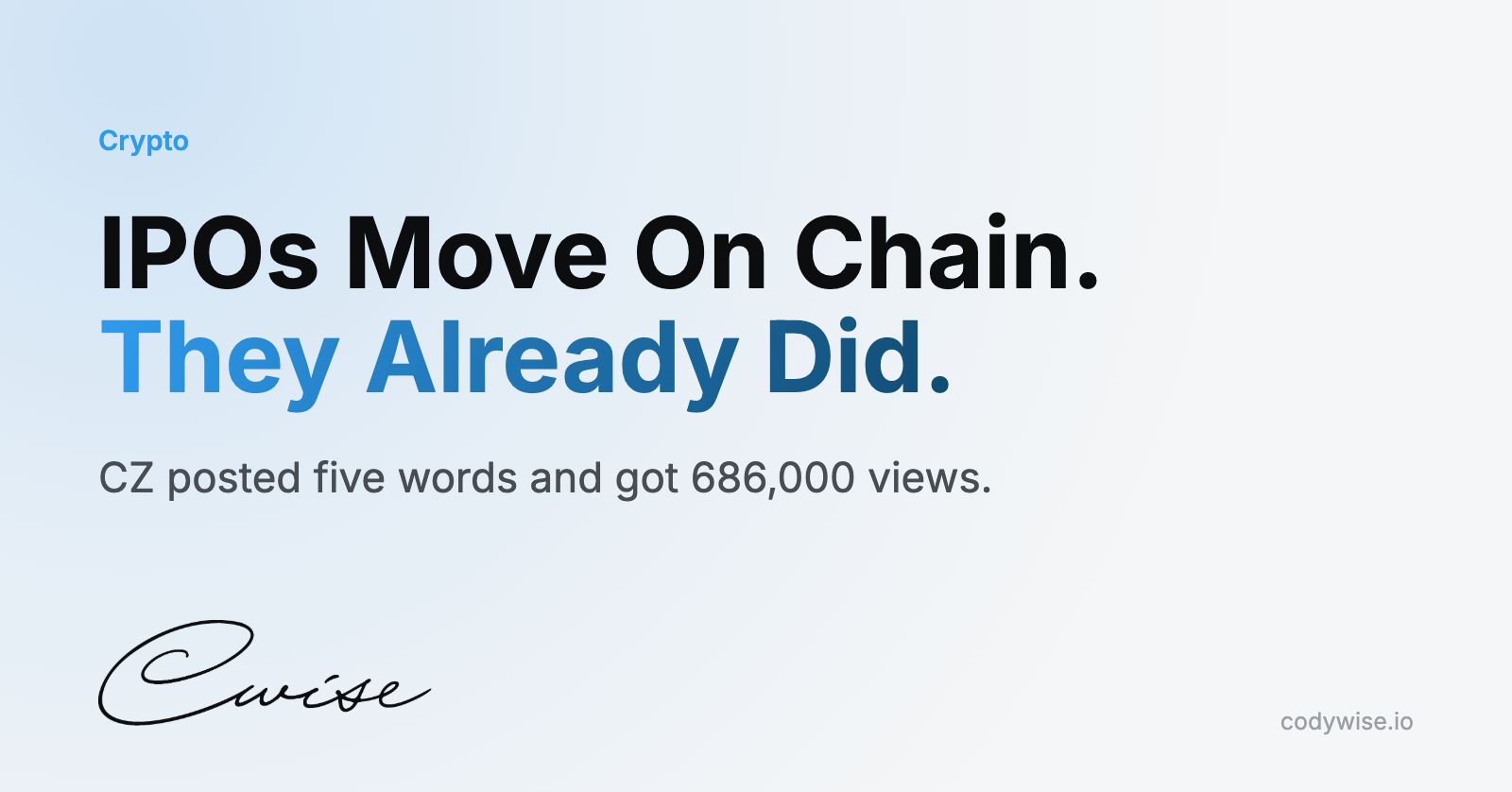
Changpeng Zhao posted five words on X and collected 686,000 views: “IPOs will move on chain.” No timeline, no detail, no argument. Two things are worth saying immediately. He is Binance’s founder, not its CEO, and has publicly ruled out returning to that job. And he was not predicting anything. Tokenized stocks already hold roughly $2.9 billion on chain, the New York Stock Exchange filed for tokenized listings in April, and Europe ran its first on-chain IPO the same month.
Summary
- CZ posted “IPOs will move on chain” on September 7, 2026. It reached 686,000 views without a supporting argument.
- He is not the CEO of Binance. Richard Teng has held that role since November 2023. CZ was pardoned by President Trump in October 2025 and confirmed in January 2026 that his exit is permanent.
- Tokenized stocks held about $2.9 billion of on-chain value as of September 2026, up roughly 14% month over month.
- The NYSE filed SEC rules in April 2026 to let tokenized versions of large-cap stocks trade alongside conventional shares with next-day settlement.
- A European exchange hosted the first on-chain IPO under the EU’s DLT pilot regime, also in April 2026.
- The SEC confirmed in January 2026 that tokenizing shares leaves registration and disclosure duties intact. The rails change. The obligations do not.
- The real constraint is not regulation or technology. It is order book depth.
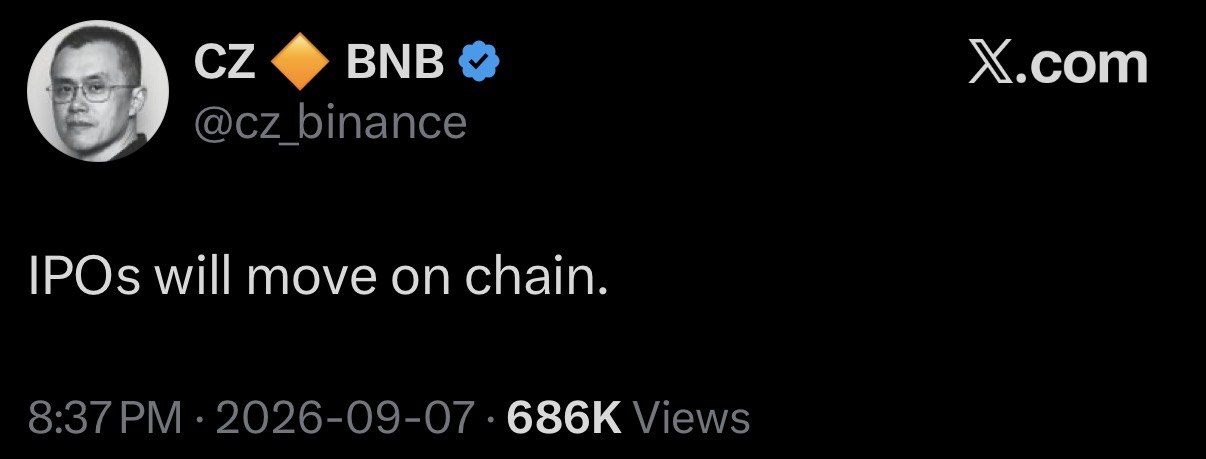
Table Of Contents
- First, A Correction
- He Is Describing The Present
- What Actually Changes
- What Does Not Change
- The Real Constraint Is Depth
- Signal Or Noise
- Frequently Asked Questions
- The Bottom Line
First, A Correction

Most of the posts carrying this quote call him the CEO of Binance. He is not, and the distinction changes how much weight the statement carries.
CZ stepped down as chief executive in November 2023 as part of his settlement with the US Department of Justice. Richard Teng has run the company since. President Trump pardoned CZ in October 2025, and Binance subsequently named Yi He co-CEO. In January 2026 CZ said publicly that he is not returning to the top job.
So this is a founder with a large following and no operational role stating an opinion, not a sitting chief executive signalling a product roadmap. That is a meaningfully different thing, and anyone forwarding the quote as company guidance is passing on something that is not true.
It does not make him wrong. It changes what kind of evidence the statement is. Which is why the rest of this article is about the infrastructure rather than the man.
He Is Describing The Present
Read the sentence again. “IPOs will move on chain.” Future tense, which is what makes it sound like a prediction and lets everyone argue about whether it is right.
Here is what already happened.
| What | When | Detail |
|---|---|---|
| Tokenized stock value on chain | September 2026 | Roughly $2.9 billion, up about 14% month over month |
| SEC position on tokenized shares | January 2026 | Registration and disclosure duties remain intact |
| NYSE rule filing | April 2026 | Tokenized large-cap stocks trading alongside conventional shares, next-day settlement |
| First on-chain IPO in the EU | April 2026 | Hosted by a European exchange under the DLT pilot regime |
A $2.9 billion market is not a thought experiment. A New York Stock Exchange filing is not a whitepaper. A completed IPO under a live European regulatory regime is not a roadmap item.
The useful reframe: the question is not whether IPOs move on chain. The question is what percentage, over what period, and which venue captures the flow. Those are answerable questions with numbers attached. “Will it happen” is not, and it is the question almost all the coverage is asking.
What Actually Changes
Three things, and they are genuinely significant.
1. Retail Gets Day One Access
The traditional IPO allocation process hands the first-day pop to institutions and favoured clients. Retail buys in the aftermarket, usually after the move. On-chain issuance removes the allocation gatekeeper by default, because there is no book-building syndicate deciding who gets filled.
Whether that is good for retail is a separate question. Access to the first print is not the same as access to a good price.
2. Trading Runs Continuously
No opening bell, no closing auction, no weekend gap. Equity markets currently concentrate risk into the overnight and weekend windows precisely because they close. Continuous trading spreads that risk out instead of storing it up.
3. Shares Divide Fractionally
Fractional ownership already exists at brokerages, but it sits inside the broker’s ledger rather than on the security itself. Native fractionalisation changes who can hold a position in a $900 share, which matters more in emerging markets than it does in North America.
What Does Not Change
This is the paragraph that most of the excitement skips.
In January 2026 the SEC confirmed that tokenizing shares leaves registration and disclosure duties intact. A tokenized security is still a security. The issuer still registers. The disclosures are still required. The liability still attaches.
Tokenization changes the settlement layer and the distribution surface. It does not change securities law, and nobody serious ever claimed it would. The version of this story where a company skips the prospectus and sells tokens to the public is not what the NYSE filed for, and it is not what happened in Europe.
So the honest summary of the opportunity is narrower than the headline: faster settlement, wider distribution, continuous trading, same legal obligations. That is a meaningful infrastructure upgrade. It is not a revolution in who is allowed to issue equity.
The Real Constraint Is Depth
If you want to know what actually decides whether this works, it is not regulators and it is not blockchains. It is order book depth.
Tokenized venues currently run thin books, which produces price volatility even while offering continuous trading. That combination is worse than it sounds. A market that is always open and always thin gives you more opportunities to get a bad fill, not fewer.
This is the same lesson from the memecoin side of this market, where a nine-figure headline valuation can sit on single-digit-million liquidity. I wrote about that specific failure mode in the ZCAT breakdown, and it applies identically here. Market cap is a multiplication. Depth is what you can actually transact against.
So the metric to watch is not how many tokenized listings launch. It is whether spreads on tokenized venues converge toward their conventional equivalents. If they do, the migration is real. If they stay wide, tokenized shares remain a parallel market for people who could not access the primary one, which is a much smaller and less interesting outcome.
Signal Or Noise

CZ has spent years compressing positions into single characters. The number four became shorthand for ignore the noise after a December 2022 post listing his priorities for the following year, and it is documented in Binance’s own glossary.
Five words about IPOs is the same technique. Maximum reach, minimum surface area to argue with, no falsifiable claim attached. It is very good communication and it is close to zero information.
The operator lesson generalises well past crypto. When someone with distribution makes an unfalsifiable statement and it travels, the statement is not the event. The event is what was already true that made the statement land. In this case: $2.9 billion on chain, an NYSE filing, a completed European listing and an SEC position paper, all of which existed before the post and none of which trended.
Read the infrastructure, not the influencer. That habit is the entire difference between being early and being late.
Frequently Asked Questions
Is CZ the CEO of Binance?
No. Changpeng Zhao founded Binance and served as chief executive until November 2023, when he stepped down as part of his settlement with the US Department of Justice. Richard Teng has been CEO since. President Trump pardoned CZ in October 2025, Binance later named Yi He co-CEO, and CZ stated in January 2026 that he is not returning to the role.
What did CZ say about IPOs?
He posted “IPOs will move on chain” on X on September 7, 2026, with no timeline or supporting detail. The post reached roughly 686,000 views.
Are on-chain IPOs already happening?
Yes. A European exchange hosted the first on-chain IPO under the EU’s DLT pilot regime in April 2026. Separately, tokenized stocks held roughly $2.9 billion of on-chain value as of September 2026, up about 14% month over month, and the New York Stock Exchange filed SEC rules in April 2026 for tokenized large-cap stocks to trade alongside conventional shares with next-day settlement.
Does tokenizing a stock avoid securities regulation?
No. The SEC confirmed in January 2026 that tokenizing shares leaves registration and disclosure duties intact. A tokenized security is still a security, the issuer still registers, and the disclosure obligations and liability still apply. Tokenization changes settlement and distribution, not the legal framework.
What is the biggest risk with tokenized equity right now?
Thin order books. Tokenized venues currently carry limited depth, which produces price volatility despite continuous trading. A market that is always open and always thin creates more chances for a poor fill, not fewer. Watch whether spreads converge toward conventional venues rather than counting listings.
The Bottom Line
CZ is right, and he is describing something that started before he said it. That is usually how these posts work.
The substance is that capital markets plumbing is being rebuilt in public, with a regulator that has already said the obligations survive the format change, an incumbent exchange that has filed to participate, and a completed listing in a live European regime. None of that needed a tweet to be true.
The thing to track is depth, not headlines. Tokenized listings are easy to launch and hard to make liquid, and liquidity is the only feature that determines whether this becomes the market or stays a sidecar to it.
This article is informational and is not investment advice. I am not a financial advisor. Figures were captured on September 8, 2026 from public reporting and will change. Verify against primary sources before acting on any of it.
Where I Track This
Live tables and written breakdowns sit under Crypto. The allocation logic is under Investing, and the on-chain data case for the current cycle is in the DeFi bull case.