

Legacy & Lineage
The Hudson’s Bay Company ran a trading network across most of a continent for two hundred years without shipping coins into it. There was no currency in the territory. So the company built one out of the only thing every party at the table could pick up and evaluate by hand.
A unit of account does not have to be scarce. It has to be something both sides can hold and agree on.
The unit was the Made Beaver. One prime beaver pelt, taken in winter, in good condition. Everything else in the trade got priced against it. A lesser fur was a fraction of one. A kettle, a blanket, a bag of shot, a gun, all quoted in MB.
Around 1795 a kettle traded for one Made Beaver. So did eight knives. A gun ran about ten. Rates moved by post and by season, but the reference point did not. Nobody carried silver into the interior and nobody needed to. The pelt was the ledger.

What makes this worth studying is not that it was clever. It is that the company solved the hardest problem in commerce: agreeing on a price with someone who does not share your language, your law, or your idea of what things are worth.
They did not solve it with force. They solved it with a reference object. Both sides could inspect a pelt. Both sides could count. The unit was legible to an accountant in London and to a trader at the mouth of a river, and that shared legibility is the entire reason the thing scaled.
The spread was written down
Here is the part almost everyone misses.
There were two prices, not one. London published the Official Standard, the list rate for goods in Made Beaver. The man actually running the post traded at his own rate, the Comparative Standard, which typically ran higher. The gap between them had a name: overplus.
Overplus was not a secret. It was a line item. The post factor was expected to use judgment, because he was the only person within a thousand miles who knew what the season had done to supply. But he had to record what he did with that judgment, and the difference went back to London in the books.
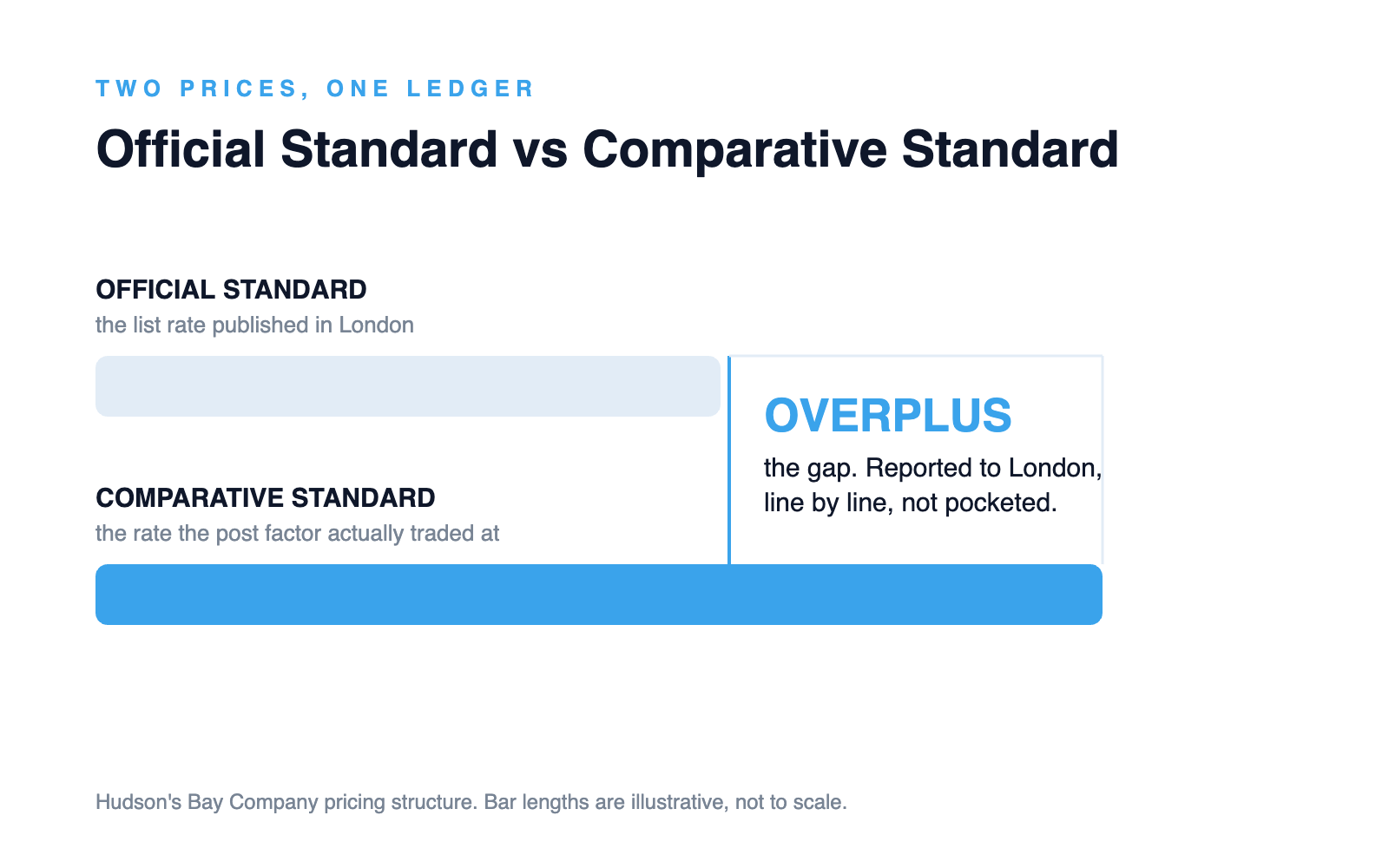
Discretion is not the problem. Undocumented discretion is the problem.
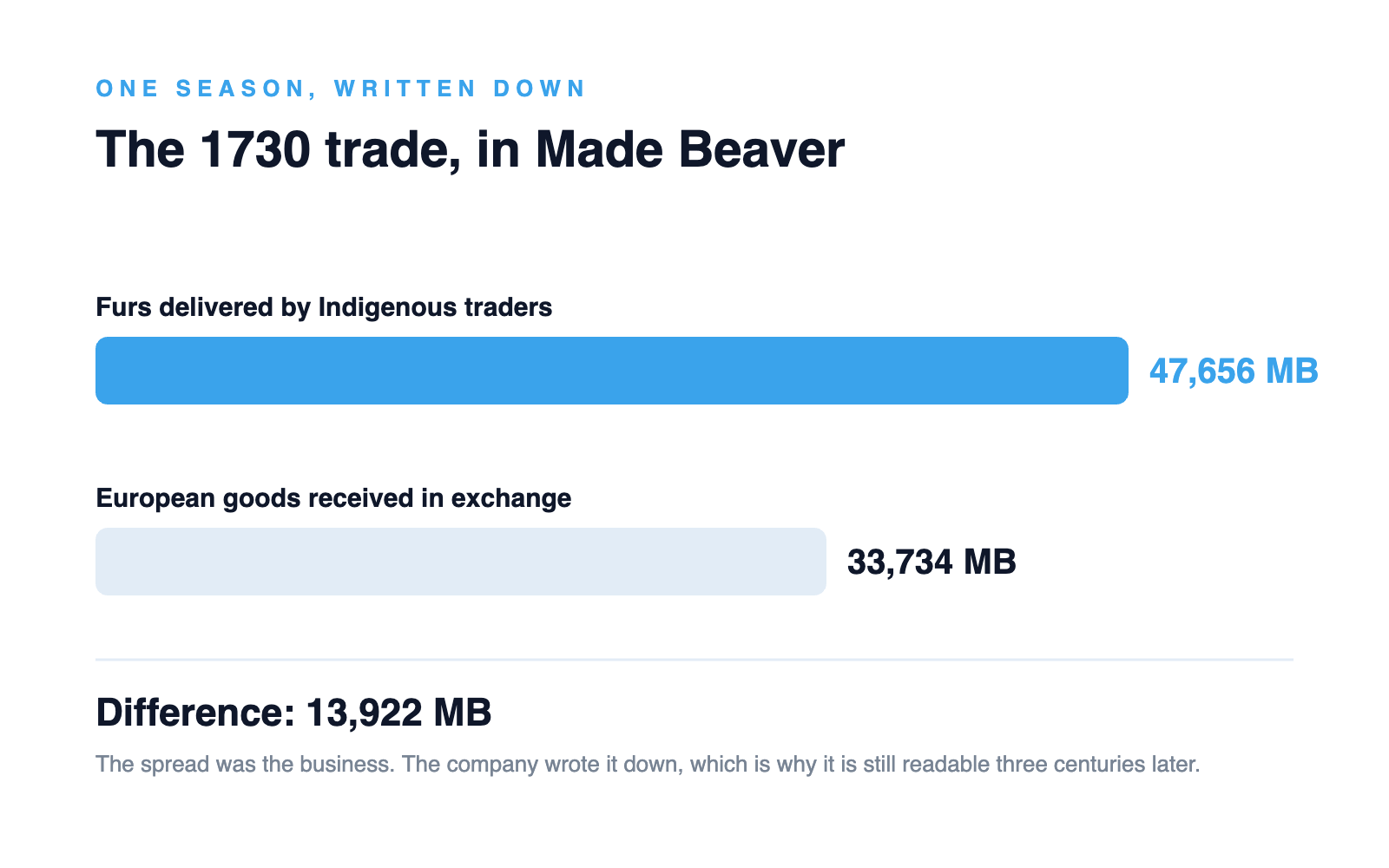
Records from 1730 show Indigenous traders receiving roughly 33,734 Made Beaver worth of European goods against about 47,656 Made Beaver worth of furs delivered. The spread sits right there on the page. Whatever you make of the terms, the company wrote them down, and that is the only reason we can read them three centuries later.
Pick your unit
Every business already runs on a unit of account. Most founders have never named theirs, so they inherit a bad one by default. Revenue. Followers. Hours worked. Units that move a lot and tell you almost nothing.
In short-term rentals the honest unit is not the booking. It is the clean, ready night. A night that has been turned over, stocked, heated and checked is what the guest is actually buying, and it is what every cost in the operation attaches to. Measure that and the whole operation organizes itself around one thing a cleaner and an owner can both point at. Count bookings instead and you will congratulate yourself on a full calendar while the product quietly degrades.
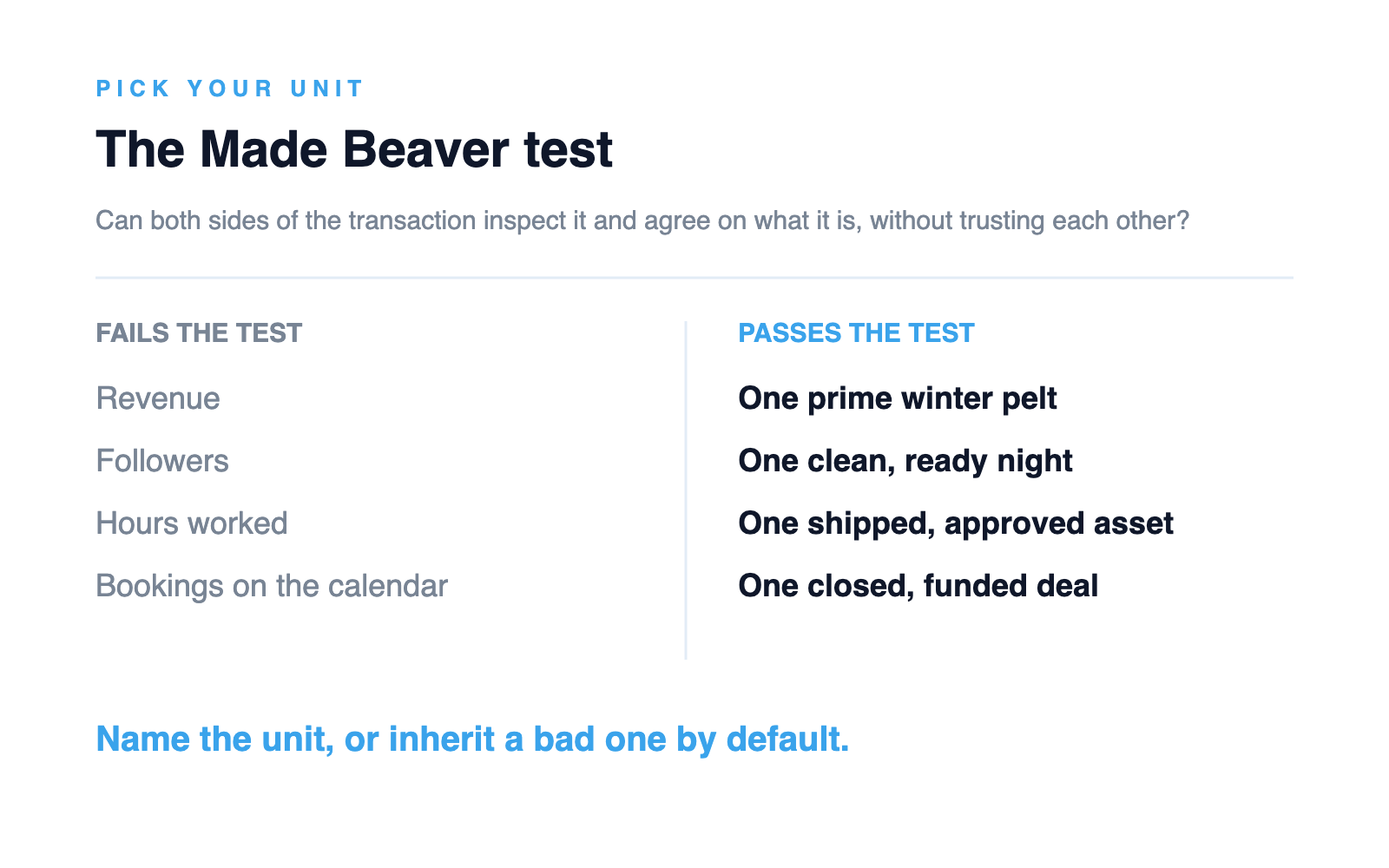
The test for a good unit: can both sides inspect it and agree on what it is, without having to trust each other?
Solomon got there three thousand years earlier. A false balance is an abomination, a just weight is a delight. He is not talking about the goods. He is talking about the scale. The instrument you measure with is a moral object before it is an accounting one, because everyone downstream of it is forced to live inside whatever it says.
A company that publishes its standard and records its overplus is running a just weight, even in seasons when the terms favour it. A company that keeps two sets of numbers and only shows one is not, no matter how fair the headline price looks.

Name the unit. Publish the standard. Record the spread. Anything you refuse to write down eventually gets decided by whoever happens to be standing closest to it.