Costco reports its fiscal fourth quarter today, 24 September 2026, with the earnings call at 2:00 p.m. Pacific. It walks into the print having already told the market that net sales for the 52 weeks ended 30 August came to $297.3 billion, up 10.2 percent. That number will lead every headline tonight. It is the least important number in the release.
The thesis in one line: Costco is a subscription business that uses a warehouse as its retention mechanism, and the only line that decides what it is worth is how many people pay the fee again next year.
The goods are the reason you walk in. The fee is the reason there is a business.
How does Costco actually make its money?
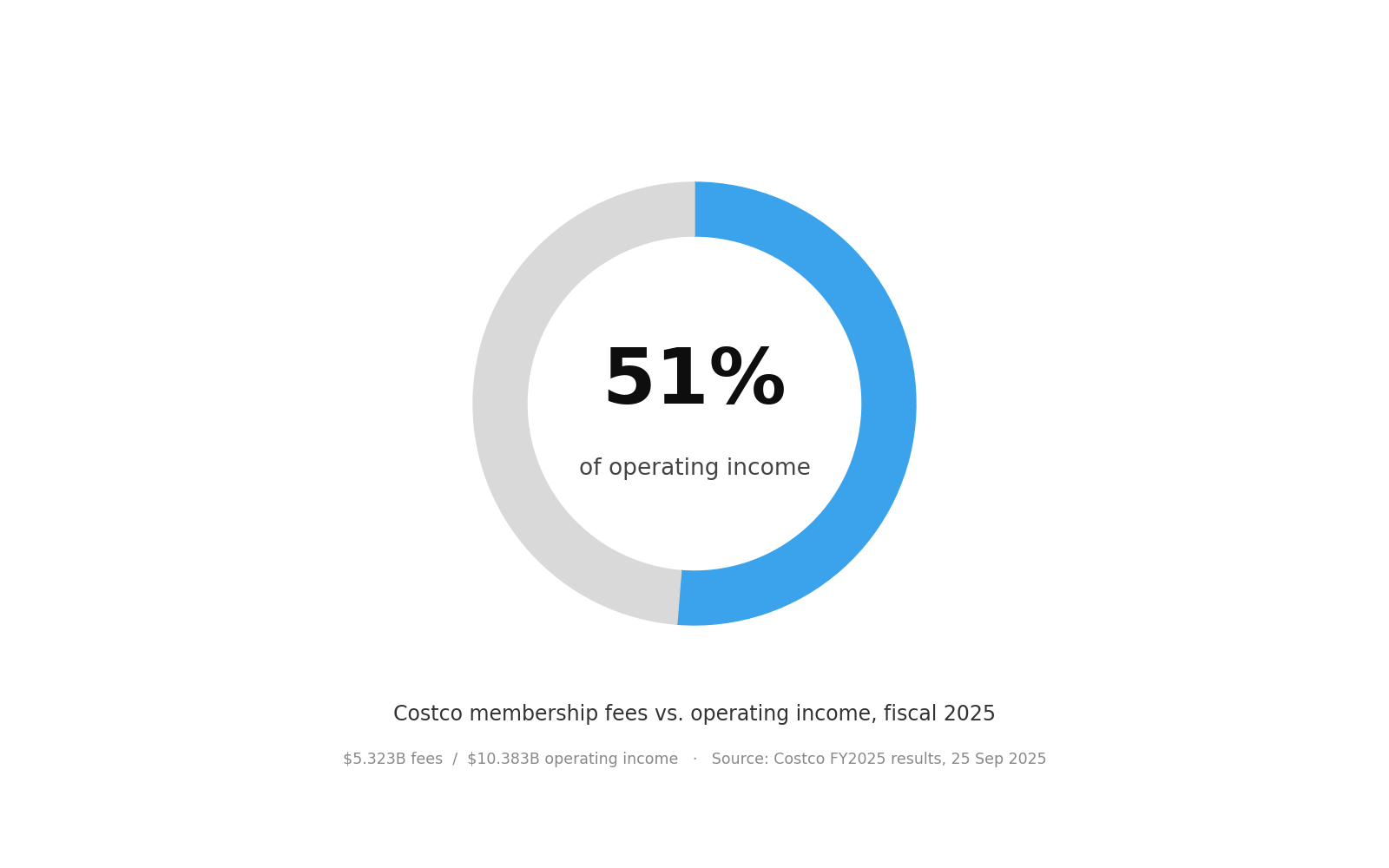
It makes about half of its operating profit from a plastic card, and the other half from selling roughly $270 billion of goods at almost no margin.
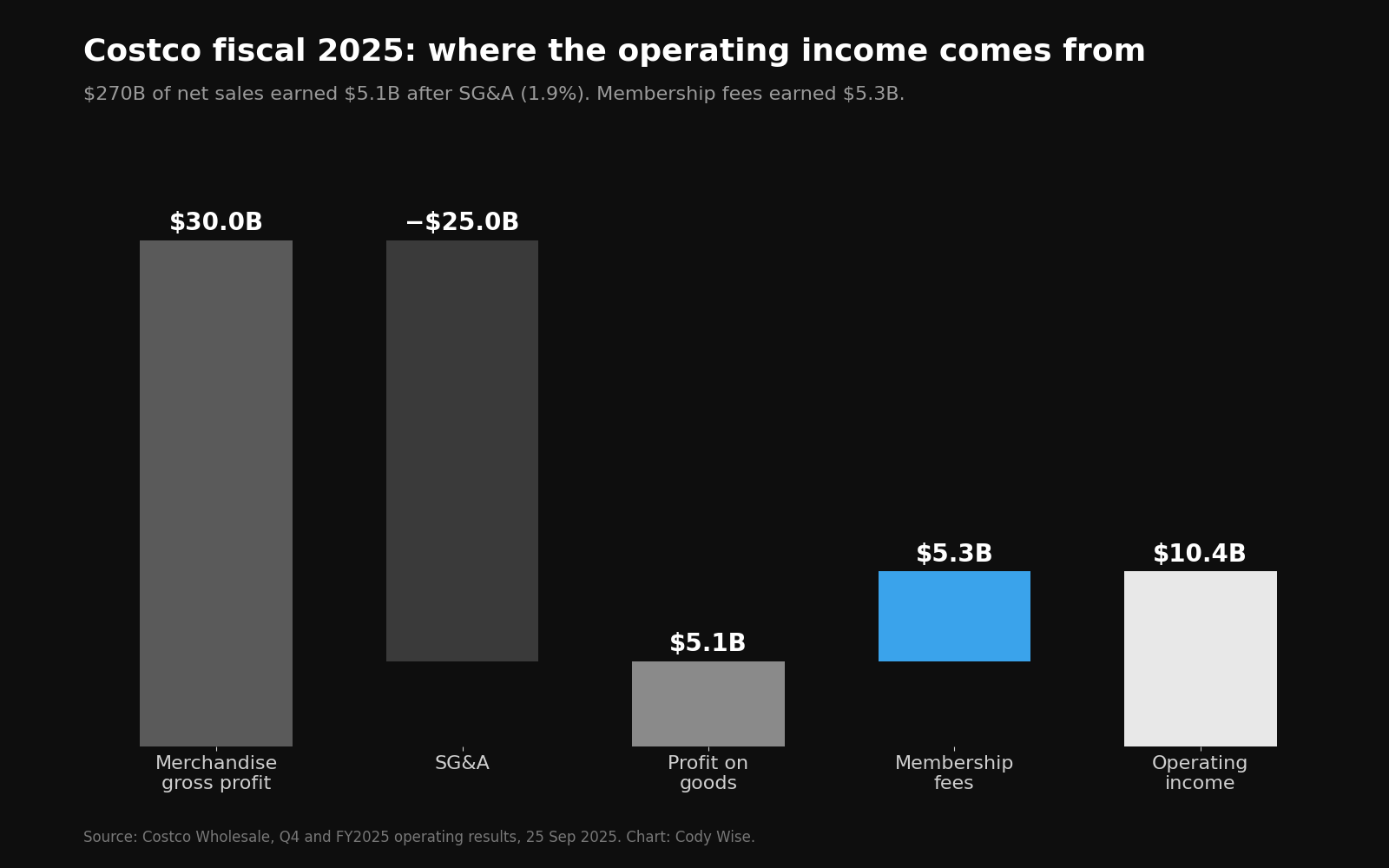
Fiscal 2025, from the company’s own results release: net sales of $269.9 billion, merchandise costs of $239.9 billion, SG&A of $25.0 billion, membership fees of $5.3 billion, operating income of $10.4 billion.
Do the subtraction in public. Sales minus merchandise costs leaves $30.0 billion of gross profit. Take away SG&A, and the entire merchandising operation, every warehouse, every pallet, every gallon of gas, produced $5.1 billion. That is 1.9 percent of sales. The membership line produced $5.3 billion on top of it, at close to full margin, because a renewal costs almost nothing to fulfil.
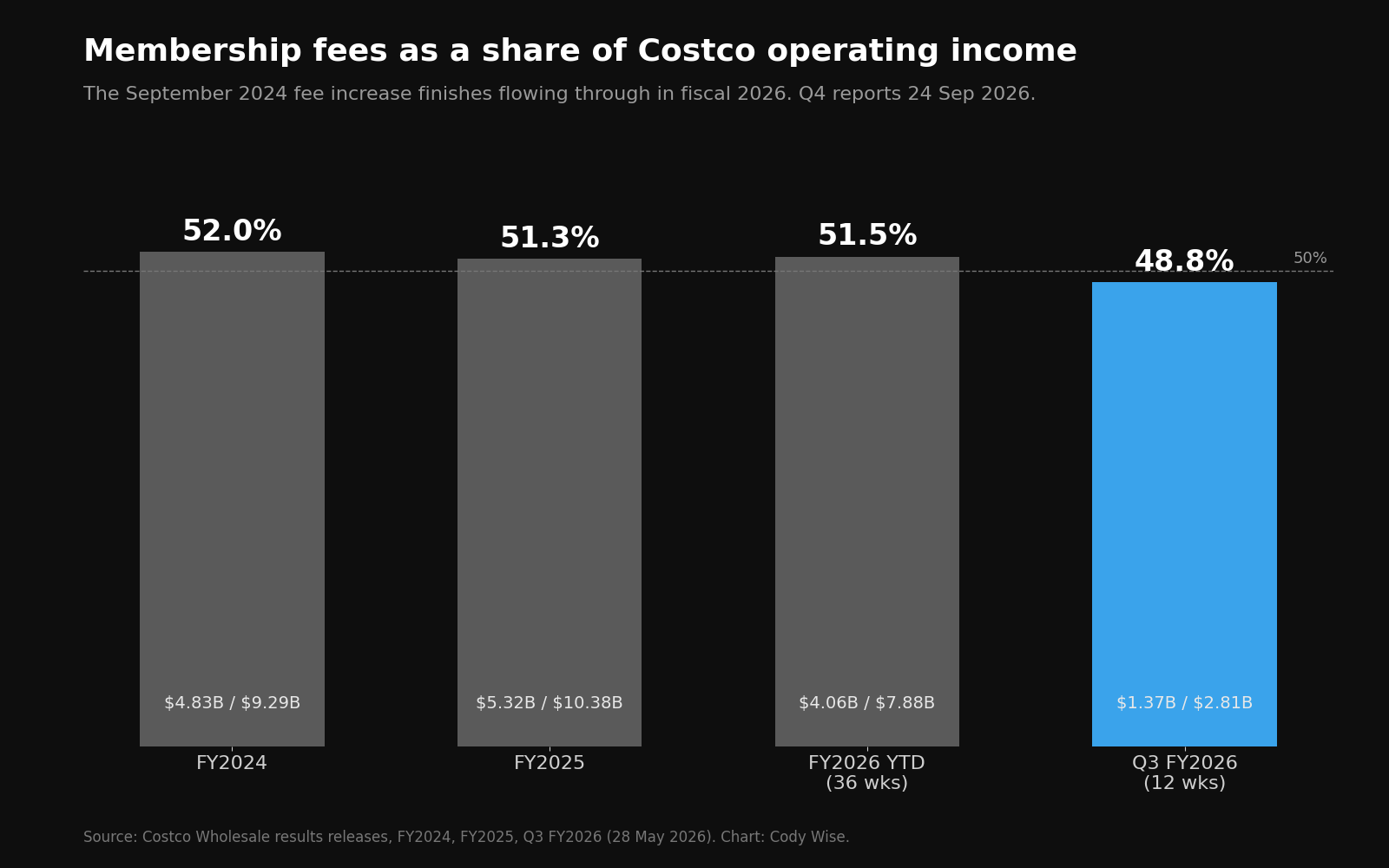
So the card out-earned the cart. Membership fees were 52.0 percent of operating income in fiscal 2024, 51.3 percent in fiscal 2025, and 51.5 percent through the first 36 weeks of fiscal 2026.
Read that the right way round. Costco does not charge a fee to earn a little extra on top of retail. It runs retail near break-even so that the fee becomes the easiest decision a household makes all year. The thin margin is the marketing budget. It is spent on the shelf instead of on ads.
Costco does not have a pricing strategy. It has a renewal strategy that shows up as prices.
Which variables actually move the outcome?
Five. Sales growth is not one of them on its own.
- Renewal rate. In the third quarter the U.S. and Canada renewal rate was 92.2 percent and the worldwide rate 89.7 percent, per CFO Gary Millerchip on the 28 May 2026 call. He also said members who sign up online renew at a slightly lower rate than members who sign up in a warehouse, and that as that group grows it puts downward pressure on the blended number. That was the most important sentence Costco said all year.
- Executive mix. 41.2 million of 82.9 million paid members held Executive memberships, up 9.6 percent against 4.1 percent for paid members overall. That is 49.7 percent of the base. Executive members pay double the fee and earn a 2 percent reward. The reward is a rebate designed so that cancelling feels like forfeiting money already earned. It is the sunk cost effect, run deliberately and in the member’s favour.
- The fee increase rolling off. On 1 September 2024 Costco raised the U.S. and Canada fee from $60 to $65, and Executive from $120 to $130, across about 52 million memberships. It was the first increase in seven years. Fees are recognised over each member’s twelve-month term, so the lift arrives slowly and leaves slowly. In the third quarter it still accounted for a little more than a quarter of membership fee growth, which ran at 10.7 percent. By this quarter it is close to spent.
- Merchandise margin discipline. Reported gross margin in the third quarter was 11.04 percent, down 21 basis points year on year. Costco keeps handing margin back to members. The question is whether it keeps doing that once the fee tailwind is gone.
- New warehouses. The count went from 931 at the end of the third quarter to 939 by the end of August. New buildings are how new members arrive. Everything else on this list is about whether they stay.

What is one point of renewal worth?
Rough, but in public. Annualise third-quarter membership income of $1.373 billion, earned over 12 weeks, and divide by 82.9 million paid members: roughly $72 per member per year. Divide fiscal 2026 net sales of $297.3 billion by the same base: roughly $3,600 of goods per paid member.
One point of worldwide renewal is about 829,000 members. The fee on those members is around $60 million, well under 1 percent of operating income. That is the number that gets modelled, and it is the wrong one. The same members take roughly $3 billion of annual sales with them, and the building’s fixed costs do not leave when they do.
These are blunt averages, not a model. They are close enough to show which line carries the weight.
Losing a member does not cost you the fee. It costs you the reason the building exists.
What would change this read?
Bear. Membership fee growth for the quarter lands below 8 percent and the worldwide renewal rate slips below 89.5 percent. That would say the fee increase was masking a leak in the online cohort. Trigger: both at once.
Base. Fee growth lands in the high single digits as the increase finishes rolling off, renewal holds within 10 basis points of last quarter, and Executive members keep growing faster than the base. Trigger: roughly what the third-quarter call described.
Bull. U.S. and Canada renewal holds at 92.2 percent or better and Executive members pass half of all paid members. Then fee growth is being carried by mix rather than price, which is the durable kind. Trigger: Executive share above 50 percent with renewal flat or up.
What would falsify the thesis. Costco lifting core merchandise margin meaningfully to replace fading fee growth. If the goods start carrying the earnings, it is a retailer again and deserves to be valued like one. I do not expect it. The company has spent decades refusing to do exactly that.
Why this matters outside retail
I run an agency on retainers and short-term rental operations out of Calgary, Alberta. Different businesses, same lesson. A retainer is a membership. The deliverables are the warehouse. The common mistake is pricing the deliverables to make money and treating the retainer as admin. Costco runs the inverse, and last quarter 92.2 percent of its U.S. and Canadian members chose to pay again.
“Be thou diligent to know the state of thy flocks, and look well to thy herds,” Solomon wrote in Proverbs 27. The flock is the member base. Most operators count revenue first. The ones who last count the people who came back.

Common questions
What percentage of Costco’s profit comes from membership fees?
In fiscal 2025 Costco earned $5.323 billion in membership fees against operating income of $10.383 billion, about 51 percent. Through the first 36 weeks of fiscal 2026 the share was 51.5 percent. The rest came from selling roughly $270 billion of merchandise at an operating margin under 2 percent after SG&A.
What is Costco’s membership renewal rate?
Costco reported a U.S. and Canada renewal rate of 92.2 percent and a worldwide rate of 89.7 percent for its fiscal third quarter ended 10 May 2026. Management said members who join online renew at slightly lower rates than warehouse sign-ups, which puts gradual pressure on the blended rate as that group grows.
When did Costco last raise its membership fee?
Costco raised U.S. and Canada fees on 1 September 2024: Gold Star and Business from $60 to $65, Executive from $120 to $130, and the maximum annual 2 percent reward from $1,000 to $1,250. The change affected about 52 million memberships and was the first increase in seven years.
Why does a Costco fee increase take so long to show up in results?
Costco recognises membership fees over each member’s one-year term, and members renew on their own anniversary dates. A fee increase therefore enters revenue gradually over roughly two fiscal years. In the third quarter of fiscal 2026 the September 2024 increase still accounted for a little more than a quarter of membership fee growth.
When does Costco report fiscal fourth quarter 2026 results?
Costco scheduled its fiscal fourth quarter 2026 earnings call for 24 September 2026 at 2:00 p.m. Pacific. It had already reported fiscal 2026 net sales of $297.3 billion for the 52 weeks ended 30 August 2026, up 10.2 percent from $269.9 billion.
Price the product to be chosen. Price the access to be kept. The second one is the business.
Not investment advice. I am not a licensed financial advisor and nothing here is a recommendation to buy or sell any security. Analyst ratings and price targets referenced are the published views of the institutions named, not mine. Figures are accurate as of the publication date and will go stale. Do your own research, and speak to a licensed advisor before acting on anything you read here.
All company names, logos and trademarks are the property of their respective owners. Their use here is for identification and editorial commentary only and does not imply any affiliation with or endorsement by those companies.