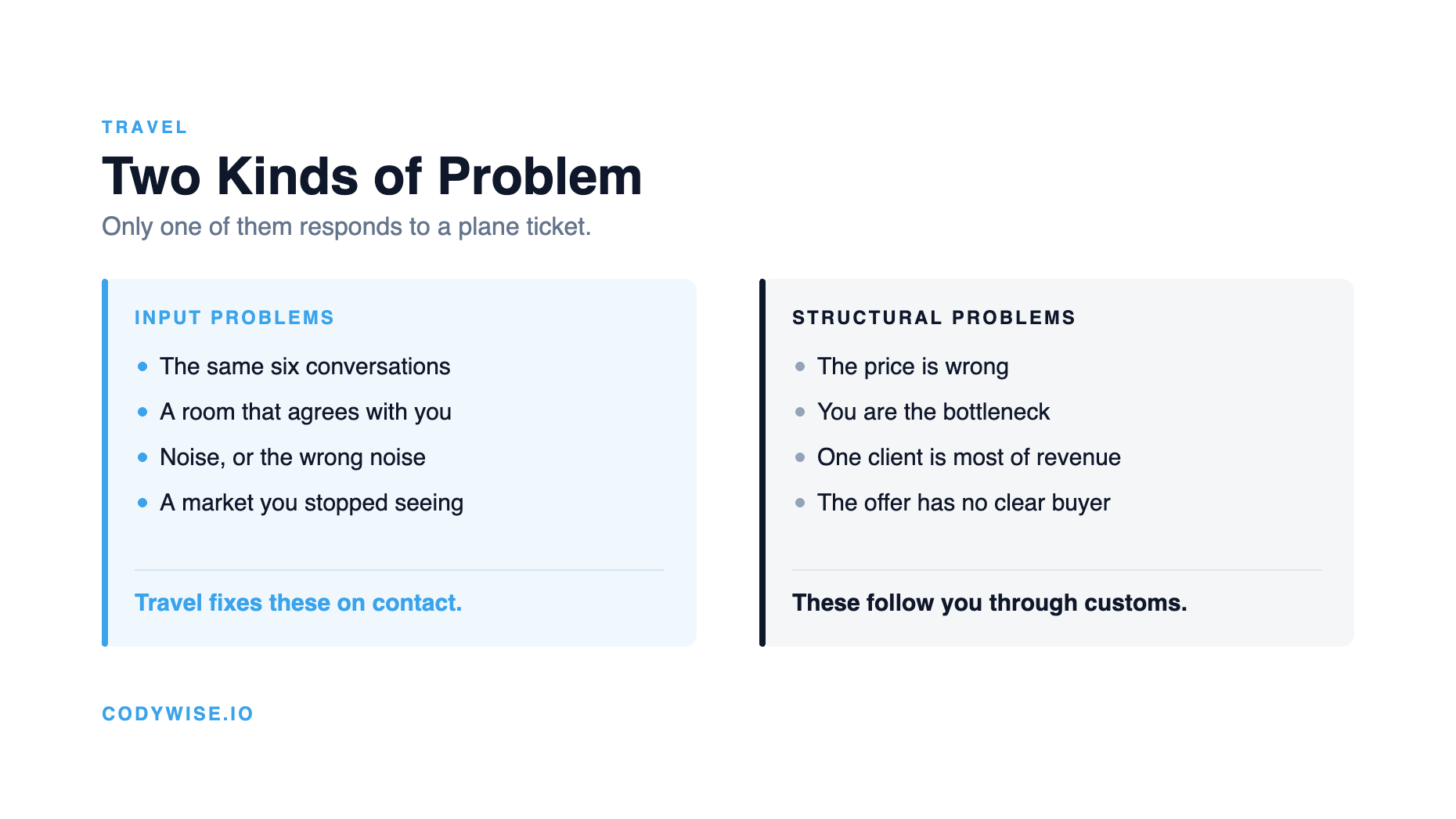

Every founder claims the business runs without them. Almost nobody has tested the claim.
Travel is the test. Leave for two weeks and the truth surfaces on its own. Whatever breaks was never a system. It was you, wearing a system as a costume.
I run short-term rentals and a marketing agency from Calgary. Both are businesses people assume require presence. Guests check in at midnight. Clients want calls. Cleaners get sick. That assumption is exactly why the exercise matters: if these can run while I’m gone, almost anything can.
Here’s what leaving actually audits.
First, decisions. Every question that reaches you on the road is a decision you failed to push down before you left. That’s not a people problem. It’s a documentation problem. The message that finds you at 3:33am in another time zone is telling you precisely which SOP doesn’t exist yet. Write it down. That’s the real deliverable of the trip.
Second, the line between process and judgment. Automation handles process. Only clarity handles judgment. When you’re home, you blur the two. You spend judgment energy on process decisions because you’re there and it’s faster. Distance separates them cleanly. The things a checklist could have handled, you feel immediately. The things that truly needed you, you learn to schedule around.
Third, the difference between owning a business and owning a job. Epictetus drew one line worth keeping: what is in your control, and what is not. A founder who can’t leave has built a job where everything routes through his control on purpose, and calls it importance. Feeling needed is a drug. Travel is the withdrawal.
The Stoics practiced premeditatio malorum, rehearsing loss before it happens. A trip is the operational version. You rehearse your own absence while the stakes are low, so the machine is ready when absence isn’t optional. Sickness, family, opportunity. Eventually something takes you out of the seat. Better to have practiced.
There’s a compounding effect, too. Every trip forces the next layer of delegation, which makes the next trip easier, which surfaces the next weakness. Founders who never leave stay at layer one forever. The audit only runs when you’re gone.
A few rules I hold to.
Don’t announce availability. “Reach me if it’s an emergency” guarantees everything becomes an emergency. Define what qualifies as one before you leave, in writing, and route everything else to someone with the authority to decide.
Don’t check in quietly to “see how things are going.” Silent monitoring teaches your team that the delegation is theater. Either you’re gone or you’re not.
Come home and write. In the first forty-eight hours back, the gaps are still visible. A week later you’ve reabsorbed them and they look like normal work again.
Solomon put the sequence plainly: prepare your work outside, get your fields ready, and after that build your house. Field operations first. Then the house, the life, sits on something that holds.
The point of building from Calgary, or from anywhere, was never the anywhere. It’s that geography stops being a constraint the day your business stops being an extension of your body. Travel isn’t the reward for building well. It’s the proof.